
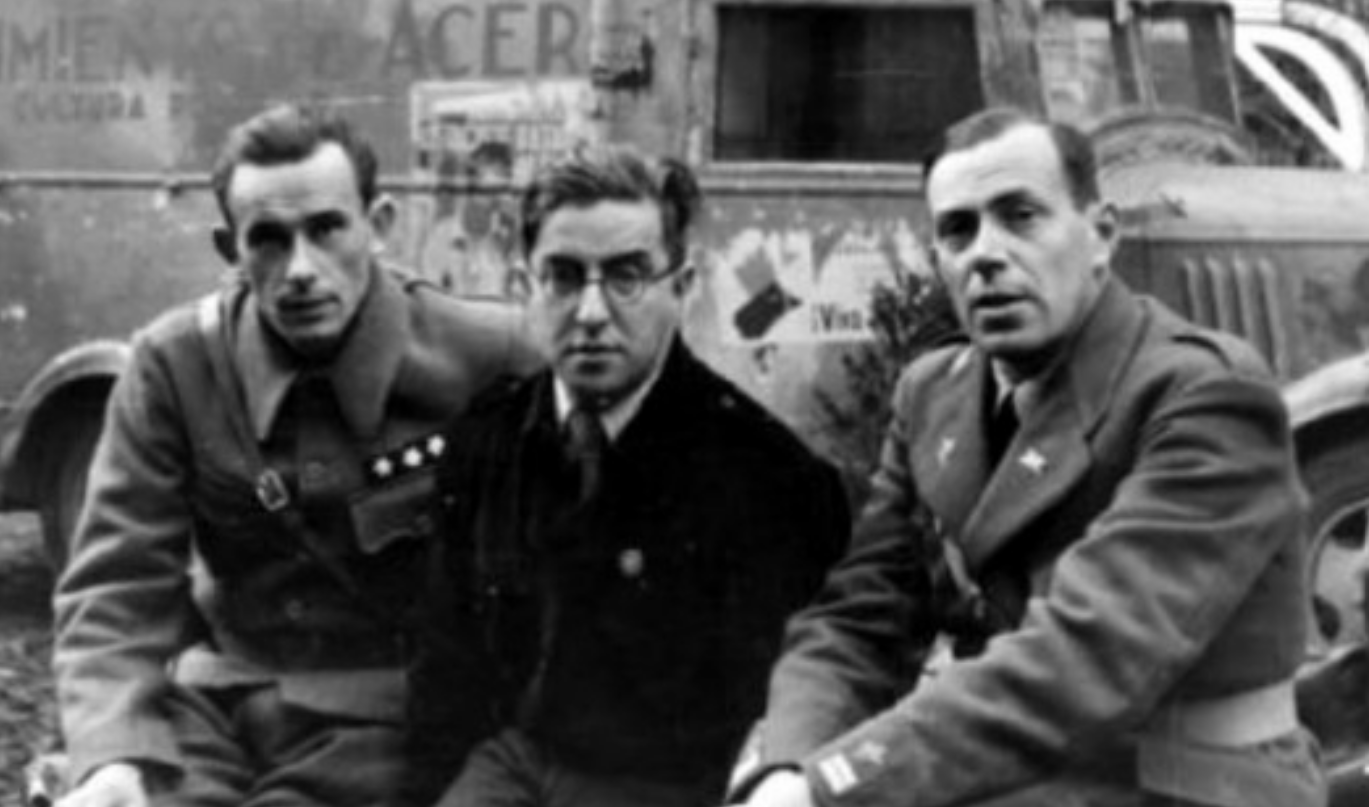
To commemorate the 90th anniversary of the Civil War, José Ángel Mañas recreates in Zenda, day by day in this section, what happened in 1936, perhaps the most pivotal year in all of Spain’s recent history.
Thursday, August 27, 1936: The Leaders of the PSOE
From Madrid, Mikhail Koltsov heard nothing but praise about Largo Caballero. It was said that every day he went to the front, clad in a coverall, to encourage the fighters, who adored him. Delegations from the UGT pressed him to give talks. Tireless at sixty-seven, he was regarded as the true leader of the revolution.
Koltsov had found only one detractor in Indalecio Prieto, when he received him in his office at the Ministry of the Navy, seated in an armchair, with his round face and half-hooded eyelids. «This petit bourgeois is pleased with your attention and your visit,» Prieto said in French, implying that he had read a certain article written about him by the Russian years earlier, which unsettled the journalist. But then Prieto proved as seductive as he knew how to be when he wanted. When talking about Largo Caballero, he declared with brutal frankness that in his opinion he was a fool posing as clever.
—He is a cold bureaucrat who plays the part of a fanatical zealot, a schemer who pretends to be methodical. A man capable of ruining it all because he believes that at his age he has nothing to lose. It is evident that our differences form the heart of the struggle in the Socialist Party. But, despite everything, he is perhaps right now the only one capable of heading a new Government. And here where I stand, I am willing to join him, at his orders. I have always argued that it is the PSOE that should lead the Republic.
Condemned by that opinion, Koltsov met on Thursday with Largo Caballero himself at the Casa del Pueblo on Piamonte Street. In a small union office full of files, behind a desk, awaited the UGT man in a work coverall and a pistol belt, weathered by wind and sun, and very energetic despite his age. Álvarez del Vayo agreed to serve as interpreter and Caballero launched against the Government.
—Explain to comrade Koltsov that they are a bunch of inept fools who do not put enough effort into crushing the uprising. Lazy people who ruin everything at every turn. They hear nothing, they have no idea of the gravity of the situation, and they hide in their offices. And worse: they do not represent anyone. The workers align themselves outside the Government around the unions. The workers’ militia does not believe in the Government nor in the Ministry of War, where there are nothing but monarchist ex-generals and career officers, all of them potential traitors. The militiamen do not obey and, if the situation prolongs, will seize power directly. This is a comedy, a disgrace.
—And why does it take so long for the militiamen to be transformed into a regular Army?
—Because the Government prefers to enlist soldiers and non-commissioned officers from the reserve instead of relying on the militiamen who defend the Republic. It is a contempt for the unions.
—Well. Lenin himself once preferred an army where soldiers, workers and peasants mixed, rather than the chaotic militias. The union of lower ranks with the workers makes for excellent antifascist armies. Separately, conflicts arise, and the experience in Russia shows that it is always better to unify…
—Bah! It’s the obsession of the communists. You want to organize everything, place chiefs, tag labels, numbers. José Díaz and Dolores Ibárruri are at it because they are young. Their prestige comes not from experience but from your success, that of the Russian communists. But by helping the Government, they drive the revolution away. The workers’ parties must sweep away the officials and move toward new and revolutionary forms of leadership. We are prepared.
Koltsov chose to remain silent. It was difficult for him to understand so much radicalism in someone who had been the heir of the reformist Pablo Iglesias, who had collaborated with the dictatorship of Primo de Rivera. José Díaz and Dolores Ibárruri had already warned him that for the socialist leader it was the Asturias Revolution that led him to rethink his political path, disillusioned with the traditional methods of the UGT. In any case, Koltsov perceived a growing coldness between Largo Caballero and the communists.
Todas las entradas de 1936 día a día
All the 1936 day-by-day entries
Entrevista con José Ángel Mañas sobre 1936 día a día
Interview with José Ángel Mañas about 1936 Day by Day