
To commemorate the 90th anniversary of the Civil War, José Ángel Mañas recreates in Zenda, day by day in this section, what happened in 1936, perhaps the most momentous year in all of Spain’s recent history.
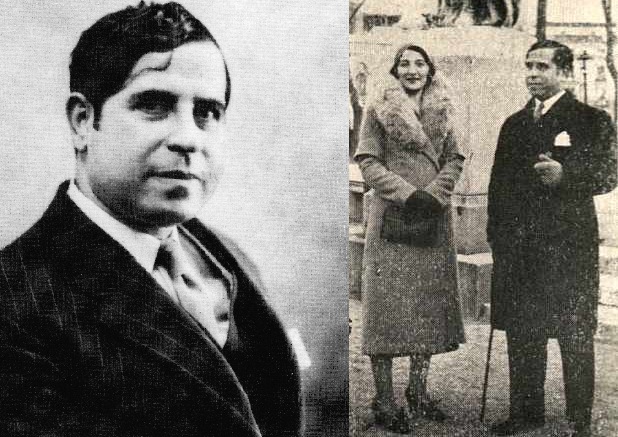
Sunday, August 30, 1936: Gómez de la Serna Flees
You’ll see that in Argentina we’ll be all right, Ramón. Steady.
Luisa Sofovich stroked her husband’s hand. They both waited with their suitcases on the station platform. It had been difficult, but he had made up his mind. Luisita, as he called her
Ramón Gómez de la Serna, knew that her husband had been deeply affected by watching Pedro Luis Gálvez, a famous bohemian, pass by in a coat and a large pistol at his belt. That Gálvez would even swap the quill for the pistol was the starkest sign of the city’s shift, a place where they scarcely still had a foothold. The tolerant Republican capital in which the Gómez de la Serna family had found some shelter gave way to the belligerent Madrid of the “no pasarán” era, and by early July the attendees at the Pombo salon, at Carretas found a note beneath Solana’s painting:
LA TERTULIA, CLAUSURADA HASTA NUEVO AVISO.
But things were getting worse, and Ramón, a nocturnal writer, could not bear his study dark and sealed off by the bombs.
—You’ll see that there you’ll feel better and you’ll start writing again.
Ramón was sad. His suit didn’t stand out on the platform, crowded with bourgeois families, as it did in the street, where lately only workers’ attire could be seen. It seemed almost miraculous that he could not only survive but finish a long novel. Besides, he had written to the Argentine PEN Club to announce his imminent journey.
—You can’t stay in Madrid, he admitted, not in the mood for wordplay. Weeks had passed without any greguerías. Had his imagination dried up?
A acquaintance came over to greet him and they exchanged a few words. Seeing Gómez de la Serna’s unusual sternness, the man stepped away. Ramón wondered whether he was making the right decision. That decision had been reinforced by a chance encounter with José Bergamín at the door of the Correos Palace. Ramón wanted to send his latest contribution to La Nación. Bergamín, after telling him that he was launching the first issue of El mono azul, the weekly of the Alliance of Antifascist Intellectuals, and that he was part of a board newly formed in direct relation to the General Directorate of Fine Arts to safeguard the artistic treasures of seized churches and palaces, asked him what he had been doing lately.
—The usual. Writing.
Bergamín gave a half-smile.
—I suppose, Ramón, you’ve realized that this is not the moment for greguerías. Neither you nor I can devote ourselves to a literary game that, as noble as it may be, is unnecessary when young people die on the front and the Republic is in danger.
Bergamín urged him to join his circle of intellectuals. His aim was to form a bloc of support for the Popular Front government. He wanted to promote a united protest by writers and sign manifestos whose echoes would reach Paris, London, and New York. Listening to him so heatedly, Ramón understood that this could never be his mission. His commitment to literature prevented him from taking on other commitments for which he did not feel capable. Soon after, back at home, he told his wife to start packing, they were leaving.
But in truth, he thought, what had decided him was his creative drought, which had stopped producing greguerías. Ramón Gómez de la Serna could not live without his greguerías.
All the entries of 1936 Day by Day
Interview with José Ángel Mañas about 1936 Day by Day