
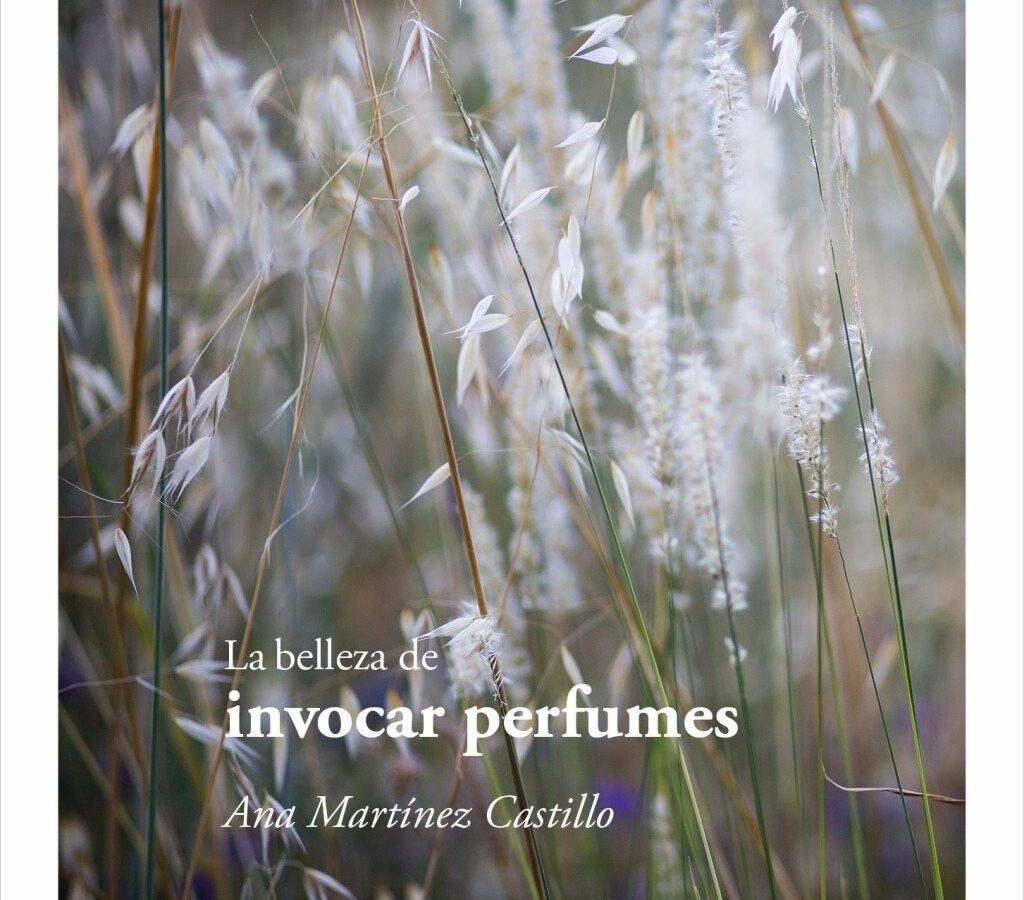
Returning to the books in Eolas’s The Beauty collection, I am increasingly convinced of the need for books like these, which are grounded in a concept of beauty by what they tell and how they tell it, yet also invite contemplation and reflection on topics as varied as literature, the eternal, ghosts, or magic, in a world where haste and the buzz that sometimes takes over social networks dominate more and more.
But there is a topic that in itself is as delicate and fleeting as the flight of a butterfly:
perfume. And
Ana Martínez Castillo has decided to venture into it to offer us a new title in the collection, drawing inspiration from the paradox that perfume embodies—the ephemeral and, at the same time, the eternal. For few things are remembered more and more vividly than a perfume, the scent of what is yearned for, of what is no longer present, of those moments that, suspended in a fragrance, end up becoming an eternal memory. And if not, ask Proust and his madeleine, whose taste, blended with tea, was enough to suddenly restore an entire world lost.
But The Beauty of Invoking Perfumes is not limited to talking about perfumes: it invokes them. And perhaps only in this way can the important perfumes become eternal. Because, as it signals in the introduction, Ana Martínez Castillo begins a journey that is, in itself, an invocation: «a personal path through the smells of this world that have served to know the other, umbral essences, daemonic, preternatural substances, whose volatile substances connect us with what is radically different and subtle, with strangeness, with the regions on the underside of the world».
And how can a perfume be written and described? If the most eternal is invisible, how then to capture that which we can only perceive once it has passed? But, at the same time, that could also be the best definition of the phantom: you know it is there, but you do not see it. It is not surprising, therefore, that many specters announce themselves precisely through smells. And this is where Ana’s writing finds its natural territory. Ana, an author of the extraordinary, of the uncanny, but also devoted to the poetic muse, speaks of perfume through language and offers an authentic homage to that invisible matter. She evokes perfumes, she invokes them, because only thus is it possible to understand their essence. And, as she tells us: «only thus could the sacred and the magical and what lives forever be invoked».
Ana invokes perfumes —and literature— through beauty —also dark, at times— and poetry. Because, if perfume is invisible, the word seems to be the perfect tool to give it a form. And synesthesia is its main instrument for turning that invisible matter into something we can almost see, touch and recognize.
Structured in four chapters, the book begins its journey from memory, in search of the scents of childhood: «(…) the plastic aroma of a doll’s head, Petit Cherie or Denenes upon leaving the bath, the steam from tissues soaked in Heno de Pravia to ease seasickness when we traveled to Lleida, the dusty nest of my father’s library books…». Or «the reverie of hysterical soap, the sensation of extreme cleanliness, so white, pure, transparent, so ethereal and at the same time creamy and compact…», one of those other smells that stays with us even after we close the book.
From intimate memory, Ana then ventures into perfumes between worlds. She takes us to ancient Greece, Rome and legendary Egypt to walk through essences that invoke, that communicate with the mythical, with the mystic, with the sacred. And here arrives one of my favorite parts: the witches. Because there are also scents capable of returning us to literary places, and Ana tells us, among other things, what Celestina’s laboratory smelled like: «I would scent Celestina’s house with the ammonia of sweat, with a haddock under a skirt, with a soiled surcoat, urine, onion, garlic, goat and hair fat, potato stew and herbal ointments, floral hydrosol, Castilla soap…».
Soon after appear the protective perfumes, essences meant to keep at bay what we cannot see. Although, at heart, who wants to protect themselves if what lies ahead may be waiting on the other side? The B-side of the world, as Ana defines it in another moment. There appear the invisible beings and, with them, perhaps the conception of perfume closest to its own nature: «the scent of a perfume is a fleeting specter, its other life cannot be conceived without annihilation; everything in the existence of perfume is a continuous memento mori».
The perfume, then, becomes also a way to traverse absence. We traverse the scent of those who have departed, of anonymous the deceased revealed through the odor of their cologne, their favorite tobacco; but also that of famous figures, such as Catherine de Médici, who, according to Ana, smelled of Acqua della Regina, or Marie Antoinette and her Bouquet de Trianón —I, for one, must get this perfume…—.
From the past and those who are no longer here we move in the last part to darkness. Because everything has two faces and there are perfumes invoked from purgatory, death or the devil. But, after darkness comes the luminous, the celestial, the aromas of narcissus, rose, lily and the goddesses such as Aphrodite, alongside other mythical figures. And thus, almost as if we were tracing the invisible trails left by perfumes, the book ends up becoming a journey through mythology, history, literature, fashions and superstitions. A journey that Ana undertakes through poetry and synesthesia and that perhaps also leads to the search for a perfume of one’s own, of our own. That perfume, as Ana Martínez Castillo says at the end, “shouts to the four winds what I am because it gathers all my facets, (…) and with it, in my last wishes, I will order that I be embalmed…”. And perhaps that is why, at the end of the book, we can only be left with one certainty, if there can be any when we speak of the beyond: “the beyond is multiform, permeable and plastic. It is clear that one cannot trust the beyond; one can discard any certainty, except one: that it smells and that the scent somehow reaches us.”
—————————————
Author: Ana Martínez Castillo. Title: The Beauty of Invoking Perfumes.Publisher: Eolas. Sales: Todos tus libros.