
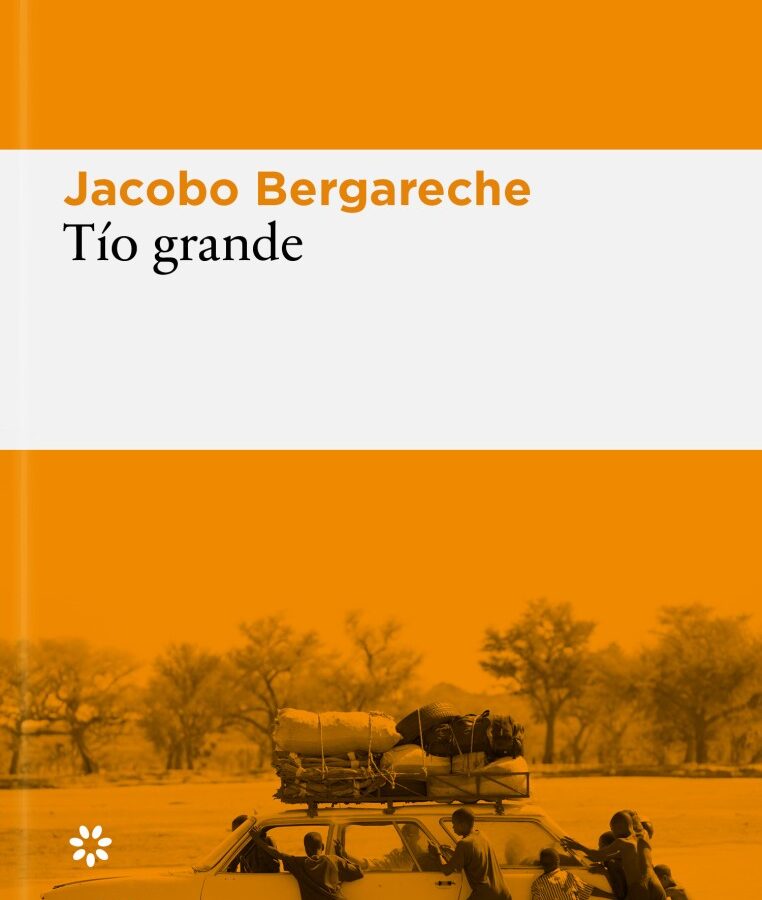
Jacobo Bergareche turned more to writing after the death of his brother Roque, who fell victim to an assault in Luanda. There are traumatic events that disrupt the continuity of the self. When it happens, restoring the bridge that connects the past with the future becomes very difficult. What we were ceases to lead toward what we imagined we would become. Bergareche had envisioned a life shared with his brother, a family continuity in which his daughters would play with his brother’s daughters. That possible future vanished with Roque.
Thus he confesses it in his latest work, Big Uncle, which deals with several journeys. One of them is the psychological journey of grief. Another is the physical journey, a road trip that begins toward Bominí, a Guinean village that does not appear on maps, where Amadou grew up.
Nevertheless, the journey does not progress in a straight line. Like a matryoshka, this journey contains other pasts, because to travel, like to write, there is something of wandering in it, but also of a reconciliation with oneself.
Bergareche met Amadou at a Mus tournament held annually in memory of his brother. Amadou was the todero, that indispensable figure who ensures everything runs smoothly at the venue where the tournament takes place. He told him his story as a migrant, when he left his country at thirteen in search of a better life in the West. Bergareche decides to accompany him to his homeland village and, by reconstructing Amadou’s exodus, he also embarks on a rebuilding of his own grief. The two journeys move forward together, though they originate from different losses.
In other Bergareche novels, mourning had been a protagonist, as in Estaciones de regreso; or a co-protagonist, as in Las despedidas. In this new work, mourning contemplates various dawns, other lives, and although the past oozes pain, the future returns as a promise. Written with humor, nostalgia and empathy, among poems and a peculiar soundtrack, Bergareche refines the narrative voice of an extrovert with an inner essence, where the will to adventure does not renounce the reflective gaze on the people and places he encounters.
Bergareche landed in Guinea on a tar-black night. At the airport, Amadou awaits and, together with his girlfriend and his mother, they traverse the country in a dusty car. They pass through dubious controls and encounter traffic accidents in which fear, also of a possible assault as the ambassador had warned him, becomes yet another passenger. Once in the village, they are welcomed with honors and with a banquet of goat, entrails included, and sticky rice.
The awareness of being the only white person reactivates another journey to Malawi. It was as a camera assistant, alongside a photographer, a woman who had sponsored a child, and an NGO delegate. In this chapter I laughed out loud, at the charming mix of absurd situations, where the grotesque blends playfully with cultural clashes. Bergareche has the ability to fuse the tragic and the comic in just a few lines, reconciling you with life in all its facets.
Among the reflections that appear in Big Uncle, religion surfaces. Together with Amadou and his fiancée, Bergareche observes Ramadan for a week and discovers in its rites an experience that goes beyond the strictly religious dimension. Rituals and ancestral practices are ways of connecting with something larger than oneself. Prayer is a way to quiet the mental noise that blinds, obsesses, and thereby closes us in. If we remove religion from its tradition, its liturgical character, staging and devotion, we are left with only a desaturated form that we today call mindfulness. Amadou does not approach God as a vending machine of favors; rather, it is a form of scheduled gratitude that slows life and purifies mental noise.
The road trip does not end in Guinea, it continues in Morocco, among the forests of Gurugú mountain and the city of Nador. In those forests, Amadou hid while preparing his leap to Europe. He managed to accumulate some money to pay for the transfer in a boat that left him at sea, where he had to swim to the coast of Melilla. Afterwards he entered a center for minors, where he met Hamada, who would become a brother. Hamada also managed to reach the peninsula and ended up becoming a Muay Thai champion.
If, as F. Scott Fitzgerald said, every life is a process of demolition, for Bergareche writing has become a way of reconstruction. Big Uncle is a book that tells how one day the present was uncertain. The journey appeared, like a turning platform, that returns to the past, but also toward the future, where the destinies we write or invent await us.
—————————————
Author: Jacobo Bergareche. Title: Big Uncle. Publisher: Libros del Asteroide. Sales: Todos tus libros.