
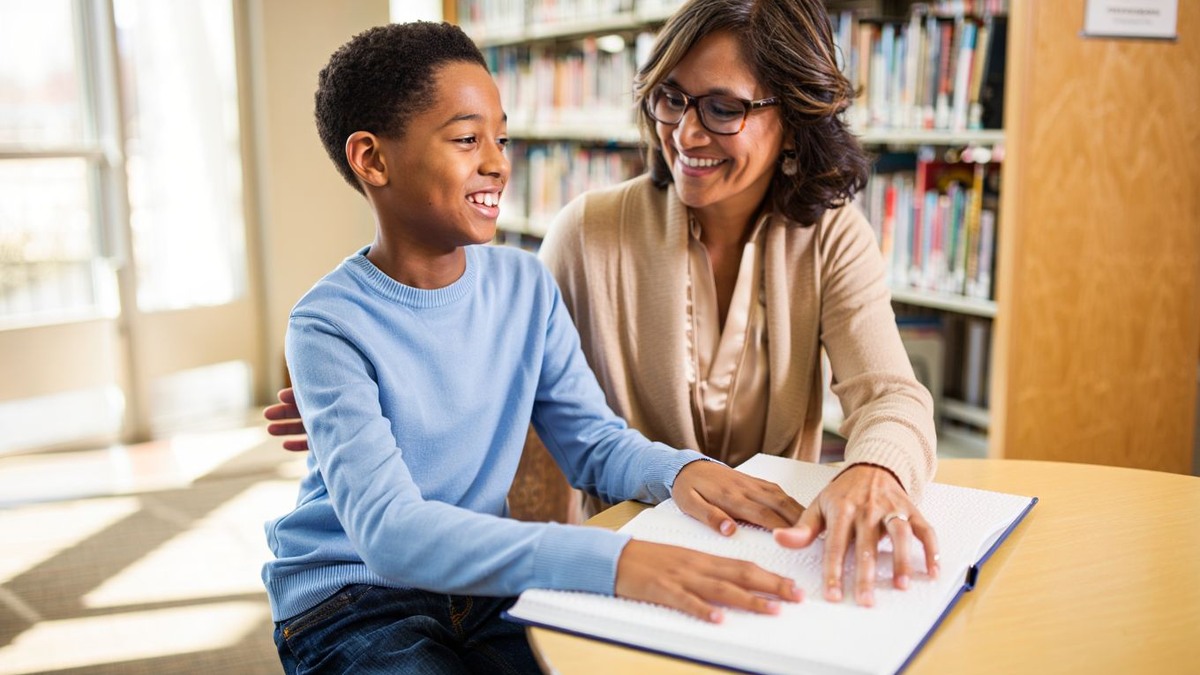
There is a particular kind of quiet that settles over a library on a weekday afternoon. Into that quiet, once a week, walks a boy who cannot see the shelves but knows exactly where he is going.
He knows because someone learned how to help him find his way without ever taking the discovery away from him.
The First Visits Were Cautious
At the beginning, the boy stayed close to the door. New spaces can feel enormous when you navigate them by sound and touch, and a library is full of unfamiliar echoes.
The librarian did not rush toward him. Instead, she described the room out loud in a calm, matter-of-fact way, so he could build a map in his mind.
She pointed out where the audiobooks lived, where the tactile picture books were kept, and where a chair waited that would always be his if he wanted it.
Consistency mattered more than grand gestures. The same greeting, the same route, the same shelf. Predictability is a form of respect.
Building a Bridge Through Braille and Sound
Over the weeks, the boy began to explore. He ran his fingertips across braille labels and along the raised pages of touch-and-feel books made for readers like him.
He listened to audiobooks with headphones, sometimes laughing out loud at a funny line, forgetting for a moment that he was supposed to be quiet.
The librarian gathered materials she thought he might enjoy, then let him choose. She never decided for him which story he should love.
That distinction is everything. Accessible service is not about handing a child a pre-approved experience. It is about opening every door and letting him walk through the one he wants.
Friendship, Not Rescue
It would be easy to tell this as a story about a grown-up saving a child. It is not that story, and it never was.
The boy was not helpless. He was capable, curious and increasingly independent, and the library simply gave him the tools to be all three more fully.
What grew between them was ordinary friendship. They talked about books, argued gently about endings, and shared the kind of inside jokes that only regular visitors accumulate.
He was not a project. He was a friend. The difference lives in the tone of every exchange.
Some of the things that made his visits work were surprisingly simple, and worth naming plainly:
- Clear verbal descriptions of the space and its changes
- Materials in braille, large tactile formats and audio
- A predictable routine he could rely on each week
- The freedom to choose his own reading, always
Why This Kind of Access Matters
A public library belongs to everyone, and that promise only means something when it is built for everyone in practice, not just in principle.
Accessibility is not a special favour extended to a lucky few. It is the baseline condition of a library doing its actual job.
When a blind child can arrive, orient himself, and read on his own terms, the whole institution is working the way it was meant to.
These arrangements are fragile, though. They depend on training, on time, on staff who are allowed to move slowly, and on budgets that treat access as essential rather than optional.
Cut any of those, and the door that opened so gently for one child begins to close for the next.
The Real Lesson in the Story
What lingers is not a dramatic turning point but the accumulation of small, steady weeks.
Trust is built in repetition. Belonging is built in being expected, welcomed and treated as fully present.
The boy did not need to be extraordinary to deserve any of it. He needed a place that assumed he belonged, and a person who acted as though that were obvious.
That is the quiet miracle at the centre of so many libraries. Not a saviour, but a companion. Not a favour, but a friendship offered as though it were the most natural thing in the world.
And in the best libraries, it is.