
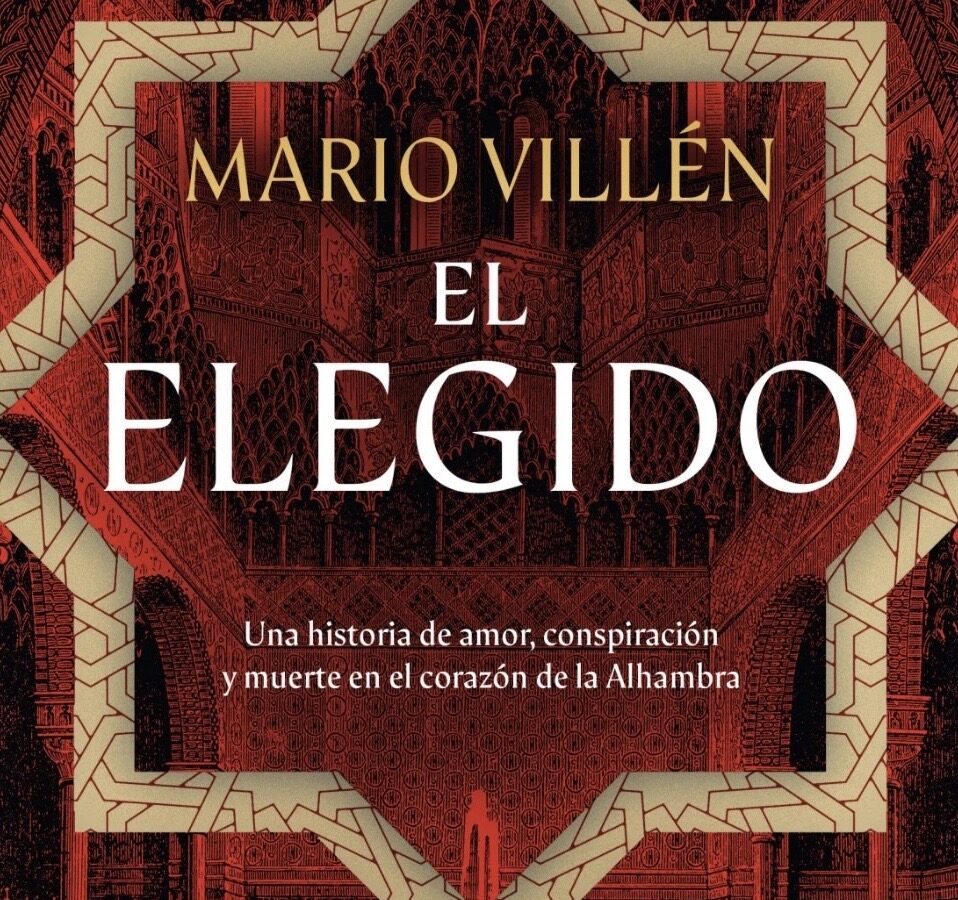
Granada, 1354. On the last day of Ramadan, a deranged man stabs Emir Yusuf I. His son assumes power in an atmosphere of betrayals and envy. Luckily, the vizier Ibn al-Jatib, a physician and poet, has sworn to protect him.
In this making of Mario Villén explains how he wrote The Chosen One (Grijalbo).
***
There are spaces that seem built for suspense, and among them the Alhambra stands out. The Nasrid citadel has always been the subject of legends that heighten its aura of mystery. Murders, deceptions, infidelities, betrayals… There are even traditions that attempt to confuse some suggestive rust stains with the blood that the marble walls must have drunk in their past.
As a Grenadian by upbringing, I have grown up receiving this legacy, learning to love it, dreaming of it. Therefore, it is no surprise that, when I proposed writing a novel set in 14th-century Granada, I decided it should be a thriller.
From the very first moment I was clear about which event would be the axis around which the whole plot would revolve. It concerns a historical fact: the death of Yusuf I at the hands of a deranged person during a communal prayer in the Alhambra’s main mosque. It is easy to think that, behind such an assassination, there could have been something hidden that has not come to light through history. That is precisely the vein I wanted to exploit in The Chosen One. The fictional plot I have crafted in the novel seeks to probe what, or who, could have been involved in that murder from the shadows.
The starting point is the known history, which is very suitable for a thriller. In fact, the documented history of the Nasrid dynasty in the 14th century could be considered a thriller in itself. Yusuf I is not the only emir murdered in this context. The previous ruler, his brother Muhammad IV, was killed by members of a North African family settled in Granada who disagreed with his foreign policy. And before him, Ismail I, Yusuf and Muhammad’s father, also died violently, stabbed by a relative within the Alhambra’s own palaces.
Recently there has been a vogue for constructing historical thrillers, shoehorning an investigative and murder plot into a context with historical figures who may not seem very suitable for such a story. However, as we have seen, when it comes to Nasrid Granada the setting is perfect.
The novel is structured with two timelines that progress at different paces and at two distinct moments. At certain points they cross, referencing each other, so that both stories seem to call to one another across time.
The historical moment is quite compelling, and I wanted to work it to allow the reader to witness events such as the construction of the main palaces of the Alhambra. In this era the Comares Palace was built and the Riyad, or the Lions’ Court, was planned. Recreating how these marvels of architecture and art were raised is one of the greatest highlights I take away from having worked on this book. I have also reflected on how Granada fought the Black Death, which was especially virulent in the Nasrid city.
The main protagonists I found during the documentation process deserve note. I must highlight three for their importance and for the fascinating information they provide about Nasrid society.
The first is Ibn al-Jatib. This figure will be my “Sherlock,” the investigator in the murders plot. From what we know about him, the role fits him perfectly. He was vizier, head of the emir’s secretariat, poet, historian, philosopher, and physician. As a physician, in one strand of his learning, he fought the Black Death and developed the revolutionary concept of contagion by air.
The second is Umm al-Hassan, a woman physician who appears in Ihata, the work of Ibn al-Jatib, as one of the Nasrid era’s most notable figures. The fact that she appears in that chronicle is already a milestone, since women were ignored in such texts. To this character, more than as an exception, it is interesting to interpret her as an indication of a reality that must have been much larger. If a woman stood out enough to be mentioned in a chronicle, how many celebrated women must have remained in the shadows of history? There are many gaps about her figure, but I recover her through fiction and place her in a prominent role in the plot.
The third notable figure is Ibn Zamrak. Of humble origins, he rose to the heights of Nasrid administration thanks to his exceptional merits. He is documented proof of the permeability of social classes in 14th-century Granada. This did not occur in the medieval Christian world, which was governed by classes whose power was sustained by hereditary titles. Ibn Zamrak was also a poet, and one of his poems decorates the rim of the Lion Fountain. In the novel he serves as Watson, assisting Ibn al-Jatib in his investigations.
With all these elements and characters, I had the material to construct a historical thriller that would be coherent and credible, anchored in a definite historical context.
Finally, I would like to talk about the language I have used in this novel. Every author has a voice that makes them recognizable across their works. However, I believe one should strive to adapt it to the historical moment one intends to portray. In the case of The Chosen One, I knew from the start that, even though it would be a thriller, it should be imbued with poetry. Nasrid Granada had a special fondness for this literary genre. The walls of the Alhambra are decorated with verses, and Granada’s Chancery used poetry as a form of official expression in its documents. I think it would have been a mistake not to include a poetic language in this novel.
In short, in The Chosen One I have built a mystery and murder investigation set in an appropriate setting—the 14th-century Alhambra—seasoned with love stories and with historically captivating aspects such as the construction of the Nasrid palaces or the overcoming of the Black Death. This is the first novel of this kind I have written, and I can state with certainty that I have had the most fun with it. I hope that enjoyment translates to the reader who dares to delve into its inner workings…
—————————————
Author: Mario Villén. Title: The Chosen One. Publisher: Grijalbo. Retailer: All Your Books.