
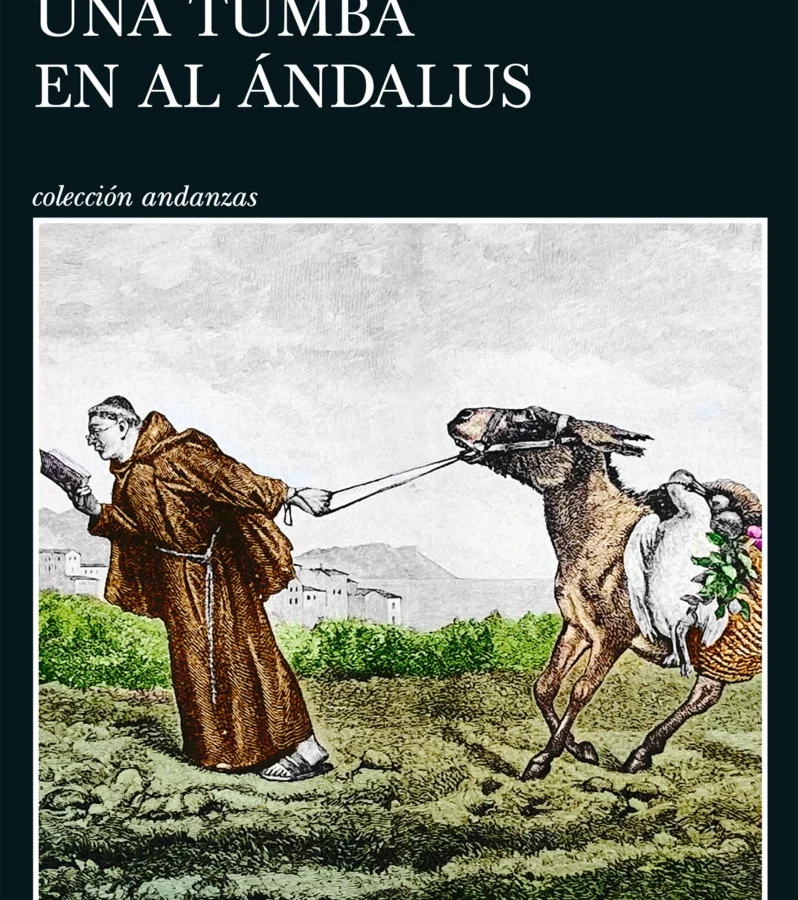
Following The Tavern of Silos (2023) and The Santa Compaña (2024), A Grave in Al-Andalus marks the third installment of this series starring the well-known — now all the more so as it has become fiction — Spanish medieval poet Gonzalo de Berceo, who momentarily puts aside his verses written in cuaderna vía and turns to police work, rolling up his cassock to the knees and, when necessary, brazenly flouting the precepts and protocols of the rigid Holy Catholic Apostolic and Roman Church.
The plot, on this occasion, leads us to the city of Córdoba, in the Al-Andalus of that era,
when King Fernando III, after being canonized by Pope Clement X, seized from the Muslims the cities of Córdoba, Jaén, Murcia and Seville.
The Castilian and Leonese king, however, who reportedly appeared to the Virgin in dreams, does not come out well in these pages. The author of the novel, although he does not renounce praising the virtues of a firm, just, and humble monarch, turns his eye, as the saying goes, toward his squint, and toward that curious portrait, with a thick woolen cloak over the chainmail, that gave him a witch-like air and likened him to a highwayman. The matter of Fernando III the Squint is more than debatable. It seems the nickname does not come from that XIIIth-century era in which this tale is set, but stems from something much more modern, quite recent, connected to Andalusian nationalism and Blas Infante’s musings.
Berceo, as a character, preserves the strength and vigor of the previous two installments, although, on this occasion, as a poet infiltrated in enemy territory in search of a treasure, his actions are less brilliant and, above all, less plausible, as if a good portion of his wit had been left behind. During these years he composes his poem devoted to the martyrdom of Saint Lawrence, with the aim, of course, of serving as bait for pilgrims and earning for himself and the convent a decent sum. Although, from time to time, he laments the quiet life at home, Gonzalo de Berceo has a forced mission to fulfill in Córdoba: to find, at all costs, the Wallada Codex, in whose pages lies an entry titled “The Staff of God,” with which one could construct a weapon of mass destruction, if I may use the much-despised term. And alongside it, the codex also houses other no-less-valuable pages, such as those showing how to brew the world’s best sherry. This is the primary motive for his journey, the element of discord among the different cultures, and yet, in the end, it turns out to be the most nebulous part of the entire novel, perhaps because it seems less plausible, as if we were watching a caper, with a touch of cloak-and-dagger from the Golden Century.
Destaca, sin embargo, la visión de una hermosa ciudad asediada que enseña sus tripas, a punto de convertirse en una ruina, y en la que se aprecian los visibles estragos del hambre, lo que hace sentir vergüenza al propio Berceo, ante la visión de unos niños “flacos como sarmientos” que “se acostaban contra el muro a ensimismarse en una espera sin esperanza.” Mucho más expresivo y bello es ese pasaje, repleto de inspiración y genialidad, todo hay que decirlo, en donde la contemplación de una casa en ruinas, recién arrasada, da una idea cabal del aspecto del resto de la ciudad: “porque cada casa que se derrumba deja a la vista algo que duele al verlo, el caballito de madera de un niño, un libro calcinado, un cántaro roto, una olla con restos de arroz, alguna prenda de ropa manchada de sangre…”.
Lorenzo G. Acebedo sometimes plays with fire, and the pyrotechnic effect does not always turn out brilliantly. Across the nearly three hundred pages of the work, there are phrases, maxims, passages and well-known expressions drawn from books or historical situations, not always timely or well-integrated, such as when someone shouts “Everyone to the ground!”, or when a certain lady “seemed made of the stuff of my dreams,” or when the king Fernando is described with his “outfit of adornment,” or when, toward the end of the book, Córdoba is depicted as once besieged, now “distant and alone.” A diabolical game, perhaps.
On the side of the “goods,” there are splendid reflections and sentences brimming with wisdom that the author drops throughout the novel, such as the one asserting that one should fear more those who temper themselves and know how to listen, “for they use that to accumulate and sharpen their malice.”
In vino veritas. In wine there is truth. This was written by Pliny the Elder in the first century CE. Because wine is, if you read these pages closely, the great protagonist of the tale, the thing toward which all the characters seem to strive, quenching the thirst of body and soul. Not by chance, Søren Kierkegaard, in his well-known work bearing the same title, asserted that wine is not a mere vice, but serves as an element that promotes social filters and mental rigidity, such that certain people, no matter how much they drink, manage to retain their usual composure.
Gonzalo de Berceo, it should not be forgotten, was from La Rioja, born and raised among vineyards, so that no one should be surprised that this noble liquor overflows in his celebrated verses, bringing him closer to the jonglerie and farther from the clerical world. The term “wine” appears up to eighteen times in his poem dedicated to San Millán de la Cogolla. And in his Vida de Santo Domingo de Silos, Berceo again asks for “a glass of good wine” in reward for recounting the saint’s feats. We are, without a doubt, facing a key element in Berceo’s literary arc: wine as a source of satisfaction and unification for an entire community.
Amid such barbarity, while the Christian troops take Córdoba, not as peacefully as medievalists have described, drinking wine becomes the only coherent thing to do in those lands: “There is no more nourishing food nor better medicine than drinking wine!”
In Arturo Pérez-Reverte’s latest novel, The Most Dangerous Hypothesis, Asier Lerrant, one of the protagonists, when asked if he only sails the Mediterranean, answers: “I am not interested in shores where there is no bread, wine and oil.”
—————————————
Author: Lorenzo G. Acebedo. Title: A Grave in Al-Andalus. Publisher: Tusquets. Sales: All Your Books.