
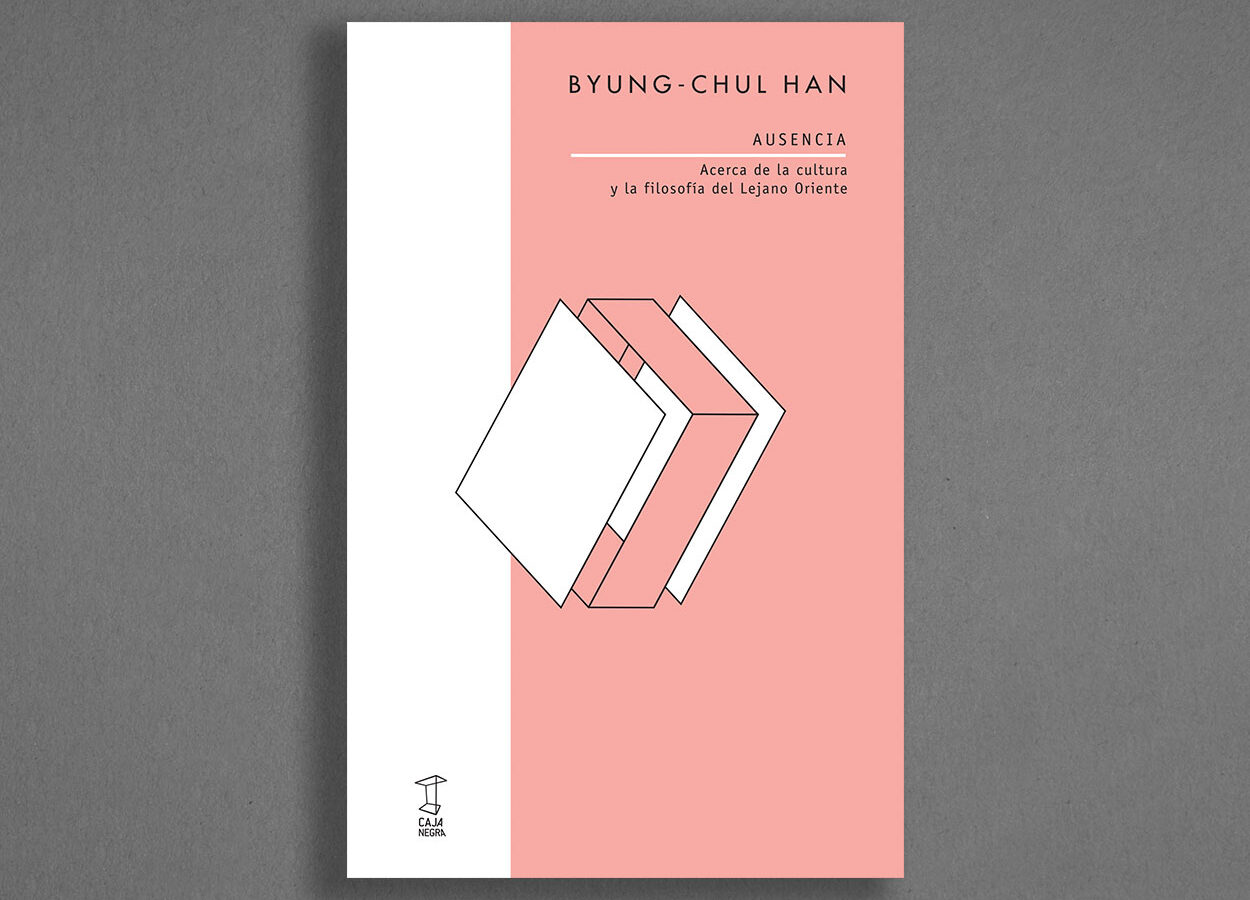
Byung-Chul Han argues in his work, Absence: On the Culture and Philosophy of the Far East, that the crisis of the great narratives (those systems of universal and unchanging truths on which the West has historically anchored its thought) should not necessarily be read as a sign of decay or nihilism. On the contrary, it can open the possibility of surpassing a worldview that has tended to neglect and subordinate alterity. The loss of those certainties would not signify a void of meaning, but rather an opportunity to relate them to what is different through openness and recognition.
West and the Far East differ in many ways, but perhaps the thickest boundary that separates them lies in the metaphysical conception of existence. The West built philosophy, religion, and science under the imperative of the being, understood as idea, essence, or substance, accompanied by principles and laws that make possible the discernment of the world’s patterns. In the Far East, the criterion of truth is irrelevant, since thought focuses on the reverse: absence or non-being. In general, it maintains an attitude of removing limits, which can be grouped in the following triad: desubstantialization, emptiness, and undifferentiation. The eastern sage aspires to reflect the world, without attempting to grasp it, and happiness lies in identifying with the fluidity of nature, where one finds a more compassionate stance toward multiplicity.
We find in Western philosophy a paradox underscored by Byung-Chul Han: the anti-gravity is an organ of desire. By hovering above appearances and gaining control of essences, however, the effect is the opposite: thought becomes anchored in a theory that compresses the becoming of the world. For instance, the anti-gravity of Christianity, with its promise of salvation in paradise, entails adopting morally rigid precepts and beliefs that leave little room for the plurality of human appetites. The anti-gravity of capitalism, with its promise of salvation through success and material wealth, constrains human conduct to the imperatives of the market. The result in both cases moves away from lightness, because ideologies that rigidly delimit an existential roadmap are conclusive and exclusive.
In contrast, in Far Eastern thought there is no essence capable of capturing unity within multiplicity. It is not about turning time into concepts, as Hegel would say, but about adapting thought to the continuous time of indeterminate flows. According to Byung-Chul Han, in Korean there is nothing akin to the expression “I think that…”; the closest approximation would be “The idea nestled in me…”. We observe that there is no prior assertion of consciousness.
For Far Eastern thought, the world deposits in oneself an idea of which you are not the author and cannot articulate from subjectivity. The speaker withdraws because the imposition of a truth is considered impolite. Another example: in Spanish we can say, “I see the sea”, yet in Korean the equivalent would be “The sea is visible”. There is no reference to a knowing subject to whom an object appears; rather, the sight of the sea simply is. Western thought has difficulty conceiving an event without a subject. We can see how language, under the heritage of traditional metaphysics, reveals our difficulties in conceiving the world from the absence of subjectivity.
Likewise, the aesthetics of the Far East do not conceive beauty as something lasting. Beautiful is what yields and withdraws, more akin to the floating than to the stagnant. It is also that which remains faithful to the transience of a transition that makes everything light, the thing that is not clearly delimited and implies the diffuse and the indeterminate. The Japanese concept wabi expresses the Buddhist feeling of beauty as the incomplete, the imperfect, the ephemeral, the fragile, and the insignificant.
Buddhist temples are horizontal and outward-facing spaces where light is softened through doors made of rice paper. Byung-Chul Han describes this as still light, which lacks direction and does not come from verticality. The light that enters the temple does not seek to crush the darkness. The rice paper has a material emptiness and absence, because indifferentiation is gentle with the coexistence of the diverse. The cohesion offered by a Buddhist temple is organic because it does not inhabit a single place; it is a religion of extinction. By contrast, Gothic cathedrals impose the heroic desire for verticality and ascent, where light is filtered through stained glass that enters the temple according to colors and biblical images. The colossal size implies the need to hover over the space in order to encompass it all. The Gothic cathedral inspires a mood of transcendence, of a beyond that gives meaning to the surrounding, yet its structure is rigid and subjects the believer through promises of elevation and transcendence.
Perhaps the absence that Byung-Chul Han advocates does not consist in renouncing the world, but in ceasing to impose our certainties on it. To learn to contemplate without grasping, to think without submitting, and to live without turning every experience into a possession. An invitation, in short, to reconcile ourselves with the indeterminate and to discover in the ephemeral an unexpected form of freedom.
————————
Author: Byung-Chul Han. Title: Absence: On the Culture and Philosophy of the Far East. Translation: Graciela Calderón. Publisher: La Caja Negra. Purchase: Todostuslibros.