
Canada is not closing every public library at once. There is no single announcement, no dramatic national decree and no empty shelf appearing overnight. The damage is happening through smaller budgets, reduced hours, fewer employees and postponed repairs—one municipal decision at a time.
That is precisely why the crisis is easy to miss. A branch that closes one evening earlier still exists. A vacant librarian position left unfilled does not produce a ribbon-cutting photograph. A cancelled program may affect only a few dozen families at first. Yet together, these choices gradually weaken one of the last indoor public spaces where Canadians can spend time without being expected to buy anything.
There is no single government to blame
Public libraries in Canada operate through a patchwork of municipal, regional and provincial arrangements. This decentralized model can reflect local needs, but it also makes the national picture difficult to see. When operating costs rise, libraries often compete with roads, policing, transit and other visible priorities inside municipal budgets.
The result is rarely described as a closure policy. Instead, councils approve funding that fails to keep pace with inflation, buildings age and staffing costs climb. On paper, a library may receive roughly the same amount as the previous year. In practice, a frozen budget is often a cut because it buys fewer books, fewer hours and less maintenance.
Recent reports have made the pattern harder to ignore. Library workers in Durham Region warned that budget pressure could lead to earlier closures and lost service hours. In Nova Scotia, libraries urged residents to contact elected officials over impending cuts, while officials later discussed possible branch closures in the Annapolis Valley. These are local stories, but they point to a broader structural problem.
Libraries are being asked to do far more than lend books
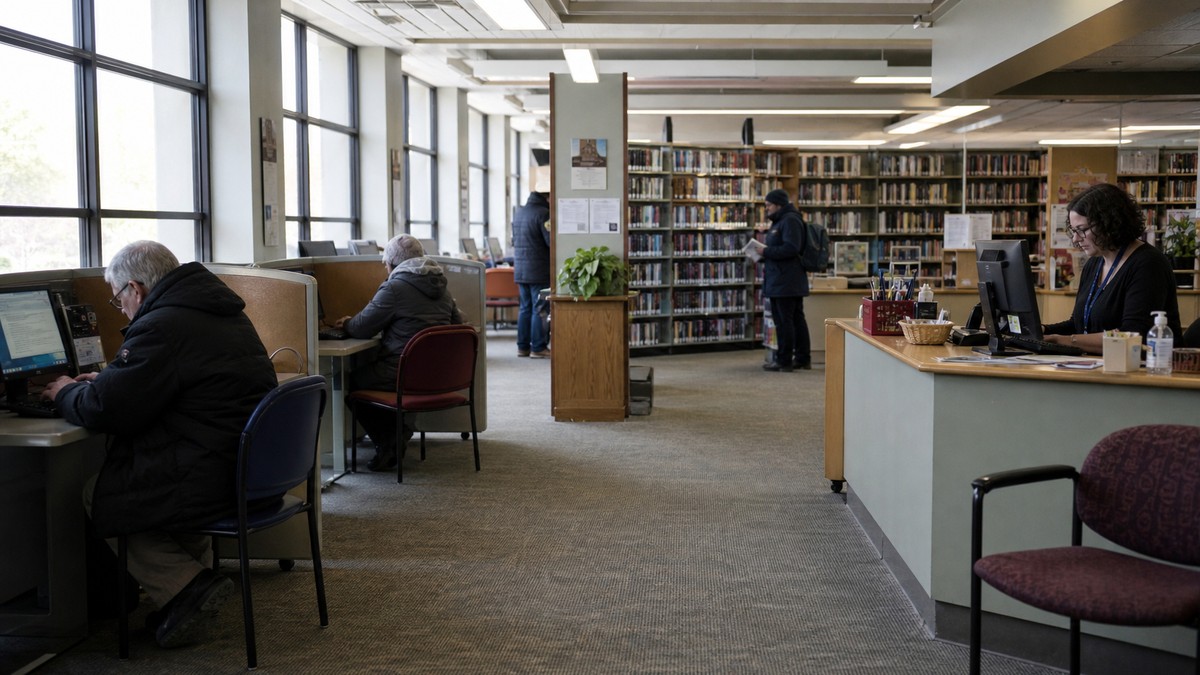
The old image of a library as a quiet room filled only with novels no longer matches reality. Branches provide computers, internet access, language resources, children’s programs, job-search assistance, research help and welcoming spaces for people who may have nowhere else to go.
When government services move online, the library often becomes the place where residents complete forms, print documents or learn how to use unfamiliar digital systems. Newcomers use branches to improve their English or French. Students rely on them for study space. Older adults seek help navigating devices and online accounts. People experiencing housing insecurity use libraries for safety, information and human contact.
The cuts are designed to look survivable
A full closure can trigger public resistance, so erosion often begins with measures that appear temporary or manageable. Sunday hours disappear. A retiring employee is not replaced. A rural branch opens fewer days. Collections budgets are trimmed. Repairs are delayed until they become more expensive.
Fundraising groups and community foundations then step in to protect popular programs or purchase equipment. Their work can be invaluable, but charity is not a stable substitute for public funding. CBC reported in June 2026 that Canadian public libraries were relying more heavily on fundraising to balance their books. Wealthier communities can raise more, which risks turning equal public access into a service shaped by postal code.
The digital shift creates another hidden expense. E-books are not simply electronic copies that libraries buy once and keep forever. Licensing conditions can limit how long a title remains available or how many times it may be borrowed. Libraries must fund physical collections and increasingly costly digital access at the same time.
What disappears when a branch weakens
Rural and low-income communities feel reductions most sharply. A shorter schedule is more than an inconvenience when the next branch is many kilometres away, home internet is unreliable or transportation is limited. For those residents, digital alternatives do not replace a physical library; they often make its computers and staff even more necessary.
Saving libraries requires naming the problem honestly
Canada’s public libraries are not dying because people stopped needing them. In many places, they are under pressure because society keeps adding responsibilities without paying the full cost. The solution begins with multi-year funding that reflects inflation, building maintenance, fair staffing and the real price of digital collections.
The country is not destroying these institutions with one dramatic blow. It is allowing them to become slightly less open, less staffed and less capable each year. Quiet decline may attract fewer headlines than closure, but if it continues long enough, the final outcome is much the same.