
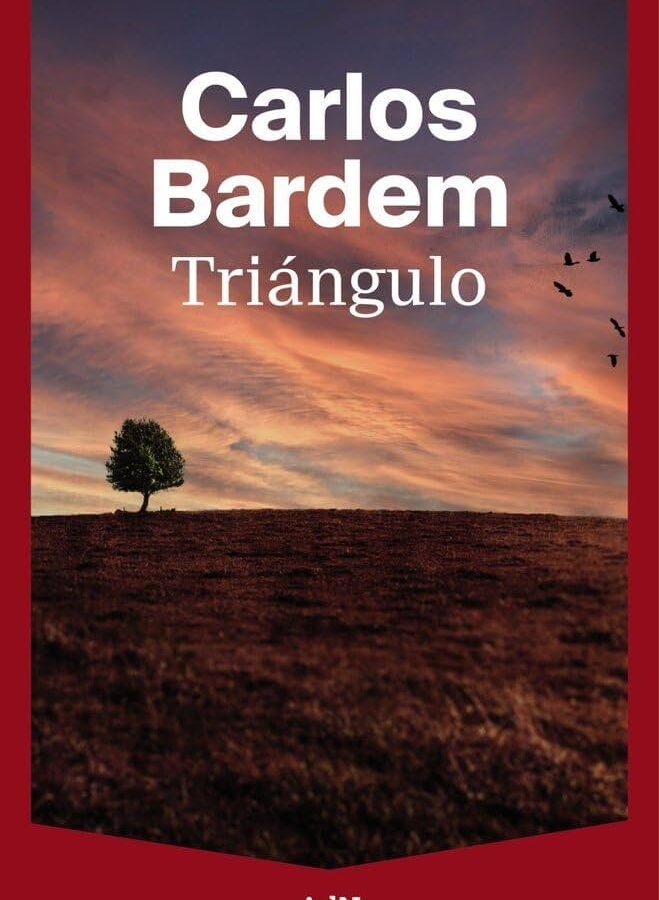
Spanish literature, I fear, is beginning to urgently require a waste-collection service for ideological refuse. In the frenzied race to occupy shelf space on the tables of new releases in bookstores, publishing houses publish so much garbage wrapped in paper of social commitment, so much mediocrity disguised as critical awareness, and so much literary indigence blessed by righteous causes, that one ends up longing for the days when to write a novel one demanded something more than a repertoire of politically standardized indignations.
Triangle, by Carlos Bardem, seems designed to satisfy all the demands of that new narrative catechism. Not a single cliché is missing, not a single directive, not a single cause neatly packaged for the applause of the convinced. Not even are repeated mentions of authors more or less established, more or less read, more or less alive or dead, whose names are invoked (in vain) as if merely citing them would contagiously borrow their supposed talent.
In the pages of Carlos Bardem that I have had the misfortune to read (there are harder professions, indeed, but mine reserves bitter moments), the protagonist bears the surname Roca. And although it would be improper for a fifty-something literature professor to resort to the easy joke about bathroom fixtures, I confess that the association of the surname with the well-known brand is tempting. Especially when, every ten or fifteen pages, one feels the pressing need to throw this novel into the toilet, finely shredded, and flush.
The (inevitable) plot you could never imagine, so original it is: a writer in (inevitable) crisis, confronted by the (inevitable) drama of the blank page, who retreats to the (inevitable) countryside to recover inspiration, whether lost or perhaps never possessed. A literary misfortune, this, which, it would seem, continues to fascinate vain scribes, sure that the difficulties of a writer to write anything constitute a plot of universal interest. To season the matter there also appear a girl who knows a lot about everything, an (inevitable) library, an (inevitable) feminist with her corresponding trauma, Civil War trenches, and a catalog of contemporary concerns carefully chosen so that no one can accuse the author of omitting any just cause. The literature, unfortunately, does not appear. It neither shows up nor is it anticipated, not in this nor in the author’s previous novels, which I have had the holy patience to read and review for Zenda whenever they fell into my hands, because one has also its wicked little pleasures, and one is to check that the self-styled novelist Carlos Bardem, undaunted by discouragement, continues to pop up in bookstores so that critics and supposed readers (in that, he is lucky, for there are few) stamp merengue pies on his face, like clowns. And those are really quite appetizing.
Specially memorable is Lola, a teenager who speaks as if she had been raised among cultural supplements, feminist manifestos, and democratic-memory conferences. The girl wants to be a forensic archaeologist because, as she explains in a display of intellectual depth, “humankind has killed for thousands of years”. She also recommends a book about historical violence with this youthful enthusiasm: “It’s a very top book!”. And then, in a burst of spontaneity (which would have made the best Golden Age playwrights pale), she asks: “Have you read it at school?”. And she adds: “What will be next? Cool?”. And all of that. Because Bardem seems convinced that simply placing a “very top,” an “insti” or a “cool” between two reflections on the human condition is enough for a teenager to acquire a life of her own. But Lola does not speak as a teenager, but as a mediocre novelist who has overheard two teenagers in a café. In literature, as in life, no one puts what they do not have. And the truth is that in Triangle there is very little.
Sometimes, the curious reader wonders if Carlos Bardem might be, perhaps, a joker at heart, a humorist. Because there are things that no one could have written in earnest. In another passage, for instance, the girl observes an archaeological dig and the narrator solemnly informs us: “Lola handles with ease the technical jargon”, as if to leave the reader in any doubt that they are in front of an exceptional creature. The problem is that the talent of a novelist lies precisely in making their characters exceptional without needing to certify it every step of the way. And in Bardem’s case, the effort (useless, besides) is as constant as it is ineffective.
Then, of course, comes the grave: the skeletons, the relatives, the volunteers, the photographs, the personal objects, the human remains. An entire inventory of authentic horrors that ought to move us, yet is reduced to a crude sentimental stage set. Bardem writes: “There is something more that many share: a hole that breaks their skull”. Besides the doubt that the author has the slightest real idea of what a bullet does to a skull, the line purports to be devastating, but the real problem is not its crudeness, but the ease with which Bardem seems to trust that the harshness of the subject will substitute for the quality of the writing. And alas! a mass grave does not automatically turn the pages written about it into literature. Nor does rape provide psychological depth to a character merely because they suffered it. Human pain is not a guaranteed literary resource. One must know how to narrate it. And above all, one must have more than good intentions to approach it. One must have talent and craft.
The novel does not shy away from offering its corresponding lessons on sexuality, violence, and human relationships. In one passage, a character explains that “boys, raised in the most violent pornography, do not arouse themselves by the woman they rape”. And he continues developing a theory about the behavior of aggressors with the ease of someone who has found a universal truth that he considers urgent to share with the reader. We are not dealing with a character who speaks; we are confronted with a platform that has taken human form. Besides making us yawn and provoking laughs we did not intend to provoke, Bardem intends to indoctrinate us. And at another moment the narration stops to reflect on men, desire and adolescence to pose the question pointedly (take note) if there is something pedophilic in all men. Understand that I burst out laughing there. Because it matters less how uncomfortable the question is (good literature is full of uncomfortable questions) than the rustic way it is formulated and the impression that the characters exist to open, one after another, all the debates of the moment.
Because Bardem seems to write with a checklist of issues to be addressed beside the computer. Civil War: included. Graves: included. Feminism: included. Sexual violence: included. Social critique: included. Trauma: included. Committed literature: included. Plausible characters, natural dialogues, style, imagination, moral ambiguity: that for the next novel.
And, between denunciation and denunciation, the books (many books, not missing). The characters read, recommend, quote, and display their libraries with the enthusiasm of someone showing their cultural credentials at the door of an institution. To the point that, in the end, the novel includes a section titled Works Cited, with Rafael Chirbes, Luis García Montero, Giuseppe Tomasi di Lampedusa, Jaime Gil de Biedma, Clarice Lispector, Milan Kundera, and other writers summoned to lend luster to the whole. A kind of undergraduate bibliography, in case someone needs documentary proof that the author has been near literature. The approach has something touching about it: as if someone prepared a can of soup and, to dignify it, placed next to the plate a list of the world’s best cooks. Citing Kundera does not make anyone Kundera, just as mentioning Lampedusa does not confer the elegance of The Leopard (far from it, by the way, to Bardem’s crude novels). And frequenting Clarice Lispector does not guarantee one has understood what the complexity of a female character entails. About Chirbes there are divided opinions. And as for Luis García Montero, permit me to laugh, and a lot. We were talking about literature.
Perhaps the most irritating thing about Triangle is that ever more widespread confusion between the moral importance of issues and the literary value of a work. In his limited view of literature, Bardem assumes that a novel must be admired because it speaks of important things, because its characters defend just causes, or because it denounces true horrors, as if ideological commitment (which drips from Bardem in every direction) absolves the obligation to write well. But literature does not work like that. A novel is not good because it is on the right side of history, but because it manages to turn human experience into something new, complex, unpredictable. Because its characters may contradict the author, be mistaken, lie, unsettle us. Because language discovers rather than repeats. Because the reader does not receive a sermon, but an experience. And here, in Triangle, almost everything seems arranged so that no one steps outside the script of the politically edifying. The characters are mouthpieces, the dialogues are vehicles for slogans, and the historical tragedies function as scenery in a performance whose moral ending we know from the first act. All very upbeat and pleasant until the nausea sets in.
There is a contemporary epidemic far more widespread than writer’s block: the endless multitude of mediocre people convinced that having opinions, social sensitivity, a library and a computer constitutes enough accreditation to be called a novelist and to write a novel. The old requirement to possess talent, ear, imagination, mastery of language, and something truly new to tell seems to have become an elitist whim. Writing is a right, certainly. Publishing, too. What does not exist is the right to pass off fakes as truth, to place flattering blurbs (more false than a politician’s smile) on books, and thus let the unwary reader confuse intentions with good literature. For centuries, great novelists managed to make us understand human misery without turning their characters into civic-education professors. Cervantes did not need to add a bibliography to Don Quixote. Dostoevsky did not interrupt his novels to check whether his protagonists had read the right books. And Galdós did not need to tag his creations with ideological labels to show us on which side injustice stood.
Perhaps the greatest misfortune of this novel is not what it counts, but the absolute inefficacy of the one who tells it. Although Bardem may ignore it (although he quotes much, he has read little and badly), there are innumerable novels written about the suffering of the novelist before the blank page. Some (very few) are reasonably readable. But after wading through Triangle, I begin to think that we should worry far less about that suffering and much more about the reader’s suffering when the supposed novelist peddles his broken merchandise. Sometimes the blank page is not an obstacle the author should overcome, but a warning he would do well to heed. Something like: stop, kid. Focus, I don’t know, on cinema, for example. Or on anything else