
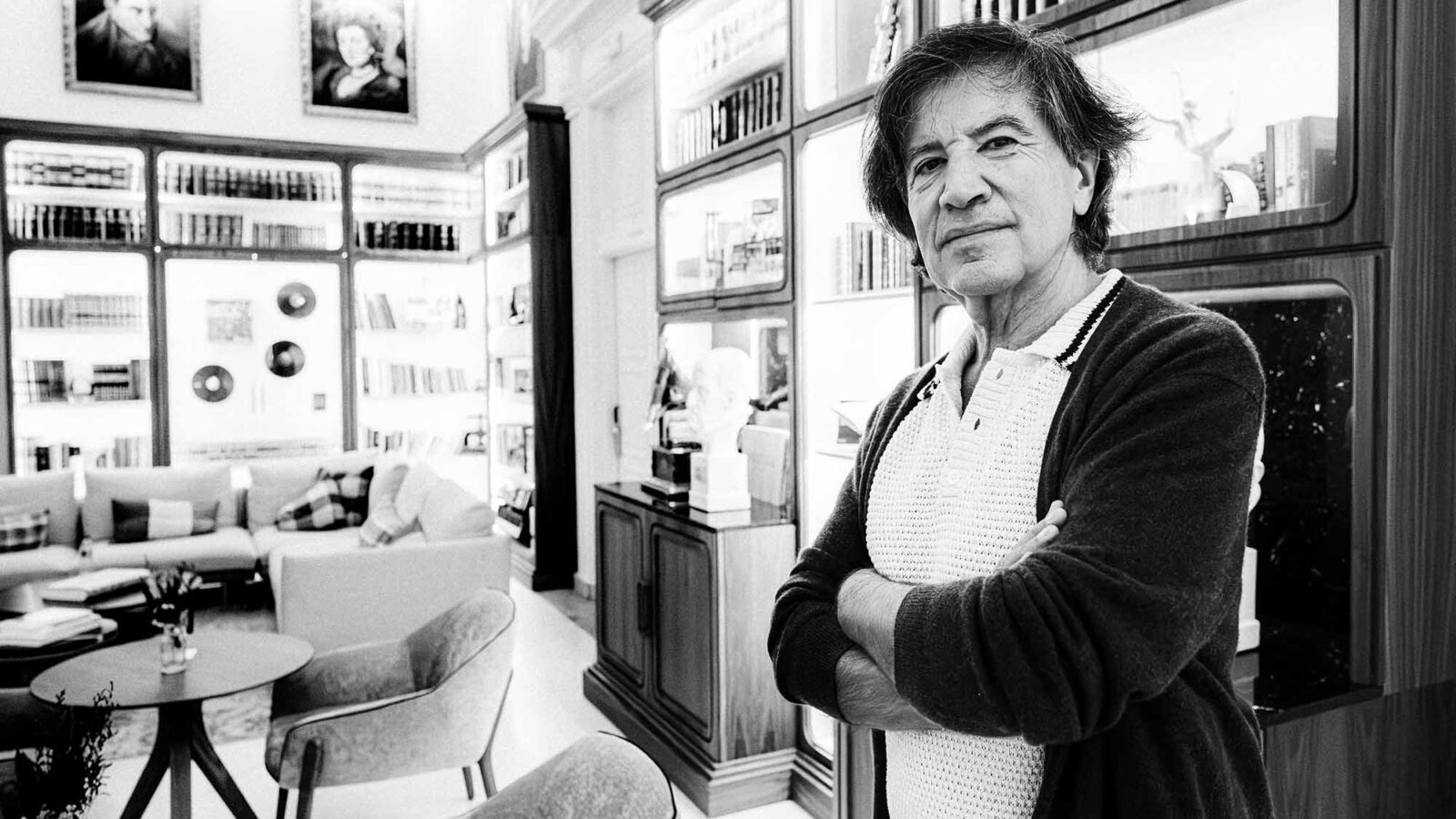
The reunions with Carlos López-Otín (Sabiñánigo, 1958) are always on Epiphany morning. Months pass and we chat by phone, or by email, or others tell us how we are, but we do not meet: he in his world, I in mine. And the day arrives when he tells me about The Eternity and One More Day: Sammy Basso’s Last Class (Paidós), his new work of non-fiction, and everything speeds up: we look for a date to meet. In his book he recounts his friendship with Sammy Basso, a patient with Hutchinson-Gilford progeria syndrome (HGPS), an extremely rare genetic disorder that leads to rapid and premature aging in affected children and an early death. Sustained by this relationship, The Eternity and One More Day —delicate and moving— traverses topics that concern us all, sprinkled with Carlos’s habitual kindness and intelligence. I switch on the recorder and we begin, happy to be together, our fifth conversation for Zenda.
*****
—How much do you miss Sammy and why do you miss him?
—The fact that his farewell to life had been long anticipated contributed to our personal goodbye being gentle, serene, and long-consented, as Borges once spoke about casual encounters in life.
—And what do you miss most about him?
—His laughter, like yours; you are two great laughers. Together with Luis Alegre you form my trio of excellent and exuberant laughers. Sammy was very sociable, a great laugher, a wonderful companion and a superb conversationalist. He practiced the art of conversation and loved talking and joking a lot. That is what I miss most about him.
—What did Sammy teach you? Because it is a relationship, at least, if we look at the photos, peculiar.
—The first time I met him, Sammy approached me simply as a scientist. We met at a scientific conference on progeria, and I had been invited to present one of the most important results in the study of this disease: the development in our laboratory of a strain of genetically modified mice that carry the same mutation as children with Hutchinson-Gilford progeria, the serious and incurable condition Sammy suffered. In my talk, Sammy realized that we had engineered those mutations into the mice’s genome, and these animals reproduced his disease. Then he realized that there perhaps could be an elixir of health and life, a gift of time for him and the other patients with his disease. After my talk, he came to the podium and told me in English: “My name is Sammy Basso and I’m Italian, you can tell, right? Back there are my parents, who are much shyer than I and don’t dare to come say hello. I wanted to ask if you think I could benefit from the research with these genetically modified animals.” I told him that of course yes, and we spoke very briefly. I had to return to Oviedo to teach, something essential for me, because I never missed a single class in almost forty years I taught at the University of your hometown. Sammy’s farewell impressed me the most. Instead of saying goodbye or “ciao,” he held my hands and said: “I don’t know if we’ll see each other again, because I’m twelve years old and, according to your talk, that is the average life expectancy for patients with Hutchinson-Gilford syndrome. So very likely at the next conference I won’t be there. All I have left is to give you a hug and tell you to keep working so that the children who come after with the same disease have more chances and, above all, are granted more time to live than I have been granted.” And just like that, he gave me a hug and walked away slowly. The trip back to Asturias was very moving for me, because I could not shake the memory of Sammy. I had met other patients with these devastating diseases, but he had a green, deep, restless gaze that showed his infinite curiosity, and at the same time it was always adorned with a smile or a laugh. This was the first lesson I learned from Sammy Basso: a lesson in accepting adversity and the end of life, because although chronologically he was a child, his appearance was that of a man over eighty.
—Where do you think he drew that strength from?
—It is very appropriate that you ask me this, because it is something I asked myself and anyone could ask, since not all children with that same disease have managed to survive as long as Sammy. Our work with the mutant mice could be applied to many patients, but only he reached so far in life. Why? First, I believe he possessed a brilliant mind capable of integrating advances about his disease, thinking about them and applying them to his life. But it wasn’t only scientific and medical knowledge that united us at the outset. Also, Sammy had an emotional circle, built by his family and friends, that was truly formidable. His parents were simple, warm, and protective, but without excess. They simply helped make life a little gentler for Sammy. Then there was a circle of extraordinary friends who stood by him from school to the end of his life. In the past these children, given their very visible and severe phenotypes, were brutally and vilely bullied. Sammy never experienced this, I don’t quite know why, perhaps because of his naturalness, but his schoolmates accepted that Sammy was different in appearance but the same in everything else. He was also the first for jokes and laughter, so he was not only accepted, but became a true leader. And finally, in addition to his intelligence and his extensive network of family and social connections, Sammy had the gift of faith.
—Isn’t this fact curious for a scientist?
—That’s right. One might think that those of us without faith—by education, by introspection, or by disappointment—are incapable of understanding those who do have it. Yet I like very much to put myself in other people’s shoes to try to understand their way of living and feeling life. Sammy was spectacular in this dimension: he had deep faith and leaned on it to face daily adversity. He was convinced that when he died, he would go to a better place. That is why one of the high points of my relationship with him is expressed with this small symbol I carry here (he shows me a small wooden “T” he always carried), the Tau of Saint Francis, which Sammy wore all the time and I always kept in my pocket. He gave it to me at his most difficult moment. After finishing his experimental work in our lab, during an annual medical check in Boston, an aortic block was detected and he needed a life-or-death operation to correct that heart issue. We had to help him decide whether he should defend his thesis first or undergo the surgery. Along with his Asturian lab colleagues we undertook a long journey from Oviedo to the Italian Veneto, and after an unforgettable group discussion in a pizzeria in his hometown Tezze sul Brenta, Sammy decided that he would first read the thesis and then have the operation. When the day appointed for his intervention arrived, I traveled from Paris to Rome to accompany him. Once in the hospital he asked for my opinion on whether he would survive the operation, and I told him I had spoken with Dr. Musumeci, the great Italian surgeon who took on that responsibility, and concluded that the situation was very difficult and at most he had a fifty percent chance of surviving, in other words, a true toss-up. And when he was about to be taken to the operating room, we talked about his faith and mine, and I reminded him of a Sylvia Plath line: “I talk to God, but the sky is empty.” It was then that he took my hand and gave me this cross, which has accompanied me since that morning in Rome. It is the greatest bond I have with him; it is deeply emotional, and although he did not restore my faith, it helped enrich my personal sense of spirituality.

—There is a transcendent bond with him in some sense.
—Sammy had a sense of transcendence; I never did. On the contrary, I believe our life is very limited and we must try to move forward as best as we can with the time we have. But he possessed this vision of extreme transcendence: that is why in the book I talk a lot about this condition and describe how I imagined his farewell to life and what measures he took to keep moving toward the sea of the infinite. This idea of transcendence, together with his infinite curiosity, helped him go far in his difficult life plan, that of a child who at birth seemed destined to have a future with no future.
The exposome, always present in his work. Tell me a bit what it is and why it fits Sammy perfectly.
—When I arrived in Oviedo I had a broad scientific training provided by wonderful teachers and mentors, such as Margarita Salas or Severo Ochoa himself, at whose center I worked. There I was educated in the molecular and cellular secrets of life, but emotions were studied in other faculties, as in yours, where it was explained that “life is not enough.” I learned this expression from Fernando Pessoa, in his Book of Disquiet, where he stated that “literature, like any form of art, is the confession that life is not enough.” And when, in addition to my scientific work, I could enjoy art, literature, or music, and admire the beauty of nature, I assumed that explaining life requires a broad, integrative gaze built from culture, education, and curiosity. And within this framework lies the concept of the “exposome,” the set of factors that affect our health and that do not have direct effects on the genome, which implies that we are not only made of genes, but that the environment is decisive in determining whether genes express their information or stay silent. This helped to address questions such as: why do patients who carry a highly penetrant mutation with a severe pathological impact not die at the same age? Undoubtedly, Sammy was a master of the art of living under extreme adversity because his exposome was low-toxicity, but very friendly and healthy. His case helped me think about the existence of gentle and healthy exposomes, which at the time was not discussed because it was thought that the exposome consisted only of negative factors: chemicals, toxic agents, environmental pollution… Fortunately, in recent years we have advanced in the molecular mechanisms underlying the positive exposome, that affectome that arises from emotions, feelings, and sensations that distinguish us as humans.
—That helps human knowledge to integrate. Suddenly human knowledge was divided into disciplines and they kept separating from one another. And you advocate for integration in human knowledge that includes both literature and medicine or biochemistry.
—That’s right. In fact, I always wonder whether life can be understood without literature, without music, without painting, without architecture, or without cinema, to name a few essential human activities. In every chapter of each of my books there is a compendium of all these disciplines that helped me write it. The soul of every chapter begins to take shape with the choice of the first song, which flows into all the others, even if nothing more is perceived than in the imagination. In The Eternity and One More Day, the opening song is “Memória” by Carminho and Rosalía. This same idea applies to scientific or literary concepts. The key can be summarized in one word: integration. Integrating concepts, data, or knowledge implies studying a lot and thinking far and fearlessly. In my professional life I have found very few people with whom I can discuss these issues in depth, and among them is Guido Kroemer. For nearly twenty years he has been my best intellectual stimulus. From our conversations emerged articles such as The Hallmarks of Aging or The Hallmarks of Health (the keys to aging and health), which have been cited thousands of times and have become new thinking frameworks for progress in these biomedical fields. In fact, this idea of creating integrative frameworks is something we now ask of artificial intelligence; we want it to look for patterns in oceans of data, although I think the human, slow, and dedicated gaze still has the best capacity to explore those gray spaces where reality and algorithms tremble.
—In Trece veces trece, by Gonzalo Suárez, there is an aphorism that reminds me of the AI’s inability to see certain patterns. One person, who could be AI, says: “If I walk through a forest and see two trees, my duty is to say that what I see are two trees.” The other, human, replies: “You do see two trees. But I see the gap between the two trees, and I move on.”
—That reflection is stunning. Everything is said in those few words.
—This book, like all his books, contains a large autobiographical portion, half-interwoven, where Miss Consola appears, who taught him to read, and later Margarita Salas, the wonderful scientist and his teacher.
—In truth, this book can be summarized in its final line. “Thank you, Sammy, for having added a long day to your eternity and for having given my last class,” and it is that in my mind his last class was also mine. So Edu, I thank you once again, because even in my first book you understood that his pages spoke of more than what might appear on first reading. With The Eternity and One More Day, the same happens. There had to be a final point to the narrated story when the two protagonists’ voices merged into one. In the Last Class. And that is why from the first chapter I draw a series of parallels between us so that it is clear that we are actually part of the same story. I speak of my school, of my early responsibilities, of who taught me to read and write. And then I speak of Sammy’s school, of who taught him to read and write. For me, Miss Consola, and for him, Miss Genny. And so the parallel evolves between us until we reach the university and I recount in the book our respective difficulties arising from adapting from our towns to the cities where we had to study. All these events are told in the book in such a way that at times it seems like a work of fiction, but for both of us it was all real, absolutely real, and that is how it is told, though always avoiding melodrama or excessive sentimentality.
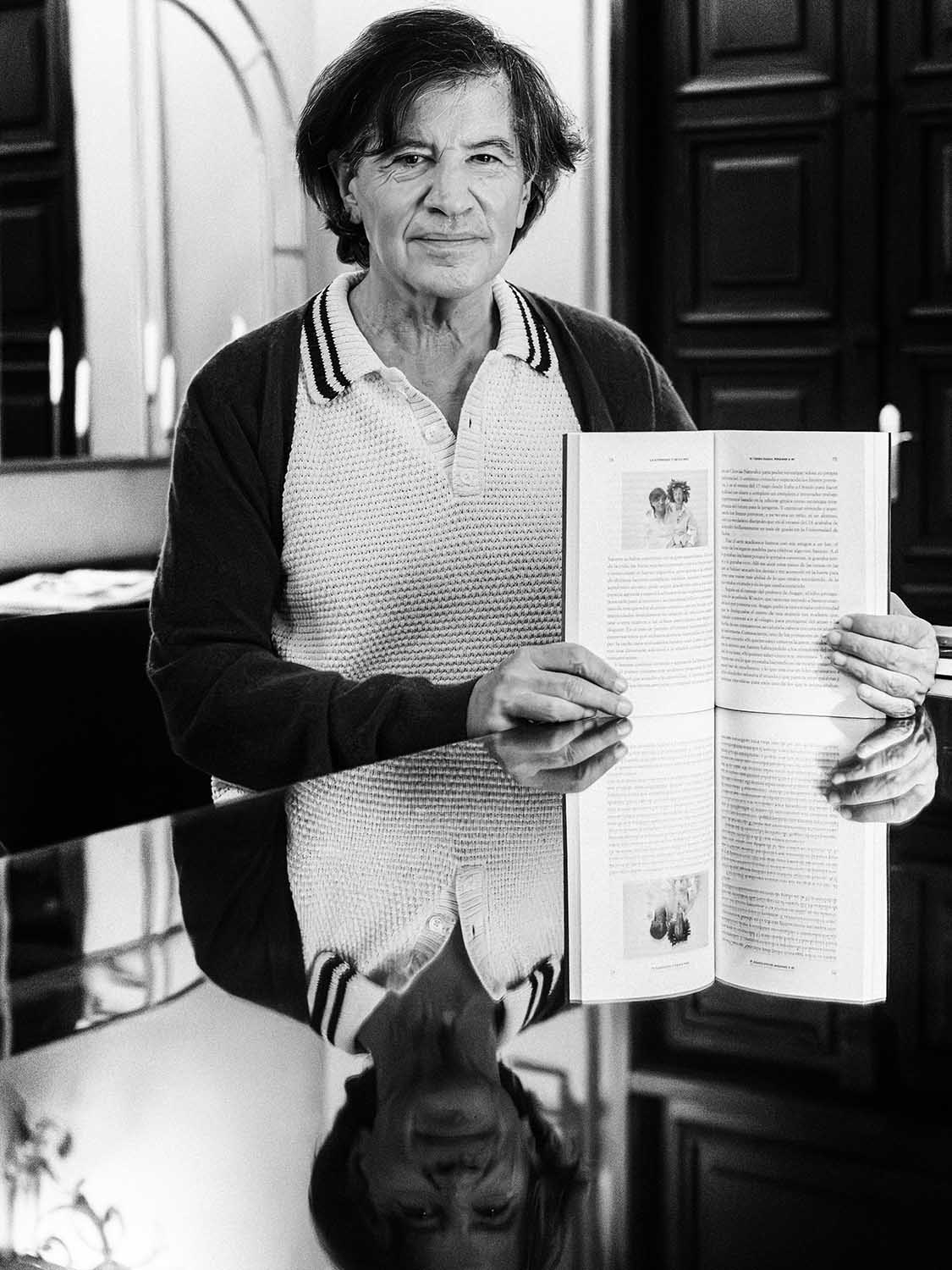
—That you manage this well is remarkable because it is a story that could end in excessive sentimentality. And yet no. Yours is an intertwined relationship, like when women wove leaves together for Palm Sunday, remember? Also like a strand of DNA. Change of topic: something in your book that astonished me and is counterintuitive, especially for those who do not know your field. The perfection of life would not have given rise to life; life was only possible through imperfection.
—“Imperfectness defines life: if we were perfect, we would be microbes.” In class I explained this to students on the first day so they would understand where we come from. That is why I do not mind repeating it once again, because it continues to surprise and remains unaccepted. Since the beginning of life, 3.8 billion years ago, the aim or dream of any primitive microbe was to copy itself, to create another identical creature. In that task lay life, because if it made mistakes, the most probable outcome was the disappearance of that promise of life that was being tested repeatedly under very inhospitable conditions. As the mechanisms for copying genetic material were not perfect, errors occurred that mostly led to the disappearance of those bacteria. But those that by chance or necessity accumulated mutations in their genetic material that gave them a selective advantage went on and transmitted their genome to their descendants. And life progressed, and over time multicellularity emerged, death was invented, and differentiation and functional diversification advanced. And in that new complexity one had to ensure cohesion, that cellular cohesion which is a perfect metaphor for the need for social cohesion. Today we often miss this cohesion in our society, but our cells miss it too when they transform and become selfish, immortal, and roaming entities that challenge altruism and the cohesion of healthy cells and attempt to colonize other distant territories of the organism until generating the unwanted and undesirable metastatic tumors. We are imperfect and vulnerable, and we will remain so as long as we are formed from biological material nourished by emotions rather than machines fed with electrons.
—Was diversity also indispensable?
—Absolutely, diversity was another major evolutionary achievement, and without it we could not have reached here. We have two hundred different cell types, all derived from a single fertilized egg that, in a relatively short time, gives rise to an organism with more than thirty trillion human cells of two hundred types, and inside it another thirty trillion non-human cells, primarily bacterial. We are holobionts, a word that I am sure your friend Arturo Pérez-Reverte would enjoy.
—And why, given such rich diversity, do you think that once we are genetically and cellularly formed in life, we are so reluctant to diversity?
—For the same reason that we are so reluctant to accept death as part of our biological essence, even though every second since we began talking has cost us a million cells to prevent the accumulation of damaged cells that could be seeds of disease. Life found a way when death was invented. At first, death had little control, but today cellular death is highly sophisticated, as it is programmed, organized, and diversified. In fact, there are at least seventeen different ways to die in our intimate cellular realm. So if I had to summarize what I have learned in more than forty years studying the keys to life and disease, I would say that the astonishing thing is to survive. That is the true miracle of life. It is the most extreme magical realism I know. And even though Cien años de soledad is my favorite among the thousands I have read, its magical realism staged in Macondo pales beside what happens inside each of us, at every moment of our life.
—This book also expresses many of your claims. Why “urge to wait”?
—“Urge to wait” is a personal mantra that has accompanied me since forever. Why? Because I learned that serenity is a form of wisdom, the wisdom that comes from the presence of calm in the soul. Of course, I know this principle is easier to explain to someone else than to oneself, because when you discover your own fragility or your particular vulnerability, or a great wave of Hokusai arrives unannounced, you need someone to grant you serenity or the guidance necessary to get out of the storm. “Urge to wait” is simply that: the appreciation of serenity and calm as simple yet effective life elixirs. Moreover, in the laboratory we have learned that living in an accelerated manner causes biological aging and chronological aging to decouple, making our life clock speed up and making us more susceptible to various age-related diseases.
—In Trece veces trece, by Gonzalo Suárez, there is an aphorism that reminds me of AI’s inability to see certain patterns. It says a person, who could be AI: “If I walk through a forest and see two trees, my duty will be to say that what I see are two trees.” The other, who could be human: “You see, indeed, two trees. But I see the gap between the two trees, and I move on.”
—This reflection is impressive. Everything is said in those few words.
—This book has, as all his books, a large autobiographical portion, interwoven, where Miss Consola appears, who taught him to read, and then Margarita Salas, the wonderful scientist and his mentor.
—Actually this book can be summarized in its final sentence. “Thank you, Sammy, for having added a long day to your eternity and for having given my last class,” and indeed in my mind his last class was also mine. So Edu, I thank you once again, because already in my first book you understood that his pages spoke of more than what might seem at first read. With The Eternity and One More Day the same happens. There had to be a final point to the narrated story when the two protagonists’ voices merged into one. In the Last Class. And that is why from the first chapter I draw a series of parallels between us so that it is clear that we are actually part of the same story. I speak of my school, of my first responsibilities, of who taught me to read and write. And then I speak of Sammy’s school, of who taught him to read and write. For me, Miss Consola, and for him, Miss Genny. And thus the parallel evolves between us until we reach the university and I recount in the book our respective difficulties arising from adapting from our respective towns to the cities where we had to study. All these events are told in the book in such a way that sometimes it seems like a work of fiction, but for both of us everything was real, absolutely real, and so it is narrated, while always avoiding melodrama or excessive sentimentality.
—That you manage this well is impressive because it is a story that could end in sentimental excess. And no. Yours is a braided relationship, as when ladies braided the leaves for Palm Sunday, remember? Also of a DNA strand. Quick topic switch: one thing that amazed me that you say in your book and which is counterintuitive, especially for those who do not know your discipline. The perfection of life would not have given rise to life, which was only possible through imperfection.
—“Imperfectness defines life: if we were perfect, we would be microbials.” In class I explained this to students on the first day so they would understand where we come from. That is why I do not mind repeating it once more, because it continues to astonish and remains unacknowledged. Since the origin of life, 3.8 billion years ago, the objective or dream of any primitive microbe was to copy itself, to create another identical creature. In that task lay life, because if it made errors, the most probable outcome was the disappearance of that life promise that was repeatedly tested in very inhospitable conditions. As the mechanisms for copying genetic material were not perfect, errors occurred that mostly led to the disappearance of those bacteria. But those that by chance or necessity accumulated mutations in their genetic material that gave them a selective advantage went on and transmitted their genome to their descendants. And life progressed, and with time multicellularity emerged, death was invented, and differentiation and functional diversification advanced. And in this new complexity there was a need to ensure cohesion, that cellular cohesion, which is a perfect metaphor for the need for social cohesion. Today we often miss that cohesion in our society, but our cells miss it too when they transform into selfish, immortal, roaming entities that defy altruism and cohesion of healthy cells and attempt to colonize other distant territories of the organism, up to generating the undesirable and malignant tumor metastases. We are imperfect and vulnerable, and we will stay so as long as we are formed from biological material nourished by emotions rather than machines fed with electrons.
—Was diversity also essential?
—Absolutely, diversity was another great evolutionary achievement, and without it reaching here would have been impossible. We have two hundred different cell types, all derived from one fertilized egg that, in a relatively short time, gives rise to an organism with more than thirty trillion human cells of two hundred types and that hosts inside it another thirty trillion non-human cells, mainly bacterial. We are holobionts, a word that surely pleases your friend Arturo Pérez-Reverte.—Why, since our diversity is so rich, do you think that once we are genetically and cellularly formed in life we are so wary of diversity?
—For the same reason that we are so reluctant to accept death as part of our biological essence, even though every second since we began speaking has cost us a million cells to prevent the accumulation of damaged cells that could seed diseases. Life made its way when death was invented. At first, death was with little control, but today cellular death is highly sophisticated, programmed, organized, and diversified. In fact, there are at least seventeen different ways to die in our intimate cellular realm. So if I had to summarize what I have learned in more than forty years studying the keys to life and disease, I would say that the astonishing thing is to survive. That is the true miracle of life. It is the most extreme magical realism I know. And even though Cien años de soledad is my favorite book of the thousands I have read, its magical realism staged in Macondo pales beside what happens inside each of us, at every moment of our lives.
—In this book many of your claims are expressed. Why “urge to wait”?
—“Urge to wait” is a personal mantra that has accompanied me since always. Why? Because I learned that serenity is a form of wisdom, the one that stems from the presence of calm in the soul. Of course, I know this principle is easier to explain to another than to oneself, since when you discover your own fragility or your particular vulnerability, or a great wave of Hokusai comes without warning, you need someone to gift you serenity or the necessary guidance to weather the storm. “Urge to wait” is simply that: the appreciation of serenity and calm as simple yet effective life elixirs. Moreover, in the laboratory we have learned that living in a hurry accelerates biological aging and chronological aging, causing our internal clock to speed up and making us more susceptible to various time-related diseases.
—He also advocates humility, and I think of Margarita Salas.
—She was a person of great humility. I realized it in the first class I took from her. She spoke about identifying DNA as the long-sought “transforming principle,” a molecule capable of creating and transforming life. At the end of her class I understood that the transforming principle was not a molecule, but Margarita herself. And this has happened to me with other people during life. Sammy Basso, or better Sammy Sensei, was also a transforming principle who always maintained a high degree of humility. Near the end of his life he had become a world icon, gave talks everywhere, received awards, was named a Knight of the Italian Republic, and yet there was something that weighed on him especially despite apparently more serious problems: Sammy could not tie his shoes by himself. This is the real dimension of our fragility. We all have our fears, our uncertainties, our vulnerabilities and our weaknesses, and we must accept them, or reject them, face them or hide them, but they are there. And in the end we will only count on ourselves and someone to accompany us in the final, most difficult meters, as the poet Margarit wrote. We are small, very small, because a single chemical change in a gene can change or destroy the plan of a life. And this happens constantly. There are more than 17,000 different diseases, and almost half of them have a genetic basis. How could we not be humble before this census of adversities? That is why it is no accident that in my mind arrogance rhymes with ignorance.
—We’re done, dear Carlos. Sammy left you a personal farewell letter, which you, I think rightly, do not transcribe in the book.
—I thought it only logical not to transcribe something so personal and moving. I also asked Sammy’s parents for permission to maintain privacy, unless they wanted, for some reason, for my letter to be made public. Interestingly, they told me that the letter their son left would also remain private. It took me several days to read that letter, which for me was a good summary of his gifts. In it he showed that, in addition to being a great expert in the art of creating a life with meaning in the midst of great adversity, he was also a master in the art of thinking, and in feeling, and in writing, and in thanking. I wanted the reading of his last words addressed to me to be on a Sunday, and it represented the last of our mythical “Sundays with Sammy” and at the same time “The Last Class of Sammy Sensei.”