
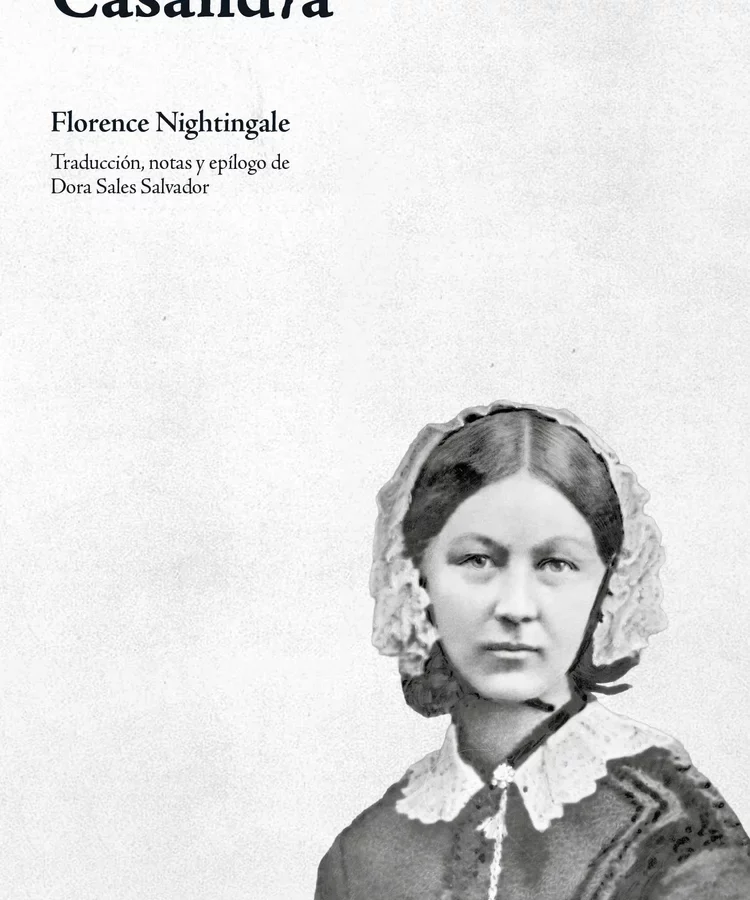
This essay rises against the restrictive life led by upper-class women in Victorian England, crushed by family pressures and social conventions. Nightingale denounces the death-in-life that society imposes on women and pleads for a decisive change to free them from that torment.
At Zenda we reproduce the opening pages of Casandra (Barlin), by Florence Nightingale.
***
I
“A voice cries out in the crowd.
Prepare the way for the Lord.”
One often finds herself wandering in solitude, within the bitterness of a life lived outside the circle. Perhaps there comes a moment when she feels tempted to seek an escape, hoping to find a more pleasant environment. Yet, perhaps if we leave this world too soon, we must endure it all over again: premature birth may not contribute to the creation of another being who must begin anew from the very start.
Such a person longs to plunge back into the blissful, unconscious sleep shared by the rest of her kind. People sleep embraced, not yet awake. For those, evil and suffering do not exist, since they are unaware of evil. Meanwhile, one person, awake and prematurely lucid, must roam in silence and solitude. That person has awakened too soon, risen too early, refused the companionship of the species, detached from any other human being. This person perceives the malice others fail to see, and yet she lacks the power to discover the remedy.
Why do women possess passion, intellect, and moral energy—three things—and yet hold a place in society where none of them can be put to use? Men say that God punishes those who complain. No, what happens is that men are angry with sorrow. They are irritated with women for not being happy. They take it as a personal affront. Women can only complain to God, without insulting Him!
And women, while outwardly agreeing that God’s work is good, fear to utter, “Thy will be done”—which would proclaim a different social order from the one He has ordained—, devote themselves to comforting one another and to teaching their daughters that “women have no passions.” In the conventional society, which men constructed for women and which women accepted, they must not have any passion; they must perform the farce of hypocrisy, the lie that they have no passions, and, therefore, what else can they tell their daughters without contradicting themselves?
“Humanity” of women, “sad, suffering” humanity! What are those feelings that they are taught to regard as shameful, to deny to themselves? What shape do Chinese women’s feet take when proper development is denied them? If the young women of the “upper classes,” who never take a wrong step, whose diligently earned reputations are never sullied—even by the stain left by the mere knowledge of good and evil—could speak and say what their thoughts, the thoughts that alone remain free, would center on, what would they say?
They would say that, with the ghostly companionship of their imagination, they speak—yet they do not love; they are too innocent, too pure, too full of genius and imagination to do so—that in their imagination they talk about what most concerns them; they seek a partner for each of their thoughts; the partner they cannot find in reality they seek in their imagination, or, if not so, if they are not absorbed in endless conversations, they see themselves involved with him in thrilling adventures, circumstances that awaken the interest missing in their daily routine. Yes, fathers, mothers, who watch your daughters reject any hint of flirtation with pride, who see them dutifully engaged in the tasks of breakfast, how little you consider how their imaginations find compensation in endless conversations and affinities—with affinities born of ideas or events—with the moment’s imaginary companion! And you say: “She is not susceptible. Women have no passions.” Mothers who cradle visions of the domestic hearth, how many of your children do you think stand there, under your approving maternal gaze? Were you yourselves present in your own—now forgotten—youth?
What do these young women think about while one sings Schubert, another reads the Review, and a third embroiders? Does one not imagine herself as the nurse to a new friend who falls ill; another envisions herself caught up in romantic perils with him, trials of her character that awaken more sympathy than the monotony of domestic life? Is not another dreaming of subjecting herself to unheard-of trials, watched by someone she has chosen as a dream-companion? And does not another fantasize about having a loving, cherished partner in the life she leads, one whom many would not wish to change?
And isn’t all this the most natural, inevitable thing? Should they, so ashamed that they dare not confess it even to themselves, be blamed for what cannot be otherwise, for causes that lie before our eyes if we would but keep them open? Many fight this as if it were a “trap.” No Trappist ascetic keeps vigil or fasts more with his body than these women do with their souls! They understand the discipline of the Thebaid, the perpetual torments endured by those moral pioneers. How could they endure the same to escape the torment far worse than repressing the “vain imaginings”? Yet the laws of God for moral well-being should not be obeyed in this way. We fast mentally, we scourge ourselves morally, we wear the intellectual cilice to subdue the perpetual waking dream, which is so dangerous! We decide, “on such-and-such day I will free myself from it”; we strive to fight it twice daily, through prayer and a record of the times we have yielded. Never with any real success. Mortifying vanity does us no good. It is the lack of interest in our life that creates it; only by filling that void of interest in our life can we remedy it. But, even if we realize it, how can we make a difference? How can we achieve that interest which Society claims it does not want and which we cannot want?
What are novels? What is the secret charm of all love stories ever written? The first thing in a good novel is to place people together in circumstances that naturally stir their elevated feelings and thoughts, providing nourishment for the affinity between them in these respects—what is known as romantic happenings. The second is that the heroine usually has few or no family ties—almost never a mother—or, if she does, those ties do not interfere with her complete independence.
These two aspects form the main charm of reading novels. Yet, when it comes to good, genuine interests, let us see what we have in real life to respond to them. Can deep affinities be fed by opera, exhibitions, gossip about the House of Commons and political caricature? If, together, a man and a woman address any of the major matters of social, political, or religious life, it is said—and rightly so, given our current dismissals—that they are going too far. That such things can exist!
“Are you the Lord?” And He answered: “It is I.” May our hearts be at peace.
[…]
—————————————
Author: Florence Nightingale. Title: Casandra. Translation: Dora Sales Salvador. Publisher: Barlin. Availability: All of your books.