
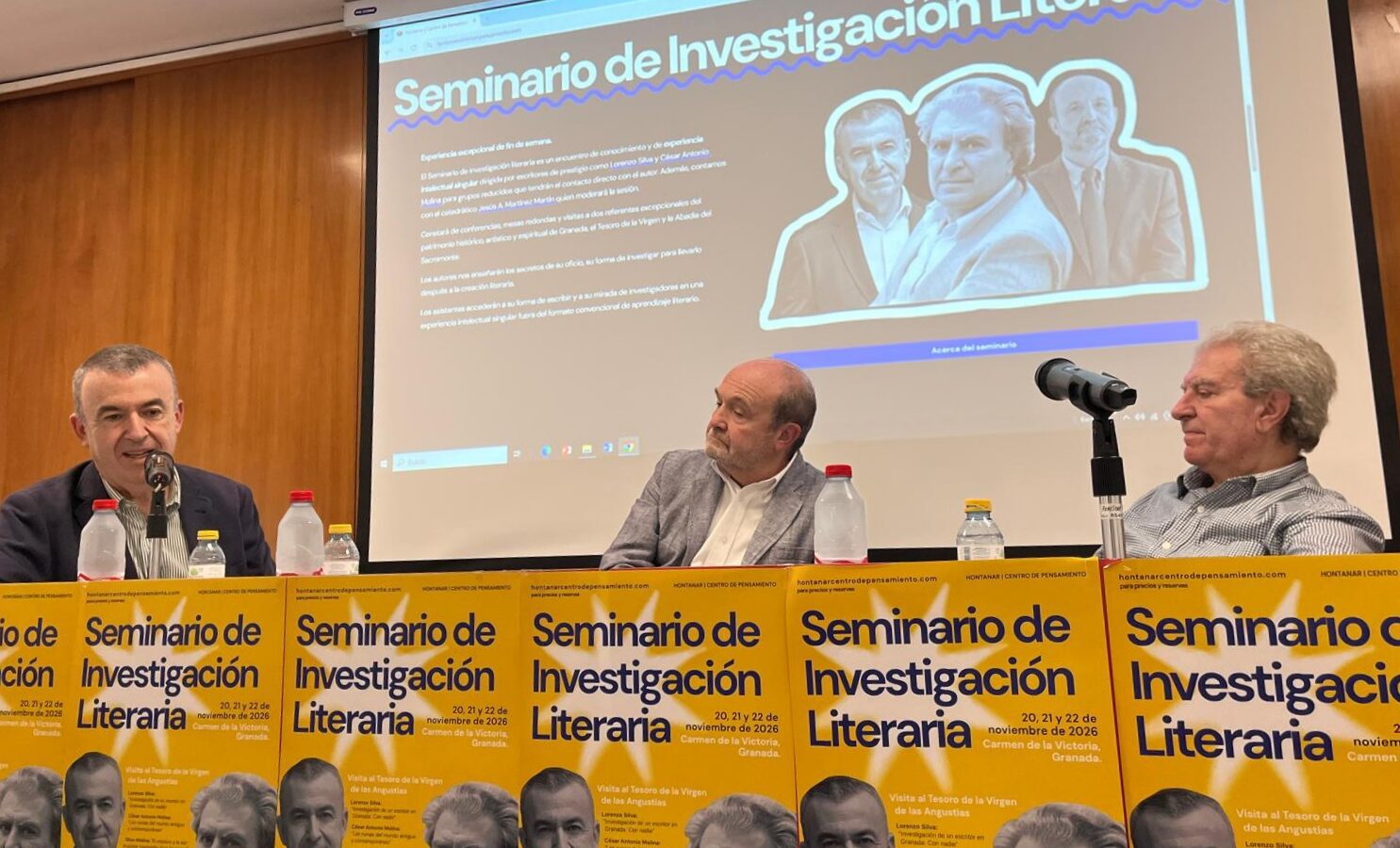
Last weekend in Granada, the writer, poet and Minister of Culture between 2007 and 2009 César Antonio Molina, the writer and Planeta Prize 2012 Lorenzo Silva and the history professor Jesús A. Martínez Martín highlighted the importance of rigorous and patient research in accessing the “truth” of literature, during the I Seminar Hontanar.
Celebrated at the Carmen de la Victoria with a small group of 30 students and led by the writer, journalist and professor David Felipe Arranz, this seminar on literary research organized by Hontanar, a new think tank founded and led by Marichu García Trejo, has marked the starting pistol in the Alhambra’s city for an interdisciplinary dialogue space with literature as a starting point.
César Antonio Molina referred to ruins — Greek, Roman, Syrian, Egyptian… — as “our memory” or “our own bones,” an essential stimulus for creativity, as evidenced in his poetry volumes Calmas de enero (Tusquets) or Exquisita supplicia: Libido moriendi (Vaso Roto). “We are the future of a ruin,” he commented in this vein, before the posthuman world that has arrived with AI: “I have had the luck to live in a pre-technological era,” he added. “It isn’t that I feel melancholy; I cultivate it,” he explained later to the attendees when referring to his poetic style, before emphasizing the concept of silence he learned in a family that had lived through the postwar period after fighting on the Republican side, like his grandfather, whom he held dear and who used to have his grandchildren read fragments of Émile Zola and Victor Hugo or take them to the cinema.
For his part, Lorenzo Silva has stressed narrative and popular biography, as in his recent publication, Erguido hacia las estrellas (Destino), about Francisco de Vitoria, based on his lessons and on episodes of his life unknown to most readers. He also spoke of the literary teachings of masters such as Franz Kafka, “one of the writers most aware of reality,” Marcel Proust, who moved him “through his gaze on time and the deep layers of things,” and Raymond Chandler, expert in the tale of “unreliable public servants.” In this sense, Silva referred to how “the construction of one’s own gaze is always a work in progress.” Among his literary references he also cited Robert Musil, Joseph Roth and Svetlana Alexievich, and regarding his teachings, he emphasized the search and creation of complex stories with facets and contradictions, the mental notes about people who have lived through complex situations, the weaving of the symphony of narrative, the gaze where no one looks, and the degree of the “truth” of all fiction, the true challenge.
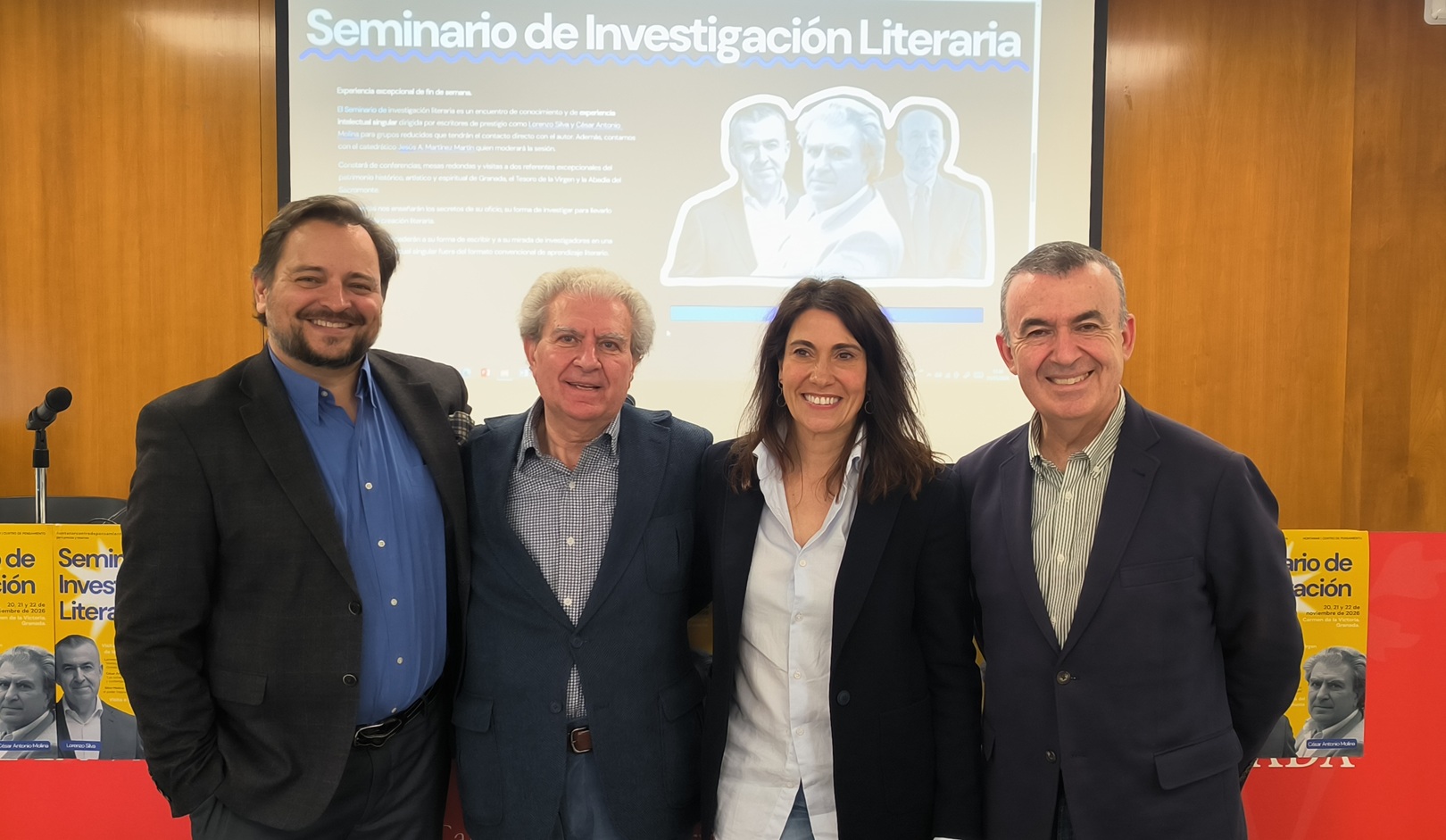
Finally, the historian and professor at the Complutense University Jesús A. Martínez Martín closed the seminar with a talk in which he noted that poetry is “the beauty of words ordered after neurological disorder, constructing feelings and awakening emotions.” Regarding the dialogue between literary fiction and historiography, Martínez indicated that there must always be in history a regime of truth different from that of literature: it can “illustrate” historical moments, though it should not substitute historiography. Thus, he pointed out that with respect to historiography, it is appropriate to study the historical conditions that make possible the experiences of the character, rather than judging them.
Furthermore, the personalized visit to the Treasures of the Virgen de las Angustias with its curator and fellow confrere Manuel Alejandro Amador and the exclusive tour of the mysteries of the Abbey of Sacromonte with the presence of Abbot Antonio Fernández Siles provided practical complement to the morning theoretical sessions.
Hontanar aims to become a “spring” of thought and humanism through gatherings that connect people with the great protagonists of knowledge. This new think tank proposes the spring as origin, search, and center of what is essential. According to Marichu García Trejo, who cites Dámaso Alonso in his verse “La hontana de aguas frescas, centro de todo,” the hontanar is a metaphor for “there exists an origin to return to, which helps us think our time so changing and uncertain, with greater meaning, sensitivity, and inner freedom.”
Thus, the upcoming I Hontanar Forum on Science and Spirituality, this time open to the public and free of charge, will be held on Saturday, December 12, at the Cuarto Real de Santo Domingo, with the presence of the writer Javier Sierra, Dr. José Miguel Gaona, the writer Pablo d’Ors, the philosopher and theologian Francesc Torralba, and the participation of actress Silvia Marsó, who will perform readings from the texts of the four authors.