
Javier Rubio Donzé (Madrid, 1983) belongs to the new generation of Spanish popularizers who have understood that History must also find space in new forms of communication. A graduate in Architecture from ETSAM of the Polytechnic University of Madrid, writer and creator of Academia Play, he has managed to gather millions of followers around a formula that seems simple: telling historical episodes in a comprehensible, visual, and direct way.
Now he transfers that way of understanding History to the page in his new publication
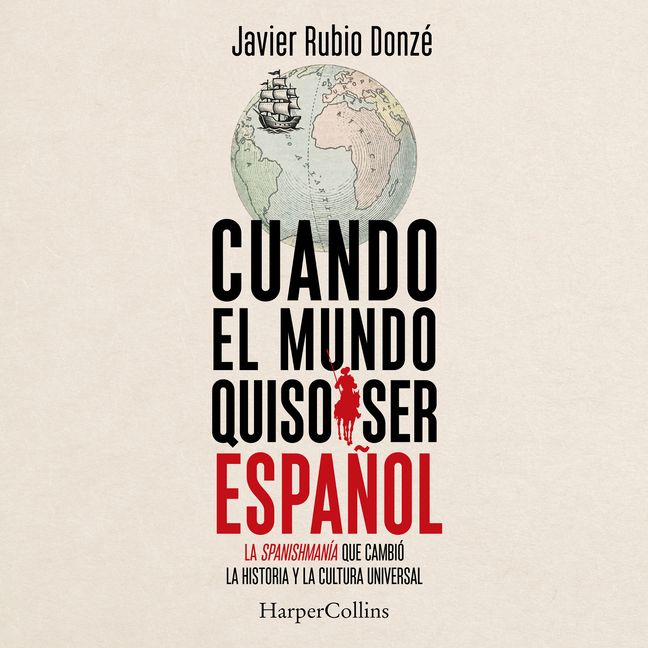
When the world wanted to be Spanish: The Spanishmania that changed history and universal culture
It is an essay built around a guiding question: how many stories, characters, customs and symbols that we consider universal maintain some relation, sometimes unexpected, with Spain?
The answer could fill hundreds of chapters. The author has chosen twenty-five representative episodes. Thus, the book traverses eight centuries in search of traces of that influence and draws connections that lead the reader from Don Juan Tenorio to the wines of Jerez, from Sanfermines to the tales of the Alhambra, from fashion in the time of Philip II to Balenciaga or Eugenia de Montijo.
No pretende to write a general history of Spanish influence nor to build an academic treatise. His purpose is to gather concrete stories that allow understanding that certain traits originating in Spain found their place in other cultures.
In that intention one recognizes his style as a modern divulgator. Donzé writes as he communicates: he discards the loaded language and the scholarly display to approach a journalistic and colloquial register. He aims for the reader to first understand the event and then want to know more.
There is a central idea that runs through much of the book: as the power of the Spanish Monarchy grew, so did its adversaries, and at the same time the followers of fashions and manners arriving from Spain increased. Yet rejection and fascination could coexist.
To demonstrate the aptness of the title, Donzé turns to examples of very different signs: Bernardo de Gálvez, Salvador Dalí or Gregorio Sánchez Fernández, known for his comedian persona as Chiquito de la Calzada, who managed to become a genuine idol for Japanese flamenco fans. A similar thing happened with Antonio Gades. Both, along with other figures of cante and Spanish dance, helped project beyond our borders the new manifestations of Spanish culture.
The journey allows leaping from the New York that discovers Dalí to Paris, which makes Balenciaga one of the great names in global haute couture; from the New York vaults of the Guastavino family to the Spanish Pavilion that Javier Carvajal designed for the World’s Fair held in the city of skyscrapers in 1964.
But part of that diffusion was also the work of foreigners who arrived in Spain, were fascinated by its history, landscape, or culture, and decided that they had to tell it. Washington Irving stands as one of the best-known examples. Archer Milton Huntington, founder of the Hispanic Society of America, devoted much of his life and fortune to gathering and preserving an extraordinary Hispanic heritage. To them can be added Ernest Hemingway, Orson Welles, George Orwell, or John Dos Passos.
None of them needed official appointment to become, in their own way, ambassadors of what they had seen and admired.
That is why it is easier to understand what Donzé calls Spanishmania. It is not that everything comes from Spain. Nor is it about substituting a biased interpretation of our history with a more flattering one. It is about recovering some documented episodes that are often little known or even completely ignored.
The important thing is to verify how Spanish talent has been recognized and integrated naturally into the culture and life of many places around the world.
As the author himself states, his intention is to provoke in the reader that sensation that appears when one discovers that «the panorama was not complete».
In my view, the main achievement of Javier Rubio Donzé in his book When the world wanted to be Spanish is having found and documented stories capable of sustaining a common idea and telling them with that author’s signature language.
This essay poses one last reflection: today, as centuries ago, Spaniards continue to show that when we set out to do something, we do not care about its scale, but about the challenge of doing a job well done. The same can apply to those great expeditions, to organizing major international events, to erecting extraordinary works, or to commemorating and disseminating any event.
Knowing what those who preceded us did allows us to understand where we come from, to value and accept the legacy received.
Because knowing our History does not require magnifying it; it suffices not to diminish it.
For all these reasons, the work of Javier Rubio Donzé deserves to be highlighted. His essay When the world wanted to be Spanish represents a step in his career as a popularizer, for he has managed to select and highlight those cultural elements that were assimilated by other countries, bringing to a broad audience an influence of which many readers may not have been fully aware.
—————————————
Author: Javier Rubio Donzé. Title: When the world wanted to be Spanish. The Spanishmania that changed history and universal culture. Publisher: HarperCollins. Availability: Todos tus libros.