
It is a fact that by the mid-1930s Madrid and also Barcelona had risen to the level of the great European capitals in terms of entertainment. It is notable, for example, that on November 12, 1931, freshly proclaimed the Republic, the Pavón Theatre, on Embajadores Street, had premiered, with great success, Las leandras, with Celia Gámez as the star: a musical revue that captured the double life of the protagonist, Concha, ostensibly a most virtuous teacher and in reality, with the help of her boyfriend, the man Leandro, a vedette. Anyone, except the youngest among us, knows how to hum the catchy songs “El pichi” and “Los nardos,” as it is said the Deputies of the time did, to the extent that the Speaker of the House, Julián Besteiro, had to call them to order and even contemplated suspending the session.
In cinema, and again to illustrate with just one example, viewers in 1935 could see
Nobleza baturra, written by Joaquín Dicenta Alonso, directed by Florián Rey, and starring Imperio Argentina, which tells a sordid Aragonese story from the early part of the century when she, the very young María del Pilar, is accused of something that could be dramatic at the time: having been caught in sin —the sixth commandment, which especially when applied to women generated a real obsession— for having sexual relations outside of marriage.
And it is that the dominant mentalities were becoming modernized, but it is well known that these changes do not occur overnight, nor do they happen at the same pace everywhere
: towns tend to lag behind the cities.
All things considered, one could speak of a kind of Madrid movida, the kind that would later be lived, with that same name, forty years afterward.
Rafael Cansinos Assens, in his extraordinary book The Novel of a Man of Letters, wrote in March 1935 a paragraph that is very expressive of the sense of modernization and acceleration that was, at least, insisted upon in the great capitals:
“What a set of things we’ve seen! Two literary fashions, one great world war, three regime changes, revolutions across the globe, portentous inventions, aviation, radio, sound cinema, and those extraordinary men, Chaplin, Lenin, Hitler, Mussolini… what will we still have to see?… life goes on forcefully, overwhelmingly… women are more beautiful and happier, nudity triumphs in the pools… what a revolution in manners this proves to be…!”.
In that context, on July 18, 1936, some military men rose up in arms. Coups d’état —as Curzio Malaparte explained in his famous book about his technique— can win or fail, but sometimes it is partial: they win in some areas and lose in others. This is what happened here — hence the civil war — with the peculiarity that Madrid and Barcelona found themselves on the losing side, the side of resistance. And, alas, the chekas as well.
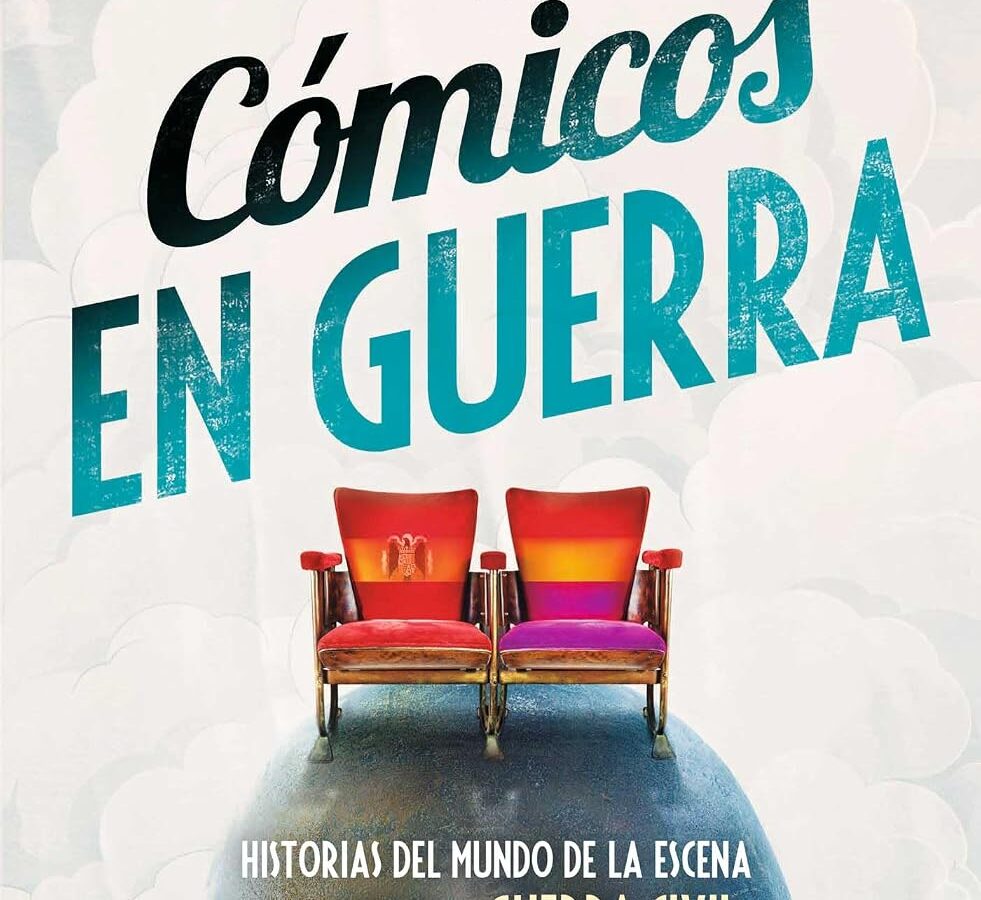
What fate awaited the bright panorama of shows that existed then? Had it all collapsed? This is the thesis maintained by Alfonso Domingo’s brilliant and highly recommended book Cabaret Iberia, with the subtitle The Crooks of the 1930s. But Pedro Corral, in Cómicos en guerra. Historias del mundo de la escena y el cine en la guerra civil, argues, and substantiates, the opposite: as the saying goes when describing what is crossed, it is a time of tragedies, life goes on. And here, step by step, it did go on. Among other things because show business had become a powerful industry and, aside from ideological considerations, there were many mouths to feed. And, of course, an audience to entertain amid bombardments and hardships.
Two clarifications about the book’s title. One, that the author himself notes in the Preface: cómicos was a word that at the time applied to “all the different protagonists in the world of show business, although today, without having lost its original meaning, it can take a more limited sense to comedy”. And second: the stories found therein do not stop, sometimes with great detail, on April 1, 1939, because they extend into the postwar period and the repression that many people endured.
Across more than 400 pages, divided into five parts, a whole gallery of characters is paraded, offering a bit of everything, like a pharmacy shelf. If a selection had to be made, one might begin with the star of one of the Chapters, the 4th, The Chekist and the Vedette, of the first part, The World of Show Business in the Face of War and Revolution. This centers on the stunning Tina de Jarque (Barcelona, 1906 – Valencia, 1937), a pioneer in showing herself as God made her, who at the start of the conflict was arrested in Madrid by Abel Domínguez, an ex-legionary anarchist who fell for her, giving rise to truly rocambolesque circumstances. Even Juan March was not oblivious. For gossip lovers, a genuine bonanza, let it be noted that in her artistic merit lay above any other consideration.
There is also the second part —the whole thing— The Lorquian Universe Ravaged by the Conflict, with obvious mentions to La barraca, created in 1932 as University Theatre with the support of the Minister of Public Instruction, Fernando de los Ríos, whose secretary and administrator was Rafael Rodríguez Rapún, whose new mention is illustrative in itself. Corral now reveals that quintacolumnists also stretched their tentacles there: the person who managed performances before the People’s Army was Manuel Balgañón Márquez, a man who in the large-scale leadership of the FUE but in Madrid’s backline clandestinity acted as an active Falange agent. Double loyalties are not infrequent in those settings, just as the adaptations to the sun that heats the most at any moment: people always have a second coat at hand, as Galdós described Juan Bragas de Pipaón. And if one has become so marked that changing sides is impossible, prudence at least counsels keeping what today is called the low profile.
To avoid an endless cast, let us cite — third and final reference — Valentín tornos, the legendary Don Cicuta, El tacañón, from the program Un, dos, tres… responde otra vez, by the unforgettable Chicho Ibáñez Serrador, which, introduced by the Peruvian Kiko Ledgard, was broadcast on TVE from 1972. And it turns out that Valentín (1901-1976), who had debuted in theater in 1920, specializing in comedy (though usually in supporting roles), found the conflict surprising him in Madrid, where he became a republican-azainista, resulting in his forced flight in 1939 to Marseille (as, incidentally, two famous footballers, Ricardo Zamora and Pepe Samitier, did), where he had to earn a living as a waiter and as a brush-painter, without having the chance to resist in 1940 against the not-so-friendly German invader. He later went to Paris, to work with something as illustrious as Luis Mariano’s operetta (another great one: justly revered in Irun). He could return to Spain in the early fifties, that is, already mature, and had the opportunity to participate in memorable films such as La verbena de la Paloma (1963), by José Luis Sáenz de Heredia; El verdugo (also 1963), by Luis García Berlanga, which is no small feat; or La ciudad no es para mí (1966), by Pedro Lazaga.
Reader, do not doubt it: you will learn a lot from this book. And, deep down, perhaps you will even reconcile, at least partly, with humankind. Above all, you will feel like a free citizen, someone who is not forced to adopt a single way of thinking. A true delight, even if only for the unusual nature of these times of radio and television pundits so committed to their own cause: they are —all of them— a real horror, the truth. For worse than the grandpa who goes on and on about his battles are the polarized great-grandchildren!