
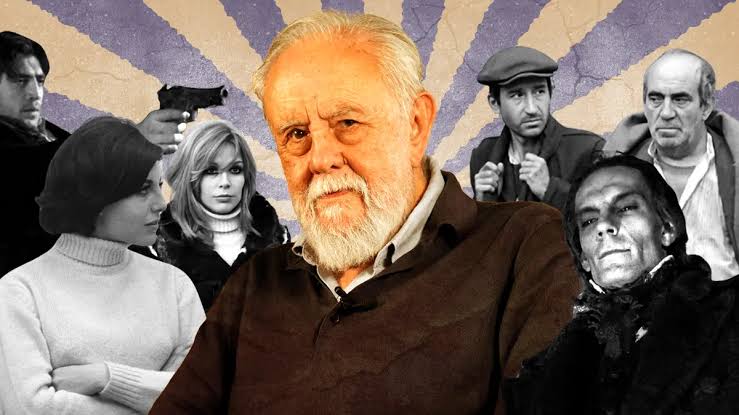
I was eighteen when I found in Salamanca’s old Cervantes bookstore a copy of La literatura, the volume in which Alfaguara had gathered some of Gonzalo Suárez’s most important works. I knew the man, but I was unaware of his oeuvre, and something must have drawn me to that book, because I took it to the college residence and began reading it that very night. I remember the dazzling impact of Trece veces trece, Rocabruno bate a Ditirambo and Gorila en Hollywood, but also De cuerpo presente and Los once y uno. There appeared there a writer who seemed to reject none of the conventions upon which literature rested, someone who had set out to blow apart the borders of genres and who, to crown it all, found in that demolition an inexhaustible source of pleasure. His books were strange, funny, disconcerting artifacts, in which the unlikely always showed up within the everyday.
I became a devoted reader. Gradually I began to acquire all his books, combing through used bookstores, chasing out-of-print titles, trying to assemble a library like no other. That year I also joined the Filmoteca de Castilla y León, and there I realized that the writer I admired so much was, in addition, an extraordinary filmmaker. There was no contradiction between the two facets, because Gonzalo Suárez wrote as he shot and shot as he wrote. In other words, he practiced the same subversion in two different ways. His films possessed something of novels that had decided to emancipate themselves from words, and his books seemed to contain images that resisted staying still on the page. I have written several times about my unconditional fascination with Aoom, a rare bird of Spanish cinema that never reached commercial theaters and that more than half a century after its filming still preserves its freshness, but it would be unfair to overlook El detective y la muerte and Mi nombre es Sombra, two films that strike me as prodigious for their ability to conjure worlds governed by their own laws. Nor can one refer to his cinema without pausing at Epílogo, that portentous exercise on creation and its mirages, or at Remando al viento, where the story of Mary Shelley and her companions at Villa Diodati becomes an inquiry into the monsters conjured by the imagination and into the possibility that they might escape the control of their inventors. Suárez was interested in those borderlands where reality begins to lose its solidity and fiction takes on a troubling semblance of truth. He never settled for simply recounting what had happened. He preferred to explore what could have happened, or even what perhaps was happening without anyone realizing yet.
At heart, all his work can be read as a prolonged declaration of independence. Suárez never accepted that literature had to resemble what was expected of it, nor that cinema should submit to the demands of verisimilitude. His stories shattered the mechanisms of conventional narration, his characters could rebel against their authors, and his films often advanced along paths that were invented at every turn. There was in all of this formidable audacity, but also an intelligence that prevented confusing freedom with caprice. He did not improvise because he lacked direction, but because he knew that art begins to become truly interesting when it dares to wander. And above all, because he retained a quality that many creators lose too soon and which is none other than the ability to enjoy oneself.
That very freedom guided his relationship with memory. Before becoming one of our most singular writers and filmmakers, he had been Martín Girard, the sports journalist who revolutionized the way football is told and whose chronicles he later threaded into La suela de mis zapatos. There, too, the narrator is recognized as someone who knows how to find a story where others could barely discern a result. And in El hombre que soñaba demasiado, his wonderful distorted memories, what was lived mixed with what was imagined until any attempt to separate them became irrelevant. That is, really, life; a story we build with our memories, our desires, and the lies we tell to keep going. Suárez understood that imagination is not necessarily the opposite of truth, because sometimes it constitutes the only path that allows us to approach it.
Over the years I was fortunate to meet him and to converse with him on several occasions. Talking with him was always a luxury. He had a vivid intelligence and a sense of humor that could be devastating. He spoke of the world as if he had just discovered it. There was nothing of the solemnity that usually accompanies those who have accrued so many accolades, perhaps because he never stopped taking too seriously the hierarchies that others insisted on establishing. He remained, in a sense, that young man eager to set his own rules, even though by then he had spent more than half a century proving that he did not need anyone’s.
He died at ninety-two, though he remained insultingly young. We had a lunch in Madrid planned with Adolfo García Ortega that we had kept postponing for one reason or another, with that carefree attitude with which we tend to manage time we believe to be inexhaustible, and which we will no longer be able to celebrate. We will always have his books and his films at hand, waiting for those who have not yet had the luck to discover them. Perhaps some eighteen-year-old boy will one day find a copy of La literatura in a used bookstore and experience the same astonishment I felt almost thirty years ago. Perhaps he will then understand that there are authors who teach us to read and others, much rarer, who teach us to imagine. Gonzalo Suárez belonged to the latter, and perhaps that is why his death carries a certain paradox: a man who devoted his entire life to proving that the impossible could also happen.