
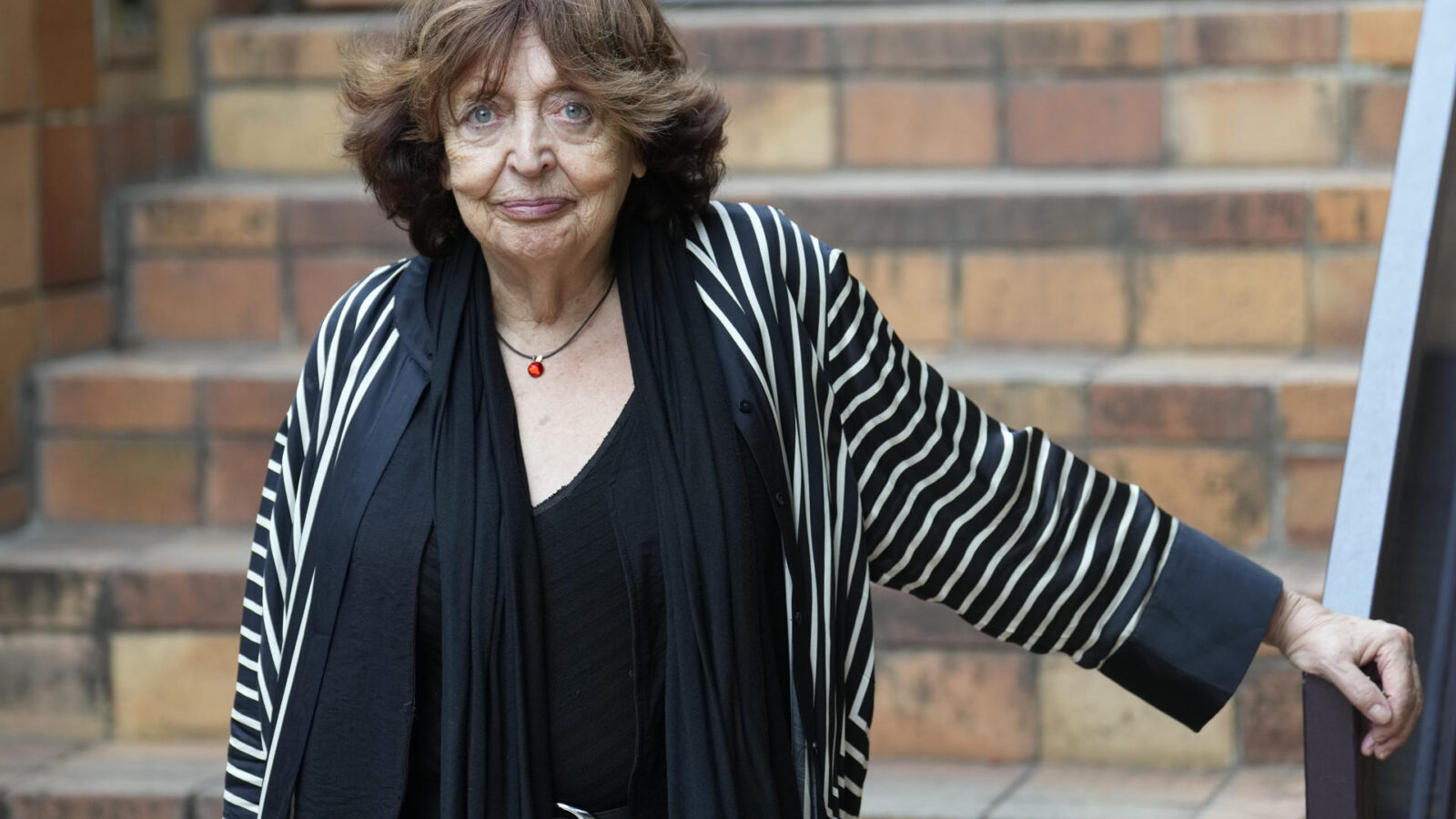
The Catalan writer Cristina Fernández Cubas has been awarded the Cervantes Prize 2026, the highest honor in Spanish-language literature, endowed with 125,000 euros, according to the jury’s decision announced by the Minister of Culture, Ernest Urtasun.
According to the minister, the jury granted the prize to Fernández Cubas for “the originality, the excellence, the coherence of a body of work that has renewed the contemporary short story and transformed Spanish fantasy literature.”
“Her solid career has decisively contributed to revaluing the short story, reaffirming it as an autonomous form capable of achieving the maximum aesthetic and existential intensity,” Urtasun said at a press conference at the Ministry of Culture.
The jury’s decision, the minister continued, emphasizes that her work represents a “fundamental contribution” that establishes the author as “one of the most important figures in Hispanic letters”.
“Far from offering soothing explanations, her stories preserve ambiguity and make imagination a tool for exploring the human experience,” he added.
The decision also highlights how her writing manifests itself in “characters who challenge conventions and established values, opening paths for new generations of storytellers and maintaining a constant dialogue with Latin American works.”
The jury was chaired by the writer Gonzalo Celorio, winner in the previous edition, and included representatives from the Royal Spanish Academy, the Cervantes Institute, the Federation of Associations of Journalists of Spain, and the International Association of Hispanists, among others.
Seventh Woman to Receive the Prize
Fernández Cubas is the seventh woman to win the prize after María Zambrano (1988), the Cuban Dulce María Loynaz (1992), Ana María Matute (2010), the Mexican Elena Poniatowska (2013) and the Uruguayan Ida Vitale (2018) and Cristina Peri Rossi (2021).
The awarded writer also counts other recognitions such as the National Narrative Prize 2016, the Critics’ Prize for The Room of Nona, the National Prize for Spanish Letters 2023, and the Albert Camus Prize 2026.
A writer and journalist born in Arenys de Mar (Barcelona) in 1945, she is regarded as one of Spain’s most prominent authors of short fiction and a master of speculative narrative.
She studied Law and Journalism and worked as a journalist before dedicating herself fully to literature. Over her life she has resided in cities such as Cairo, Lima, Buenos Aires, Berlin, and Paris.
Among her works are the short-story collections My Sister Elba (1980), The Angle of Horror (1990), Poor Relatives of the Devil (2006), The Room of Nona (2015), and What Is Not Seen (2025).
She has also written novels such as The Swing (1995) and a play, Sisters in Blood (1998), among other literary works.
The publisher that prints her books, Tusquets, highlighted in a statement that “since her debut in 1980, she has remained true to her narrative world filled with everyday mysteries that become menacing. The driving force of her writing has been an approach to the unsettling and the mysterious.”
It is reiterated that she is “unanimously regarded as the great author of Spanish storytelling” and that “her work sits in the tradition of Poe, Henry James, Chekhov, Kafka, Borges and Cortázar,” according to the same statement, which also emphasizes that she has known how to renew the fantastic short story in the Spanish language, broadening its thematic horizons.
Tusquets defines her style as “elegant and precise” and notes that “the uncanny, the fantastical, the ambiguity between reality and fiction, the subconscious, childhood, and femininity are the universe in which she has built an unparalleled body of work. Her literary output has influenced new generations of short-story writers.”
The Great Spanish Short-Story Writer
Shaped by the stories the nanny who cared for her at the family home used to tell her and her sisters, the Barcelona-born Cristina Fernández Cubas, Cervantes Prize 2026, is today regarded as the great Spanish short-story writer, a renovator of the genre, an author capable of guiding readers toward unease and disquiet with what remains unseen yet present.
In September of last year, in an interview with EFE about her new short-story collection What Is Not Seen, ten years after The Room of Nona, she did not hide that she feels very comfortable with the short story and that it continues to fascinate her, because she finds it “very mysterious.”
The writer believes that with the short story one can go off the rails, because it is “very tyrannical” and can even decide on its own how it ends; thus, she has confessed, at times it is she herself who gets a jolt at the direction her texts take, some with endings that are even cruel.
Nevertheless, although she has written novels, plays, or a personal memoir, Cosas que ya no existen (Things that No Longer Exist), she continues returning to the short story, with the reader as accomplice, delving into daily life until something disturbing happens that transforms everything, leaving a sense of unease in the air.
Obsessed with the Word
Cristina Fernández Cubas, who has also published as Fernanda Kubbs, is an author obsessed with the word from the very first short story she wrote and finished, The Window of the Garden, included in her first collection of tales, My Sister Elba (1980), in which a family is isolated and communication through language fails.
A journalist in her youth, living in different countries such as Peru, Argentina, or Egypt, she gathered experiences of all sorts, which also helped shape her character.
Film is another passion of hers, and the proof is that many of her stories carry cinematic overtones.
The writer, who never sets pacing guidelines for sitting down to write, also states that to craft her literary devices she can draw on a dream she had in Italian, or fictionalize an event that happened decades ago, or place particular emphasis on how spaces shape human relationships.
The unusual, the imaginary, the fantastic, the ambiguity between reality and fiction, or the subconscious are part of her universe, of an imaginary world in which the psychology of the characters carries significant weight, just as family secrets do.
A reader of Edgar Allan Poe since a young age, when her older brother told her and her sisters The Fall of the House of Usher, with some alterations to the original tale, Cristina Fernández Cubas believes in the relevance of the fantastic short story and its possibilities in a world where nothing is as it seems.