
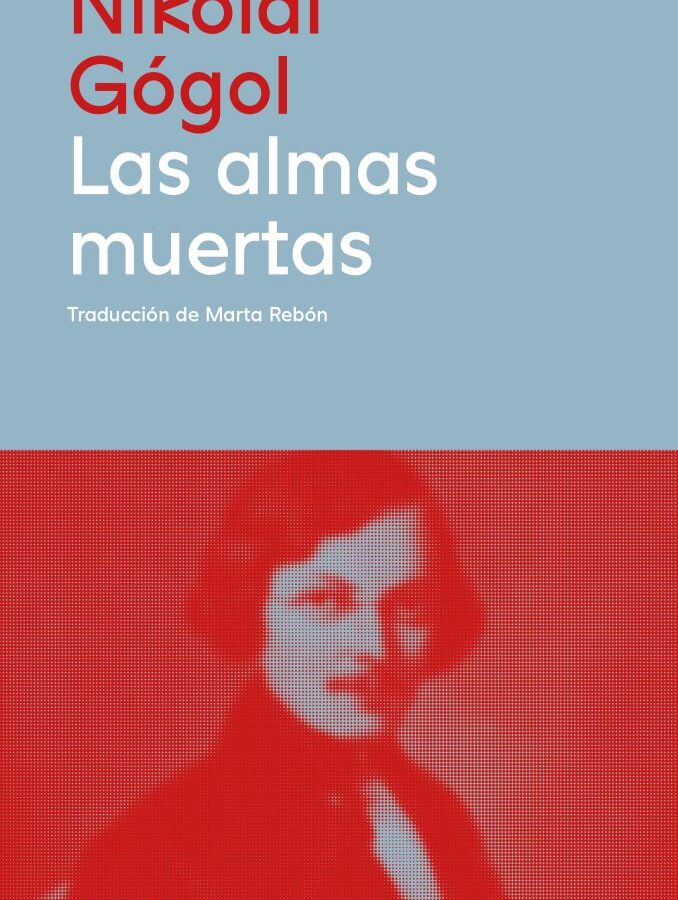
Pavel Ivanovich Chichikov arrives in a town determined to enrich himself by purchasing “dead souls,” serfs who have died but still appear on the census. A masterful satire of Russian society in a new translation by Marta Rebón.
At Zenda we offer the opening pages of Dead Souls (Navona), by Nikolai Gogol.
***
CHAPTER ONE
Through the gate of the provincial capital’s inn in N., arrived a small, handsome carriage with leaf springs, one of those for bachelors: retired lieutenant colonels, second captains, landowners who own a hundred souls of peasants; in short, all those known as men of middle means. In the carriage sat a gentleman who, though not handsome, did not look bad: neither too fat nor too thin; one could not say he was old, but neither very young. His entrance did not cause in the town the slightest stir nor was it accompanied by anything particular; only two mujiks at the tavern door opposite the inn made certain remarks that, otherwise, referred more to the carriage than to the person inside. “Come on! —one told the other— Look at that wheel! What do you say? If it came to it, would that wheel reach Moscow, or wouldn’t it?” “It would reach,” replied the other. “Well, to Kazan, I figure, it won’t reach…” “Kazan won’t reach,” replied the other. And the conversation ended there. And there was more: when the carriage approached the inn, a young man wearing white cut‑off trousers, very tight and short, and a frock coat with fashionable airs, under which a shirt-front fastened with a Tula pin topped by a bronze pistol showed. The youth turned, looked at the carriage, held his cap with one hand, which wind almost snatched away, and continued on his way.
When the carriage entered the courtyard, the gentleman was greeted by the inn’s servant, or boy, as they are called in Russian inns, a man so lively and roguish that it was hard to discern what face he had. Quick and eager, he presented a napkin to the arm, and, all tall and lanky in a long demi‑cotton frock coat with a waistline almost at the nape of the neck, he shook back his hair and promptly escorted the gentleman up the stairs, and through the wooden gallery, to show him the room that God had willed him to receive. The room was the kind one knows, for the inn was the sort that is familiar in provincial capitals; that is, precisely as inns in such towns usually are, where for two rubles a day a traveler is offered a peaceful room, with cockroaches peering out like dried plums in every corner, and a door leading to the adjoining room, always bolted with a chest, where a quiet and tranquil neighbor lodges, though extraordinarily curious, eager to learn every detail of the newcomer’s stay. The façade of the inn matched its interior: it was very long and two stories high. The lower floor remained unenclosed and kept its exposed brick walls, the dark red bricks darkened still further by the abrupt changes of weather, though already quite dirty in themselves. The upper floor was covered in the perpetual yellow paint. On the lower level there were little shops where one could buy halters, ropes, and ring-shaped loaves of bread. In the corner shop—or, better said, in its window—stood a sbiten vendor with a copper‑red samovar and a face as flushed as the samovar itself, so that, from a distance, one might have thought there were two samovars, were it not for the fact that one bore a beard as black as the fish’s.
While the newcomer inspected his room, his luggage was brought in, and first of all a white leather suitcase, somewhat battered, proof that he was not traveling for the first time. The suitcase was brought in by the coachman Selifán, a short man with a sash, and the footman Petrushka, a lad of about thirty, with a thick nose and lips, somewhat stern in appearance, wearing a loose worn frock coat evidently handed down from his master. To the suitcase followed a mahogany box with Karelia birch inlay, a set of boot lasts, and a roasted chicken wrapped in blue paper. When all this was inside, the coachman Selifán went to the stable to attend to the horses, while the footman Petrushka began to settle in the entrance hall, a very dark little room, where he had already managed to drag his cloak and, with it, that distinctive odor of his that clung to the bag brought later with his master’s gear. In this little room he pressed a narrow three‑legged cot against the wall, covering it with a makeshift mattress, as flat and greasy as a blini, and perhaps equally slick, which he had managed to obtain from the innkeeper by sheer persistence.
[…]
—————————————
Author: Nikolai Gogol. Title: Dead Souls. Translation: Marta Rebón. Publisher: Navona. For sale: Todos tus libros.