
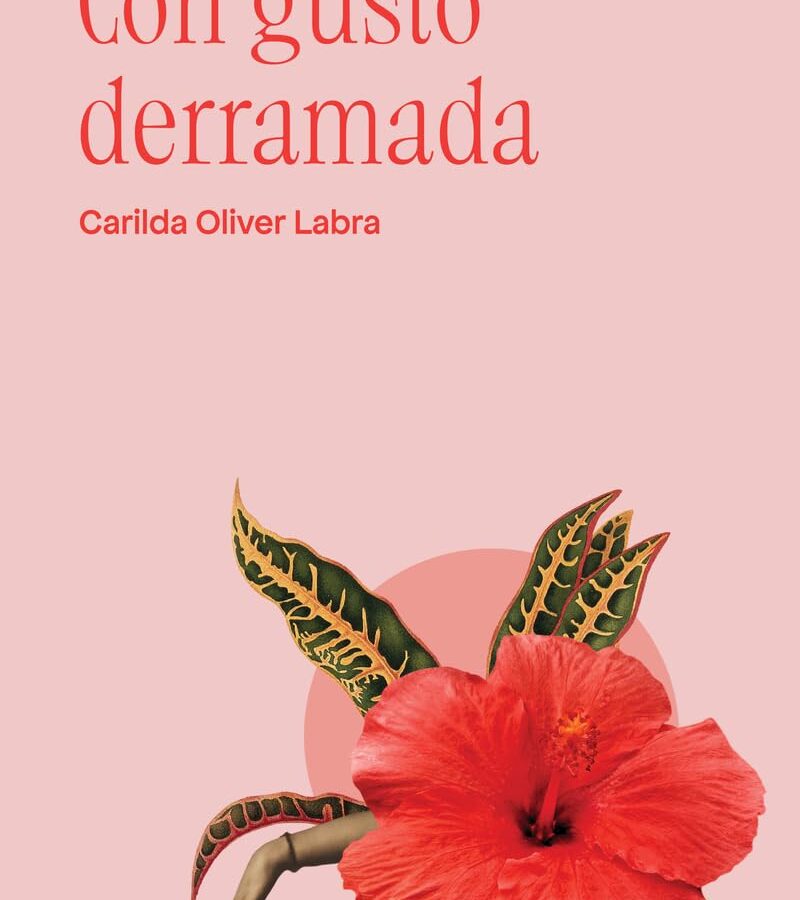
Long before feminine desire could be spoken without asking for permission, Carilda Oliver Labra was already writing from the body. She loved, desired, and turned that experience into unruly, sensuous, and provocative poetry, capable of borrowing the forms of tradition and making them burn from within.
In this making of Bibiana Collado Cabrera, editor of the poetic anthology Con gusto derramada (Rosita y Amparo), she explains how she became acquainted with the work of Carilda Oliver Labra.
***
Twenty years.
Twenty years old, she thought that the University was a chest full of fireworks of knowledge, that its classrooms housed secret colors of intense knowledge, that its corridors would transport me to a world unreachable for me up to then, that the offices hid stimulating promises and intellectual challenges that would tingle my brain with just the thought of them.
Or perhaps I thought all that at eighteen, and by twenty, already in my third year, I began to realize that the fireworks faded, the walls of the classrooms lost their color, the unattainable remained unattainable for people like me, and the offices sometimes concealed sticky and dark traps.
What I remember for sure is that I was twenty when I studied at the Universitat de València, as part of the Hispanic Philology program, that subject on Latin American Literature which opened the door to a series of fascinating authors and steered my academic path forever.
The professor of the course was an Argentine, a full professor, intelligent and daring, ready to strike energetically at the traditional curriculum until a series of incredibly powerful women entered it—women I had never heard mentioned (and I suspect the rest of the class hadn’t either).
She was tremendously captivating when she spoke. Back then I didn’t know it, but now that I am the one who teaches, I have no doubt: to teach is to seduce, to play with desire (to identify it and, even, to invent it). And she achieved with ease something of enormous, revolutionary scope: she recognized us (us, the female students) as desiring subjects.
There were many writers she brought before our bench, a new world of referents to inaugurate, but there is a day I remember with special vividness. She wore a blouse, a black fitted skirt, and dark tights too. She sat atop her desk, legs crossed (it seemed like a scene from a movie) and spoke words that went roughly like this: if you ever have a lover and you write him a letter, finish it with these verses “Ven con tu nuca de infiel, / con tu pedrada. / Júrame que no estoy muerta. / Te prometo, amor mío, la manzana”.
It was the closing of the poem “Discurso de Eva,” written in the sixties by the Cuban Carilda Oliver Labra. I knew very little, if anything, at that time about Caribbean poets and their fierce and dazzling use of eroticism. I quickly looked up the author in the class dossier, underlined the page corner with my pencil, and listened as the professor recited the entire text.
The voice that rose through those verses deseó with vehemence and challenged, provocatively, the object of its desire and itself, aware of the contradictions hidden within its longings. The philology class was predominantly made up of women. We had spent years reading men who wrote about men who desired. We had learned, without anyone telling us, to align our fantasies with theirs. The way we had been taught to desire consisted of letting ourselves be desired. Characters like Cortázar’s La Maga, eternally mythified by our few male classmates and our many male professors, suffocated us without us realizing it.
Facing that legacy, the voice of that professor and the poems of Carilda Oliver Labra proved to be a detonator that blew everything up to rebuild us anew. We too desired, and our desire could be defiant and intense and could generate poetic images of a thunderous beauty.
Her verses have accompanied me ever since. I undertook a research stay in Havana and discovered how fascinating and hugely popular is the figure that surrounds the writer. I drafted a doctoral thesis on poetry written by women in 20th-century Cuba. I became a teacher and read her poems in my classes.
And now I am glad to be able to publish this anthology and bring it to a wider audience.
Do not miss her fierceness and her lucidity. It is worth it, I assure you.
—————————————
Author: Carilda Oliver Labra. Title: Con gusto derramada. Publisher: Rosita y Amparo. Sale: Todos tus libros.
BIO
Carilda Oliver Labra (Matanzas, Cuba, 1922-2018) was one of the great voices of Cuban poetry in the twentieth century. A lawyer, a poet, and a fiercely free woman, she made her life and her writing into a single terrain of insubordination. Love, the body, solitude, death, and desire run through a work of extraordinary verbal intensity, in which lyrical tradition coexists with a challenging sensuality. Author of Al sur de mi garganta and Memoria de la fiebre, among many other poetry collections, she received the Cuban National Literature Prize in 1997.