
The first morning of class I used to give a test. Short answers. Invitations to improvise thoughts. I grew fond of a question. “What is a weather vane for?” There was a preface: “We all know it is to point out the direction of the wind. But which direction?” I recall some answers. “The good one.” “The one that helps.” Others, as meticulous as my question: “It’s worth clarifying: it marks the sense more than the direction.” And yet, the solution was and is only this: “It points to where the wind comes from, not to where it is going.”
Another crucial question of those days: “Is the straight line always the shortest path?” Any member of the diplomatic corps or those slippery forwards in football or sellers of anything could confirm it without trouble. Going around, making a few zigzags, not going stubbornly straight to the point, saves time and sometimes even space.
The father of Doña Tere, the mistress of Alfanhuí, undertook a journey without bending or deviating at all and carved a furrow across the surface of the Iberian Peninsula. He told it Rafael Sánchez Ferlosio (Rome, 1927-Madrid, 2019) in his first book. Purely didactic zeal leads us to leaf through from Industrias y andanzas de Alfanhuí (1951) that episode. An attractive theory allows one to play at stripping from complete writings fragments with substance. Lauro Zavala has authorized with his judgment to share that opinion: the fragments — converted into micro-stories, in revealing proofs of DNA: a valuable drop condenses a map — can be read as nearly complete works. Similar to what had already happened in the Castilian balladry.
Although, of course, what some regard as indispensable is missing: “the awareness of literary genre,” the intention. Jesús G. Maestro has once again made this clear, forcefully: “Literary genres will be the different sets of common characteristics that can be identified according to gnoseological criteria, that is, materially and formally, among the various parts or species that constitute the totality of works recognized as such.” To identify oneself. Was there, specifically, in the early fifties of the twentieth century, a recognition of a very short narrative like the micro-story with its peculiar traits?
Sánchez Ferlosio was always ahead. While this character of his moved along, from east to west, a long stretch — perhaps almost five hundred kilometers straightened out — the young Ferlosio anticipated what, a decade and a half later, in Literature would be called the “boom hispanoamericano,” that is, the explosion of the stubborn, dull reality, the eruption that left the novel asleep in the ordinary and the vulgar repetition in ruins.
In that paragraph I excerpt from the novel, perennial themes of letters become evident. The theme of travel is the most visible. But with a singularity: it is not a journey undertaken, because the father of Doña Tere travels while he sleeps. It is a kind of involuntary journey, and outside the majority’s conventional logic.
The dream, the act of sleeping, is another of the themes. But here it is shown very closely tied to waking. An ending that does not always resolve itself in certain literary devices. Or as often happens in those easy tales that end with the abrupt line “… and then he woke up.” The act of sleeping by that farmer has a great particularity: it suspends the character’s consciousness and allows the world to go on without him. Without me there is life. I am not so indispensable. In the etymology of indispensable lies precisely the idea of splitting, of cutting. Look where. And the where of the sea acts here as a kind of return to reality. Or as a border of another limit.
And in that stubborn furrow there is room left for fate. For in that grand straight line of persevering earth, a fatalist dimension opens. The farmer does not decide anything: events lead him to the edge of the ocean, and afterwards he returns to his land and his origin. To die.
Because death is not absent. The fact that this man makes a will and dies on the very same day would lead some to suppose that all that unchanging journey had been a kind of final prelude to the certainty of death. A sober death, in this case. Almost Quixotic. Or some will hear the evangelical echoes of the Nazarene’s voice: he who grips the plow’s handle yet looks back is not worthy of knowing the Kingdom. Because not only will the furrow twist. Trust will be diverted. It requires a full commitment. Trust. And Doña Tere’s father is one of those. The sort who are of one piece.
Rural life is blurred today. The mistress refers to a time wholly linked to the peasant world: the farmer, the lands, the oxen, the plow, the yoke, the fields. The inventive twenty-something Ferlosio began from a rural universe recognizable enough to sow in those circumstances what makes being alive a marvelous surprise. But it is not only the countryside and the land. A cherrywood chair suffers from a “weariness illness” and it infects the woman who sits upon it. In the attic, resting on a constant puddle of drips and dust from eroded tiles, she gives cherries and Alfanhuí remains asleep in it. That has been happening in Alfanhuí for three quarters of a century. An absolutely impossible fact is told with a calm, tempered, sure language. With a condensation that does not describe landscapes or emotions or conversations. Nor dreams. Without saying that that display of geometry is impossible nor explaining why the oxen manage to cover such distance with the sleeping man. And with that enigmatic phrase: “No one dared to wake him.” Nor to stop the oxen.
No, it wasn’t a microrrelato comme il faut, as they say, but it is.
I dared to reproduce this fragment in no. 577-578, July-August 2002 of the magazine Nuestro Tiempo. A scholar like Professor Miguel Díez R. adds two other marvelous gears to the mechanism of the game that the book Alfanhuí keeps offering. One feels supported.
***
A Fragment of ALFANHUÍ
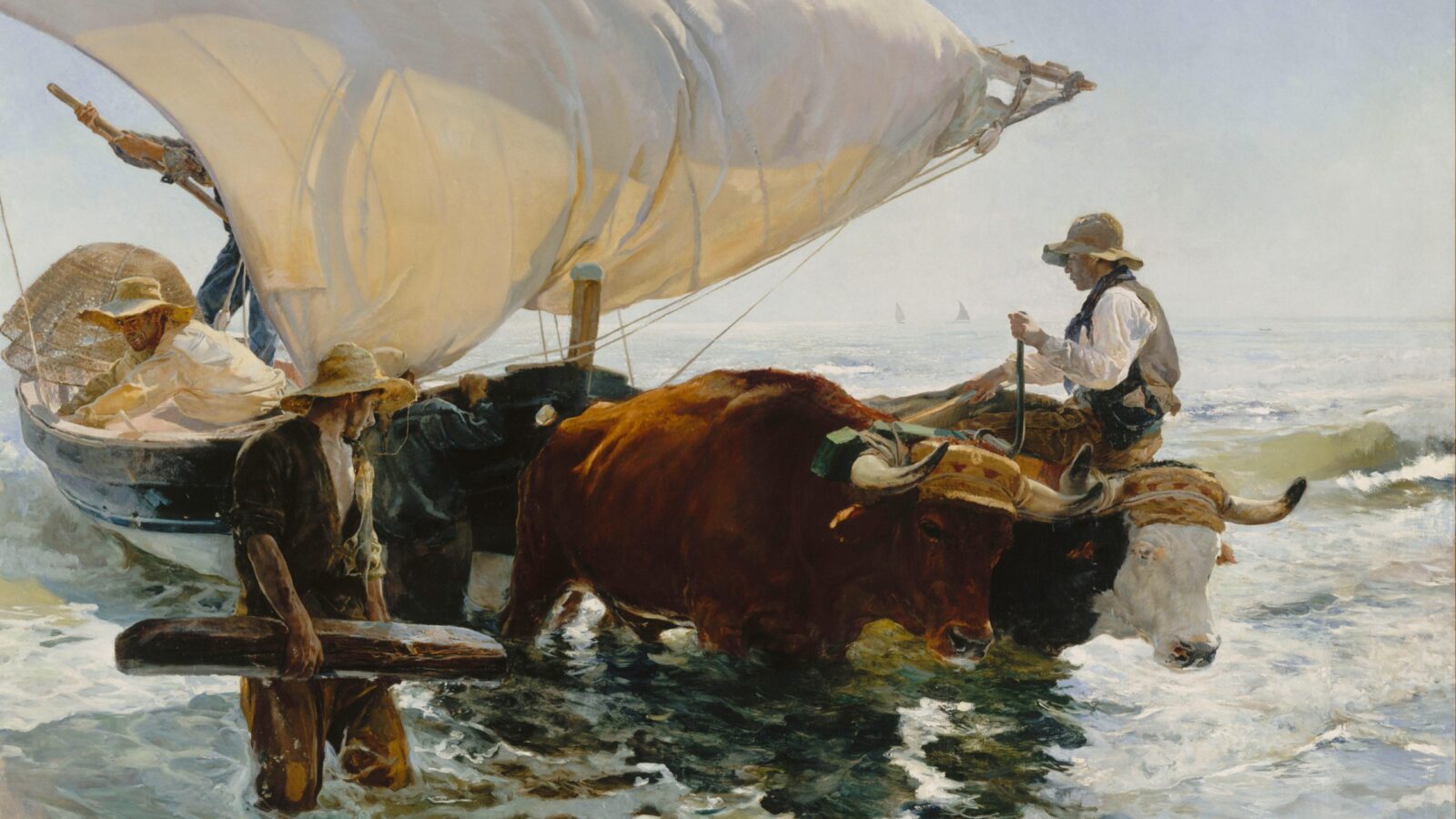
The mistress also told the story of her father. They were from Cuenca. There she had met her husband. Her father was a farmer and owned some lands. One afternoon he fell asleep plowing with the oxen. And since the plow did not return, the oxen kept going and moved out of the field. The man kept plowing, with his hands on the yoke. They were moving toward the West. They did not stop at night either. They passed fords and mountains without the man waking. They went all the way along the Tagus and reached Portugal. The man did not wake. Some people saw this man passing by, plowing with his oxen a single furrow, long and straight, along the mountains, through the rivers. No one dared to wake him. One morning he reached the sea. He crossed the beach; the oxen entered the sea. They broke the waves against their chests. The man felt the water in his belly and woke up. He stopped the oxen and ceased plowing. In a nearby town he asked where he was and sold his oxen and the plow. Then he took the money and, along the same furrow he had made, returned to his homeland. On that very day he made his will and died surrounded by all his kin.
—————————
In Industrias y andanzas de Alfanhuí (1951) and in Rafael Sánchez Ferlosio, Industrias y andanzas de Alfanhuí. Comentado por Danilo Manera. Epílogo de Manuel Sánchez Sacristán, Barcelona, Destino, 1996.