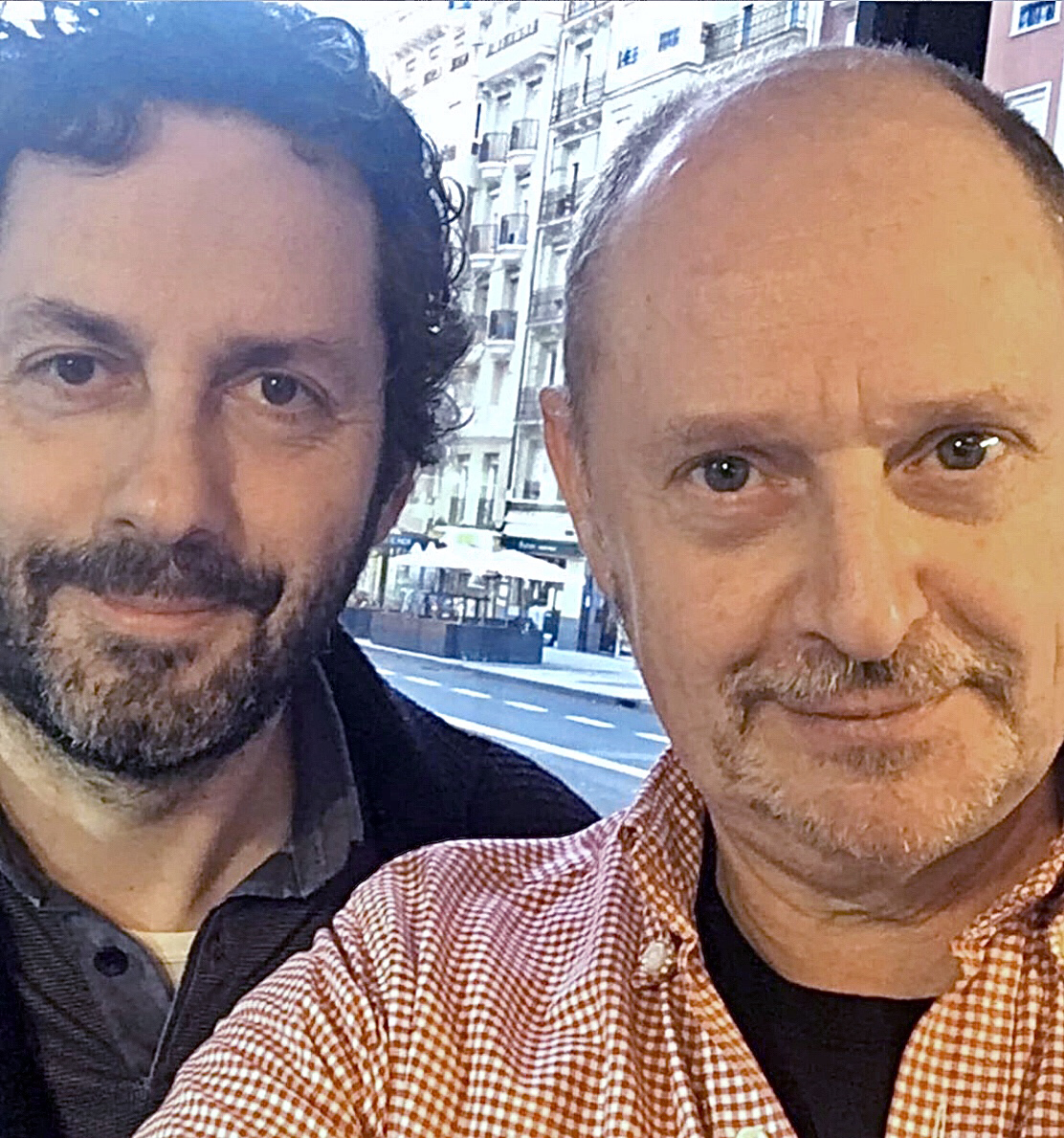
Fernando Marías, the origin
On the night of May 30, 2017 I heard Fernando Marías tell an extraordinary story in a basement in La Latina, a vaulted and shadowy space with exposed brick walls, an old 17th‑century coal yard. Before a small, expectant audience, it felt clandestine, and he detailed the vicissitudes that his short novel “This Night I Will Die” had endured, its scant sales, and its mysterious disappearance from bookstores in a short period of time. A cursed book, unfindable. He attributed it, without a doubt, to exposing the way the Corporation behaved.
His account moved us, and when it ended I approached him, we hardly knew each other back then. He seemed uneasy; in the shadows he kept glancing toward the doorway, as if he were being watched. I cannot reveal what we spoke about that early morning, for I too would be in danger, but from then on we shared in secret snippets of press about artworks that appeared in storage rooms, old bookstores, attics, or abandoned monasteries. I urged him to publish the full story, but he refused; he had done enough, so I asked for permission to be the one to share it. He gave it, though not without warning me about the place I was venturing into. Other authors had tried before him, but they had only uncovered fragments of the truth [2].
***
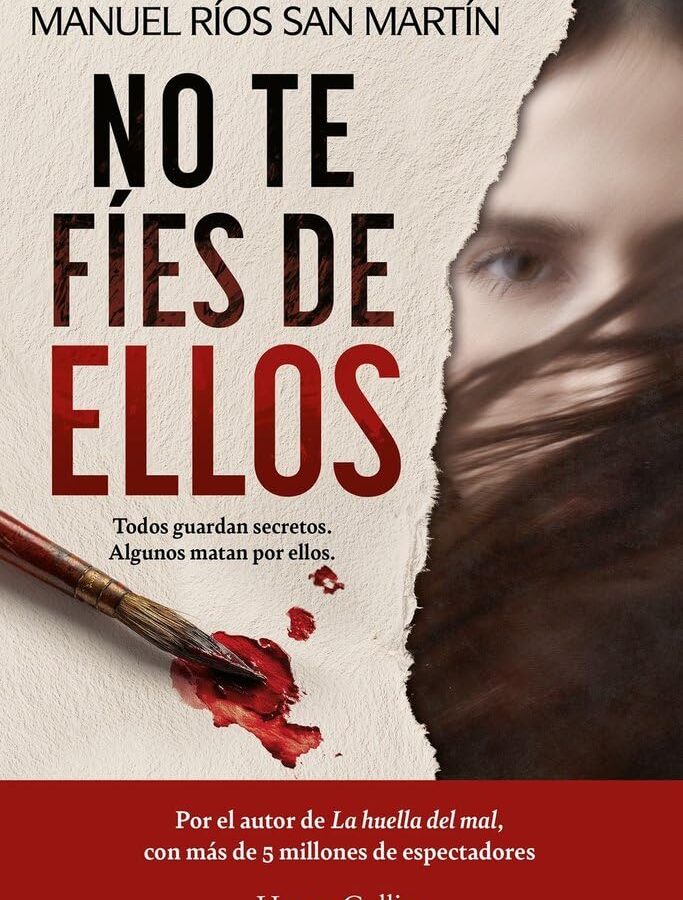
This is an excerpt from my novel No te fíes de ellos, which I have just published with HarperCollins.
What I recount in the preceding paragraph is embellished, but it remains fairly faithful to what happened. Fernando Marías and I had met at the 2017 Valencia Noir festival. I had attended my first festival with my debut novel,
Círculos
, and I shared a table with authors Agustín Martínez (Carmen Mola) and Javier Castillo. Everything felt new and exciting to me.
Fernando welcomed me as he used to welcome everyone, with a kindness and enthusiasm that made you feel important.
We dined, talked about a thousand topics, and ended the night at the show he organized with the poet and writer Raquel Lanseros, if I recall correctly.
To him, Círculos stood out because it did not respect the conventions of traditional crime fiction, and I explained that at the time I was not a reader of that genre and did not know the codes well. From the very first meeting we understood each other, and he offered to present it at that year’s Celsius festival. I also met Rosa Masip, with whom Fernando organized various cultural activities and with whom I later collaborated as well.
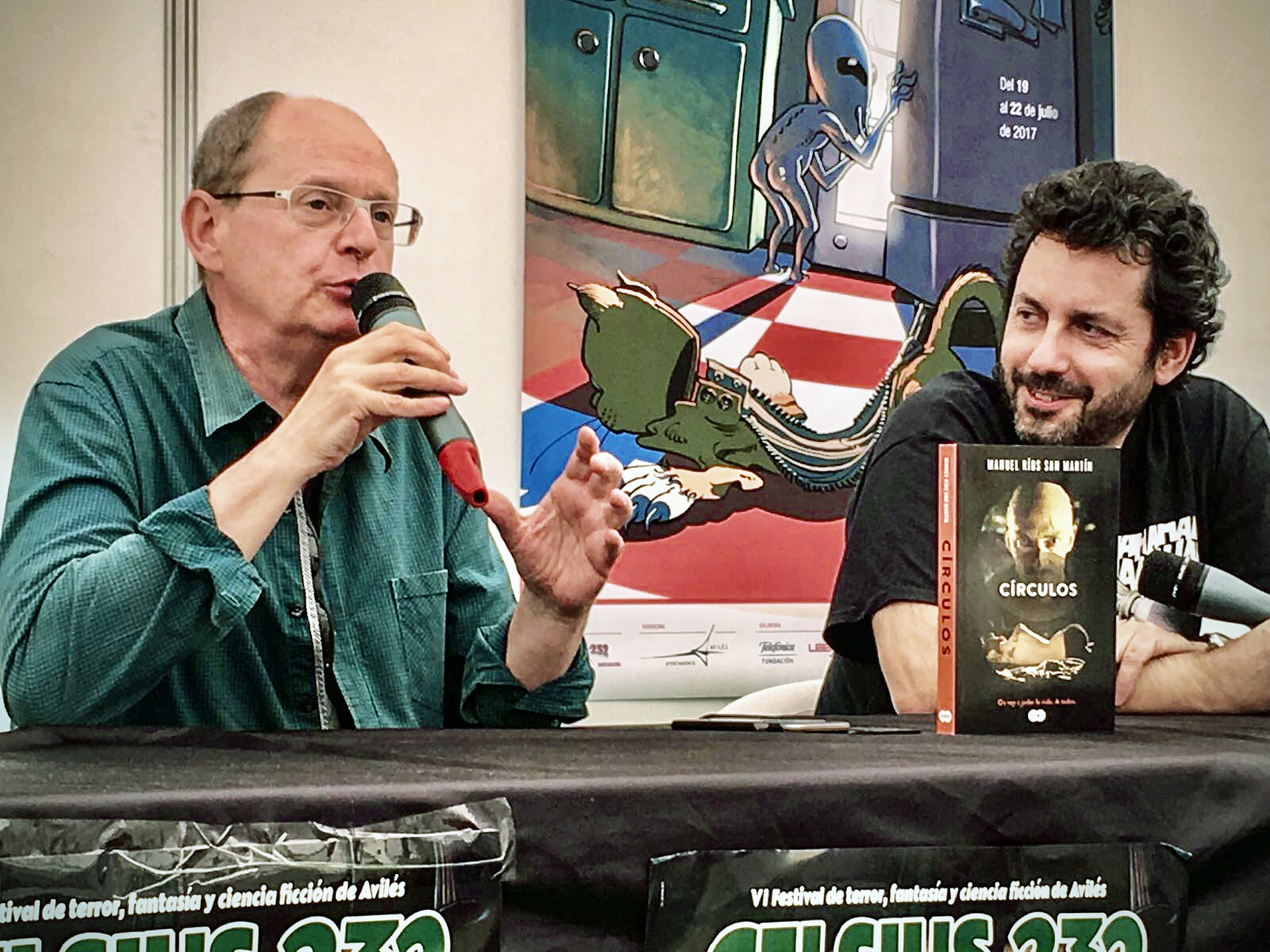
At the Celsius festival. Photo by Rosa Masip.
From there we spoke often, crafting various collaborations, some ideas for television series, and a thematic trip through Atapuerca based on my second novel, The Footprint of Evil, which stalled due to the pandemic.
But back to that night when I saw him on stage, reciting the monologue based on his short novel This Night I Will Die. I had already read it, and that story about a sophisticated and nearly impossible revenge had unsettled me. On stage, the tale gained even more power: the blend of reality and fiction, which Fernando handled so well, was fascinating, and that clandestine organization that was threatening him for revealing its secrets and that could end his life at any moment.
I began working on an initial outline of the project with screenwriter Mónica Martín-Grande. We presented it, and she liked it a lot. But then I got caught up in writing another novel, perhaps a TV series, and the concept languished in a drawer. I still kept meeting Fernando from time to time, some joint conversations at the University, coffees in my neighborhood and his, and numerous collaboration ideas that never came to fruition, because he died in February 2022.
Like all friends and family, his sudden disappearance affected us deeply, especially after publishing Burn This Book, a intimate reflection on his relationship marked by alcoholism in the 1980s and 1990s.
Some time passed, another novel, The Scent of Fear, and the adaptation into a feature film of The Footprint of Evil, which delayed my literary activity for more than a year. And when I contemplated my next book, I pulled from the drawer those notes based on the Corporation.
So I decided that the reader would delve into the mystery as they turned the pages.
What No te fíes de ellos is about
(Editorial synopsis)
In the Prado Museum’s iconic restoration workshops, Irene Llamas, a young and brilliant director, faces the greatest test of her career: authenticating an unpublished painting in the 2nd and 3rd of May series by Goya. What she doesn’t imagine is that she’s about to uncover a disturbing secret that could shake the world of international art… if she chooses to reveal it.
A few hours later, Emcy, the world’s pop star, is murdered backstage at his much-anticipated mega concert. Lola Baltanás, a detective with caustic humor and unfailing instinct, leads the case and suspects that beneath what appears to be a crime of passion lie motives far darker and more dangerous.
Two cases with no obvious connection. Two women willing to risk their lives to uncover a web of conspiracies, manipulation, and power struggles. One way out: do not trust anyone.
Before diving into the development, I shared a coffee with Espido Freire to tell her my intention and exchange viewpoints on Fernando’s work. From that meeting, we’ve been sending each other articles about artworks that surface without a clear explanation.
For the plot around the Goya’s appearance at the Prado, I needed extensive and precise documentation. I’m fortunate that my wife, Susana Pérez, is the restoration director at the Thyssen-Bornemisza Museum, which helped me detail the technical processes required to authenticate a work (chemical analysis, ultraviolet light and raking light, X-rays, etc.).
But I needed to adapt them to Goya’s specific case and to the series of paintings on May 2nd and 3rd. For this, I counted on the collaboration of restorer Almudena Sánchez and, above all, Laura Alba, the X-ray expert at the Prado. Thanks to her I could learn about the analyses that had been performed on existing works and thus tailor my story to the notion of examining a supposed third painting belonging to the series within the museum. Discovering secrets through X-rays, learning about the pigments used by the master, his method of preparing canvases and applying brushstrokes was an exciting process. But perhaps what surprised me most was Aracne, a software program developed by Laura together with engineer Juan José Murillo that analyzes the vertical thread pattern of fabrics and provides information as relevant as whether two paintings unequivocally belonged to the same canvas cut in half, something I used in the plot.
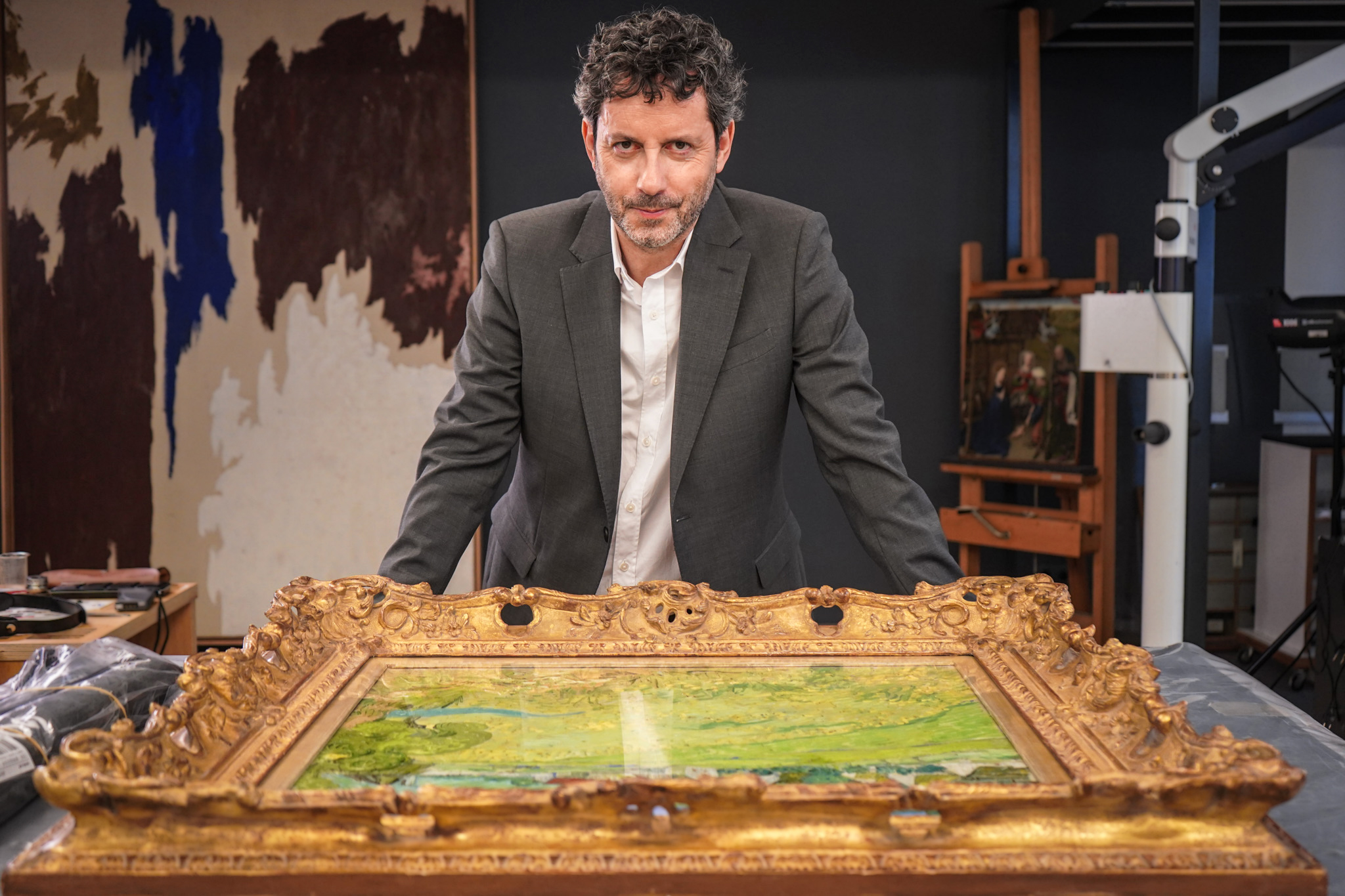
In the Thyssen-Bornemisza Museum restoration workshop @danielrios
Also essential were my conversations with Gudrun Maurer, the Goya expert, about the artist’s personality, far removed from the image of a madman painting possessed.
The documentation wasn’t limited to these technical processes; it also covered the multitude of works of all kinds that have appeared in unsettling ways or have been stolen throughout history, and not only paintings: Leonardo da Vinci’s Salvator Mundi, the most expensive painting ever sold; Raphael Sanzio’s Portrait of a Young Man, stolen by the Nazis during the Polish occupation and still missing; Caravaggio’s Ecce Homo, which currently hangs in the Prado and about which an interesting documentary has been made. There was also a new Jim Morrison song found more than fifty years after his strange death at twenty-seven (the same age as other artists like Jimi Hendrix, Janis Joplin, Kurt Cobain, Amy Winehouse, or Basquiat) or Kafka’s unpublished manuscripts…
The novel fantasizes about other works that might exist, such as Mozart’s Requiem, known to us in an unfinished form due to the author’s death, in a complete version, or Velázquez’s La expulsión de los moriscos, burned in the fire of the Real Alcázar of Madrid in the eighteenth century.
To understand how the Corporation operates I needed to add a current case: I focused it on the murder of the pop star Emcy, a stand‑in for Miley Cyrus. This would demonstrate that the secret organization remains active in the present.
All of this with a conspiratorial backdrop, a reality that has a constant presence on social networks. Many of the examples we encounter are absurd, such as flat-Earth theories and vaccines that implant chips; others include serious political manipulation, like fake videos about immigration that fuel xenophobia. When a person accepts these distorted facts, it’s as if they fall down the rabbit hole of Alice in Wonderland: from that point on they will believe any news proposed by that power group with interests not always obvious.
In that breeding ground lie hidden other plots that are true and that we know little about, such as Epstein’s papers or foreign powers’ interventions in various electoral processes. But surely there are more that never come to light, tangled by so many fake news.
One of my goals with the novel was to maintain that game of reality blended with fiction that Fernando loved so much, and it has led me to wink at the character of the disgraced minister, Max Utiel, who suspiciously resembles my dear Máximo Huerta (with his proper authorization).
All that remains is to invite readers to continue the investigation themselves, and to send me the articles they find about works that appeared mysteriously. But I must remind them to be careful. We are being watched.
The only regret I’m left with is not being able to see Fernando enjoy this game.
And as he used to say: if something happens to me, if I die tonight, you all, every one of you, will have the definitive proof that the Corporation exists.
Madrid, now 2026.
***
[1] Alrevés Editorial (1996).
[2] Secret History of the Corporation, tales by Elia Barceló, Fernando Marías, Juan Bas, Constantino Bértolo, Vicente Luis Mora, Marta Rivera de la Cruz, Lorenzo Silva, and José Carlos Somoza, 451 Editores (2008).
————————
Author: Manuel Ríos San Martín. Title: No te fíes de ellos. Publisher: HarperCollins. Sales: Todos tus libros.