
He died on October 7, 1849, two days after being found lunatic in the streets of Baltimore. And today marks 177 years since Edgar Allan Poe went to meet his beautiful dead. All lovers of the fear tale, of somber literature, should pay him tribute. Months earlier, the memory of his wife, the sweet Virginia Clemm, who died in 1847 of tuberculosis, had inspired Annabel Lee, his last great poem.
The Dead, the dead beautiful women in the splendor of their beauty, had been his literary material since he fell hopelessly in love with the mother of a schoolmate, Jane Stith Stanard, who welcomed him with such kindness that the young Edgar made her his muse, his first idea of lost love. After her death, due to a tumor—or meningitis—Jane died barely 31 springs; a teenage Poe, as night fell, frequented her tomb.
To her he dedicated the famous poem “
To Helen”
.
Nor is there any doubt that the image he kept of his mother, Elizabeth Eliza Arnold Poe, an English actress renowned for her beauty —as were actresses of old—, was a decisive factor in shaping the universe of the future writer: he was only two springs old when tuberculosis —the most literary of all illnesses— took Eliza. It is hard to remember what was seen at such an early age. But there is evidence that the Master did: the scene of his mother spitting blood and dying slowly in the foul room of a shabby pension was Poe’s first and deepest trauma, marking his ideal of beauty.
Needless to say, the relationship between Edgar Allan and his adoptive father (John Allan) was fraught. Yet his stepmother, Frances Keeling Allan, gave him sincere maternal affection. The tuberculosis, the cursed tuberculosis that carried off those who inspired him in one way or another, ended Frances’s days while Poe was in the army. He arrived too late in Richmond for the farewell. He could not go to her tomb to read him the proper verses in the shadows.
And Virginia Clemm, his beloved wife. In 1842, while singing and playing the piano, Virginia burst a blood vessel in her throat: a sign of the onset of a five-year decline. The Master endured that protracted deterioration, immersed in despair and alcoholism; his death destroyed him emotionally and accelerated his own decline until his death, under strange circumstances, on a gray day like the one 177 years ago. A gray day but not ill-omened: that seventh of October was the day when, after so much suffering, Edgar Allan Poe was finally granted the reunion with the absent women who illuminated his disaster-stricken existence.
All of them shared characteristics that the Master would idealize: they were young, fragile, of sickly beauty, and, as they began their journey, they left in him such abandonment that the great Edgar made biological deterioration a literary myth.
Translated by Baudelaire — who, according to T. S. Eliot, removed from his versions any archaisms that hindered the originals —, by Mallarmé and Cortázar — to whom one of his finest biographical notes is owed; admired by Jules Verne — who dedicated The Sphinx of Ice (1897), a continuation of The Adventures of Arthur Gordon Pyn (1838) — and placed by Pablo Neruda in his “matemática tinieblas,” Edgar Allan Poe was the first universal writer produced by the United States, although he achieved this after his exaltation in France. As the years wore on and the French validation arrived, something very similar to jazz would come to claim a cultural identity for him, and to the great craftsmen of classic Hollywood to rise to the stature of filmmakers.
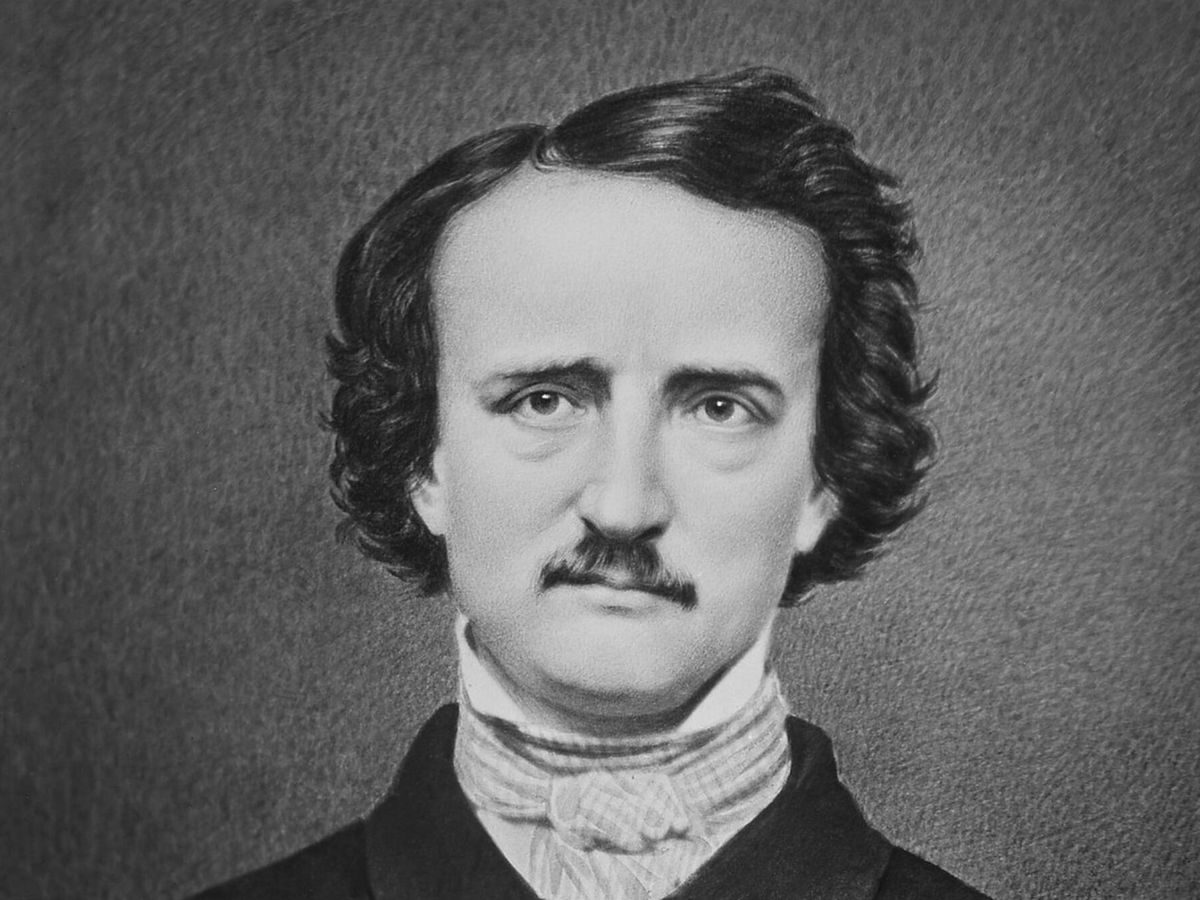
But Edgar Allan Poe was also the first damned one of American letters. He was so because of the Grim Reaper, which, like it did to Mary Shelley, had hovered since childhood around the ones he loved most; he was that intellect of the alienated, that other self that inhabited him, constantly pushing him against himself. He was also the first heterodox against the Puritanism dominating the pages that formed that golden age of American literature from Nathaniel Hawthorne to Ralph Waldo Emerson, whom he despised. He was, in short, the first madman: he drank to delirium, he smoked opium… It is not surprising, then, that all those mists seem to weigh upon him in that daguerreotype of his, taken by W. Hartshorn, the best-known image of the Master that has come down to us.
Now, however, his calvary, his disorders and his dissipations did not prevent him from being the author who carried Romantic poetry into new directions. That said, his great transport was the one he promoted in the horror tale, which removed it from Gothic settings that served as a backdrop for doomed souls and the Papist villains of Radcliffe and Lewis, to place it in a materialist backdrop.
Also perhaps a case like the one in The Pit and the Pendulum (1842), whose protagonist is subjected to a torment—in Toledo of the Inquisition, of course—consisting of waiting for death while an enormous blade — the pendulum — descends, gradually and inexorably, toward him.
That verisimilitude, that mathematical exactness in his proposals for fright — which would also extend to that deductive method by which he wrote his most famous poem, The Raven (1845) — is what led Pablo Neruda to place Edgar Allan Poe in his “matemática tinieblas”.
“The analytical faculties are, for one who possesses them to a degree of extraordinariness, a source of the most vivid pleasures — he noted, referring to the crushing logic of his horror—… The results, deftly deduced by the soul, and the essence of his method, truly present the character of an intuition.”
“Deity and reference” of all diabolical fiction, according to H. P. Lovecraft, posterity would not venerate Poe for his humorous tales, a genre he cultivated with the same frequency as his extraordinary stories, but for his most macabre creations.
All signs point to the idea that the latter protagonists were nothing more than projections of the psychic imbalances that the Master suffered throughout his life. Few works reveal the psychology of their authors as clearly as Poe’s. The writer is the Roderick Usher of The Fall of the House of Usher (1839), that priceless metaphor for the sinking of an intelligence.
Needless to say, those beautiful dead women who inspired him so much —“I have only managed to love where death mingled its breath with beauty,” he writes in one of his poems— are the direct consequence of the premature death of the woman who brought him into the world. It would also prove premature the death of his young wife. All the women he loved died, just as the protagonists of Ligeia (1838), The Oval Portrait (1842) and Morella (1850) will die.
Aside from fiction, in his Philosophy of Composition (1846), one of his most influential essays, he maintains: “Of all the sad themes, which, in the general concept of humanity, is the saddest? The answer is obvious: death. And when is it more poetic the saddest of themes? When it is allied with beauty. Therefore, the death of a beautiful woman is, without doubt, the most poetic theme that can occur in the world.”
Pouché to Boston on January 19, 1809, misfortune turned him into the Southern man he claimed to be in the lies about his person, which he invariably foisted on those who had the immense luck to hear him. He must have been as loquacious as all drinkers.
Son of itinerant actors, he was left an orphan at just two years old. While some biographers insist that his father did not die but left him to turn to drink after the mother’s death, that frail Englishwoman who bore him on a tour.
What is certain is that little Edgar Allan was raised by his uncle John Allan, a tobacco merchant in Virginia. That he took his second name from this relative and acquired along with him that Southern air mentioned above does not mean that he found happiness at home. Quite the contrary, the tortuous relationship with his stepfather also contributed decisively to the psychic imbalances that weighed on the great Edgar Allan until his death.
Expelled from the University of Virginia (1827) for his dissolute habits, the writer proved to be a precocious disciple of Byron with the publication of his early verses: Tamerlane and Other Poems (1827). While he continued cultivating lyric poetry — for some of his biographers he is mainly a poet — in search of an ethereal beauty in titles such as Al Aaraaf (1829), he entered the military academy at West Point for a romantic halo. But the army would dispatch him with the same diligence as the cloister of professors. He was expelled from the cradle of heroes — as the Spanish translators of John Ford’s film called him — in 1830. The circumstances were very similar to those that forced him to leave the university.
Hardly had he lost the army to which he would surely have been a poor officer, when Poe’s pen revealed a great journalist and a storyteller without equal who would already be admired by his time. His first piece — Metzengerstein — appeared in 1832. This would be followed by A Manuscript Found in a Bottle (1833) and The King Pest (1835).
Always underpaid, in 1835 he would become the editor of the Southern Literary Messenger of Richmond, which would become the most important literary publication in the entire American South. Also in 1835 he published Berenice. In this extraordinary tale — Odd Tales would be the title under which he would gather his most celebrated stories in 1847 — his interest in surpassing the conventions of the Gothic novel with what some very wise person — we could not quite determine who — called “materialist terror,” the plausible rather than the beings of fable. Berenice is the cousin he intends to marry; Egaeus, the narrator, is her destined suitor. She is afflicted with a degenerative disease — one of those captivating degenerative diseases that traverse Poe’s entire body of work; he, her first monomaniac, as will be the protagonists of The Oval Portrait, The Black Cat (1843) or The Tell-Tale Heart (also 1843). The evil that Berenice seems to bring to life seems to corrode almost his entire body except the teeth. Poe lets us understand that Egaeus tears them out to pay them proper homage, before burying her alive. The horror, as you can see, is feasible, albeit set against a backdrop as Gothic as some tombs. In Robert Louis Stevenson’s view, expressed in his Literary Essays, Berenice is a story “terrible, tugging at the heart, a string perhaps better left untouched.”
Already in 1836, Edgar Allan Poe marries his cousin, Virginia Clemm, who had not yet turned fourteen. Indeed, as Machado, he would have been a pedophile by today’s standards. One may say in his defense that his love was as fleeting as it was sincere. Given that his calvary inspires us with the same sympathy as we reject the regenerationist efforts of the blessed Antonio Machado, in our view Poe’s pedophilia does not contaminate his work.
Nor does it do so for the anachronism of The Pit and the Pendulum, where his protagonist is freed from torture by the Napoleonic forces; it is known that the French invasion dates to 1808 and that the Inquisition ceased to operate in Toledo in 1600.
As we have seen, if Neruda places the American in a “matemática tinieblas,” it is because the horrors Poe presents obey a logic as exact as an addition or subtraction. Take, for example, the famous appearance of the ghost ship in The Adventures of Arthur Gordon Pym — Poe’s only novel — where a voyage without return to Antarctica is narrated: the lookout who seems to smile from such a terrifying vessel, though in the tale he plays the role of a specter, is but a corpse whose face has been half eaten by carrion birds, disfigured in that awful grimace that resembles a smile.
Although in Ligeia, Rowena, the narrator’s second wife, ends up becoming Ligeia, his first wife, Poe’s chill does not arise from fantastical or fictitious matters: the undead, the tormented by the Inquisition and the dead while sleep in a hypnotic slumber, his protagonists are all subjected to plausible horrors. When not, to psychological terrors of the monomaniacs. Here there are no bloodstained nuns with souls in torment — as suggestive as they are — as in Mathew G. Lewis’s pages.
It should be stressed that Poe’s three analytical tales, i.e., those featuring the chevalier Auguste Dupin — The Murders in the Rue Morgue (1841), The Mystery of Marie Rogêt (1842) and The Purloined Letter (1845) — set in motion something as logical as the detective story. Perhaps that tireless search for verisimilitude in his proposals was due to the fact that when he began to cultivate the short pieces, they were conceived for the demonstration of a science. That could be the reason for The Truth About the Case of Mr. Valdemar, conceived to demonstrate the effects of mesmerism, at the time the subject of a genuine debate.
But the origin of such celebrated text, considered one of the most disturbing tales of all time, Lovecraft’s favorite, a true pillar of the genre and other glories of the same sort, could also lie in the tuberculosis that relentlessly consumed Virginia Clemm. If anything, Poe was more egotistical than the rest of the writers. One way or another, he always spoke of himself. Perhaps conscious of his imbalances, his faith in reason was absolute, just as his contempt for ordinary emotions and easy feelings.
Although his activity as a journalist and a short-story writer brought him glory in life, the Master always stood at the edge of the abyss. His constant depressions dragged him into alcohol and opium. In the end, both substances only worsened his melancholy. Yet, if there is something that characterizes his literary criticism, his narratives and his poems, it is/shows his insight. From which follows that Edgar Allan Poe suffered as much as all those who enjoy moments of lucidity alternated with delirium.
“The curse of certain spirits lies in not being satisfied with their capacity to carry out a work — the author himself explains in Marginalia (1844-1849) —. They are not even content when they have already executed it. They must show others the optimal results achieved.”
We would like to believe with Rafael Llopis, one of the great Spanish-language translators of the fear tale, that when he was found delirious to the point of delirium, he had just received one of those thrashings civilians give to drinkers in taverns when their loquacity becomes verbiage. If that were true, Poe would have already poured out his last drink and would have been in a “back alley with no way out”.
Everything is conjecture regarding the Master’s death. In one of the last letters sent to Maria Clemm — his mother-in-law and aunt — he confesses to having suffered delirium tremens. Since this is the only withdrawal syndrome that can be mortal, there are those who think it was what carried Poe to the grave. Be that as it may, he could not clarify the causes of his death. He was found delirious and never recovered his reason to explain what had happened. The forensic certificate has been lost. Thus the history is written.