

Eduardo Jordá (Palma de Mallorca, 1956) has written a book about Bob Dylan. Number Zero. Bob Dylan: Portrait of an Invisible Man (Libros del Asteroide, 2026) adds to the, according to a specialized bibliography, 1910 volumes that have been written with “Dylan-related” themes. This narrator, poet, translator and professor of Creative Writing has approached a monster of creation —perhaps of Creation?— because he believes that in his work, as he tells Zenda, “one can discover how human creativity works.” “Like Homer —he writes—, like Shakespeare, like Emily Dickinson, like Emily Brontë, like John Ford, Bob Dylan will always be an enigma. His music is as grand, as powerful, as vast as America, and the man behind it, the human being who created it, is a speck of dust lost on a train track. No matter how much we search, we will never find him.” We spoke from admiration, far from the Dylanologists… and from the pallid detractors.
*****
—Mr. Jordá, why do you like Bob Dylan?
—Why do you like living? (Laughs) I don’t know how I can answer that question! Let me start by saying, first, I’m not an unconditional fan, I’m not a Dylanologist, I’m not an expert. Surely, someone will find in the book some fact or reference that isn’t entirely accurate. Dylanologists tell you: “No, that was in such a year, in Nashville, at 4:01 in the morning.” That said, I’m someone who likes Bob Dylan very much. I write poetry and fiction and I like to delve into the mystery of the creation that Dylan represents. He has a substantial body of work, and within it you can discover how human creativity works, artistic creativity.
—Do you remember when you discovered him?
—Yes. Deliberately, on the radio, I think on RNE. It was in the year 1971, I was fourteen. I heard on the radio, I don’t recall the program, a song from the Self Portrait album: “Wigwam.” It was a song in which Dylan simply expresses a moment of vital fullness. He hums: “Da-da-da…”. I didn’t know who Bob Dylan was and I asked myself: “What is this?”. Imagine, more than fifty years have passed and I remember that moment perfectly.

—In the beginning was the Word, and the Word was Bob Dylan?
—Of course! And the Word was with Dylan (laughs). That is how the Gospel of John begins. When you read it aloud, it has a sound, it carries you into Dylan’s world. Well observed!
—Dylan is Homer and is Odysseus…
—And many of the characters from the Odyssey. Odysseus is the man of many faces, of many turns. The wanderer. I quote the opening of the Odyssey that Dylan likes to cite and that he used in his Nobel speech, which he did not actually read, but the American ambassador did: “Sing, O muse, the story of the man of many faces who wandered long after he had destroyed the stronghold of Troy.” It is he, the man of many faces and twists. In Greek it is polýtropos. It is a word that is incredibly hard to translate; he is the man who has turned many times, who has many faces and who tells many lies. It is the best definition you can find for Dylan.
—“It’s impossible —he writes— to encounter a contemporary musician who hasn’t been influenced by Dylan’s music or lyrics, whether by action or by reaction.” Come on, really? What about Dylan in Bad Bunny?
—Look, the reggaeton artists, I don’t think so. I’m talking about musicians with a minimum level. But Taylor Swift, for example, or Dua Lipa do know who Dylan is. I don’t think they’ve listened to him constantly, but they have indeed felt some impact from one of Dylan’s songs: the lyrics, the delivery, the passion he puts into the music… People who care about composing songs and writing lyrics that make sense. Reggaeton, in my view, is Auto-Tune; it is intelligence… no, it is artificial stupidity.
—The closer one thinks they are to Dylan, the further away they become?
—From what I’ve read, and I’ve read quite a lot, the closer you get, the more he will slide away from you. He is a very irascible, very elusive man. Unless you are someone who knows him and can convey trust… and there are very few of those. Or you are a woman who, for whatever reason, interests him. This happened with the violinist Scarlet Rivera: she was walking down the street with her violin case; Dylan saw her, I imagine he liked what he saw, because she was a stunning girl, and he said: “Hey, want to play with Bob Dylan?” And she replied: “Yes.” “Well then, tomorrow at nine in the morning, we go on tour.”

—In matters of women, Dylan is more Penelope than Nausicaa.
—He is many things in one (laughs). He is Nausicaa, Circe, Calypso…, but when it came to living, he chose a Penelope, the woman he married: Sara. He also had a Nausicaa: Suze Rotolo. She taught him many things.
—She introduced him to Rimbaud.
—She was very young and possessed a mind that was very powerful. She read a lot. And Dylan didn’t have that kind of knowledge. Suze Rotolo published a memoir that is very good. She did not forgive him for being a guy who slept with all the girls in the neighborhood. And then he was very deceitful.
—I have the impression that he enjoys shaping it into fiction. I’m recalling Scorsese’s documentary about the Rolling Thunder Revue tour: it was all a ruse.
—He loves to fictionalize everything. And his life, above all. We see it in his records. There are several periods, and in each period Dylan is a different Dylan: the protest singer has nothing to do with the psychedelic; the psychedelic with the pastoral; the pastoral with the biblical; the biblical with that disenchanted and repulsed late-eighties rocker… They are all different. In the last one, he speaks to you with a voice from the other side, as if from beyond…
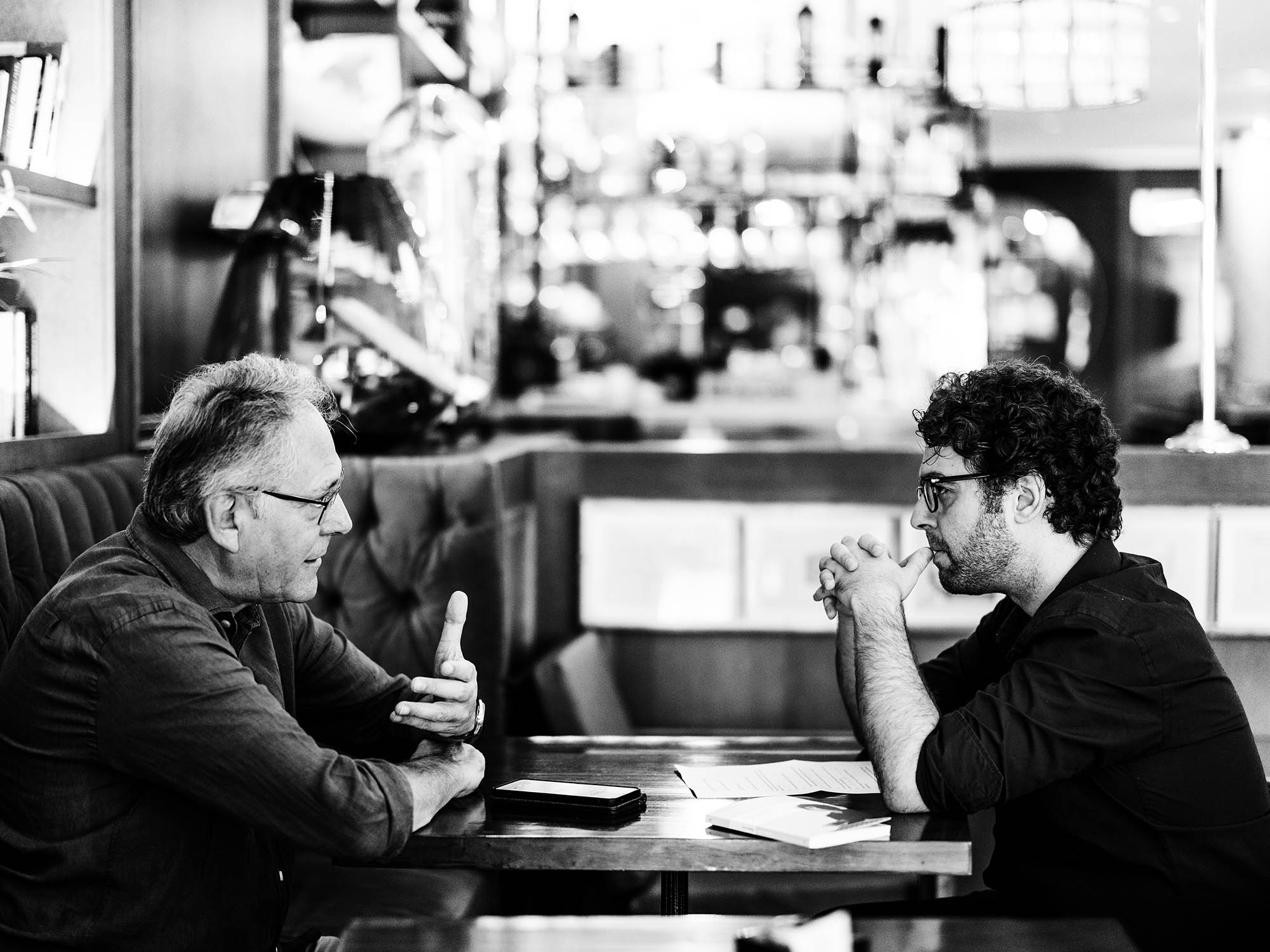
—Let’s wrap up, Eduardo. Is the worst thing about Dylan his ultra-orthodox followers…?
—Yes, the Dylanologists. They believe that only they are capable of interpreting Dylan, and I think Dylan shouldn’t be interpreted. You listen, absorb what you hear and incorporate it into your life. Make out of a song composed by a man from Minnesota who, perhaps, was driving a caravan through Wyoming, material for your own life. Listen to it and let it seep into your bloodstream. Dylanologists do not want that.
—There is only one thing worse than a Dylanologist: his tiresome detractors. When the Nobel prize was awarded, the infantile wailing of many apostles of the national coolturetismo was unbearable.
—They’re the same. It’s people who have a totally visceral and ridiculous reaction to Dylan: that he’s a bad poet, that he can’t sing, that he can’t play the guitar, that he’s tedious…
—I can’t think of a better poet than Dylan in the last half century. To equal him, yes; to surpass him, not by a long shot.
—Of course. And one thing: review the list of Nobel laureates in the last thirty years. Not a single one of them has been immune to Dylan’s music.