
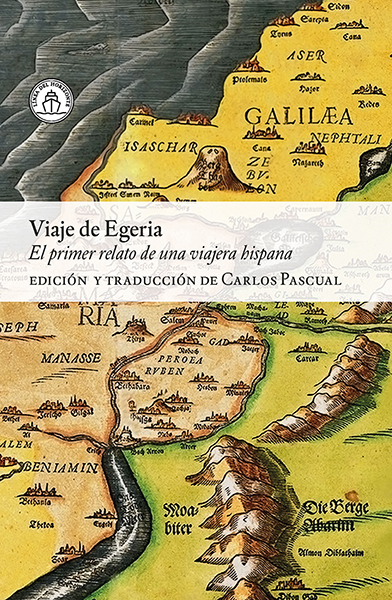
The first great travel narrative in our tradition was written by a woman. In the fourth century, Egeria, a traveler from Roman Hispania, undertook a long pilgrimage to the holy places of the East: Constantinople, Jerusalem, Egypt, Sinai, Mesopotamia…
At Zenda we offer the Introduction to Viaje de Egeria: The first account by a Hispana traveler (Línea del Horizonte), translated and annotated by Carlos Pascual.
*****
INTRODUCTION
A colossal discovery
The story we are about to explore could easily unfold as a thriller. It was 1884 when an Italian scholar, Gian Francesco Gamurrini, sifted through dusty bundles and manuscripts at the Biblioteca della Confraternità dei Laici (or Santa Maria) in Arezzo, trying to impose some order. One codex drew his attention in particular. It consisted of Latin parchments, copied in the eleventh century, in which two texts appeared together—though written by different hands—that had nothing to do with each other. The first consisted of fragments of Saint Hilary of Poitiers. The other text was more intriguing: a curious account of a journey to the Holy Land, written in a very early period, by an anonymous woman who spoke in the first person.
From what could be observed at a glance, in this second text many leaves were missing; many at the beginning, some at the end, perhaps some in the middle… A calm examination of the find began to shed the first light. It consisted of “travel notes” drafted in a well-known mold, the peregrinatio or itinerarium, one of the earliest medieval genres, according to the classical typology of Jean Richard. The curious thing is that the notes were written in the form of letters or epistles, dating to the late fourth or early fifth century.
Apparently, the author was writing to distant dominae et sorores (“ladies and sisters”) who would have remained far away, in the common homeland to which she trusted to return, as she indicated at the end of her account. The author had undertaken a long circuit, from “extreme lands” to the biblical sites, and described them to her remote recipients with a freshness and candor of language that captivated from the very first moment: this was a singular work.
Immediately, Gamurrini began to investigate and probe more deeply how and from where that codex could have reached Arezzo. From the handwriting and its dating, one could presume that it had been copied in the scriptorium of the famous Benedictine abbey of Monte Cassino; indeed, it seemed that that very codex had served the abbey librarian, Pedro Diácono, to draft the treatise or catalog De locis sanctis around 1137. By 1610, Abbot Ambrosio Rastrellini would have carried it from Monte Cassino to the monastery of the Saints Flora and Lucilla in Arezzo, upon taking charge of the latter; and from there it had passed to the Biblioteca della Confraternità when the Arezzo abbey, a branch of Monte Cassino, was suppressed in 1810.
But this did not resolve the main questions. Who was that woman whose account had been copied in the eleventh century by the devoted hand of some monk? In what exact era had she undertaken her wanderings and written them down so that her sorores could see through her traveling gaze the most revered places of Christendom?
The year after its discovery, Gamurrini himself put forward the first hypotheses and named the anonymous author: it appeared, as he seemed to glimpse in a sudden illumination, to be Silvia of Aquitaine (or Silvania), sister of the prefect Flavius Rufinus, in the time of Emperor Theodosius, in the late years of the fourth century. That was the name and authorship he proposed in the prince edition of the text, in 1887, and also in the more careful second edition, the following year.
But by that very year the doubts grew ever denser for Gamurrini himself. In 1903, Benedictine Dom Mario Férotin delivered a decisive turn: the author was not Silvana or Silvania, but a certain Etheria or Egeria, about whom scattered reports existed. Specifically, she was praised for her fearless travel and her piety in a letter written by the Abbot Valerio to some monks of Bierzo in the seventh century; that letter had been collected by Father Enrique Flórez in his monumental work España Sagrada, a significant product of the Enlightenment encyclopedic impulse of the eighteenth century.
Thus, according to Férotin, the true author of what had until then been known as the Peregrinatio Silviae would actually be the Hispana Etheria or Egeria. Later we will examine in somewhat more detail how hypotheses were gradually cleared away, and how the authorship of the manuscript found by Gamurrini came to be fixed — meanwhile, in 1909, De Bruyne had discovered other loose leaves of the same journey among the Toledo Manuscripts in the National Library of Madrid; leaves, incidentally, copied a couple of centuries earlier than those from Arezzo. For the moment, what matters is that Gamurrini’s find suddenly brought to light a Hispanic woman as the true author of that narrative.
The significance of these investigations is evident. We would indeed be looking at the first known Spanish woman writer whose work has come down to us. And her account, the first Spanish travel book. Because, even if it was drafted with other purposes, specifically out of religious piety, the fact is that Egeria’s text constitutes an authentic travel diary, which anticipates by several centuries what some medieval explorers would later turn into a literary genre, not to mention Romantic travelers, long after. Even the formal vehicle of her observations and notes—the epistolary form—is a mold adopted by traveler-writers across all ages.
With our current mindset, after digesting the Copernican revolution, and with the shock of current discoveries and the abyss they open for our imagination as twenty-first-century people, it is difficult to gauge what Egeria’s journey meant. A circumnavigation that traversed the entire known world —as Valerio would gloss it; a journey that only paused at those distant frontiers where the civilized world faded into dark bands, not subject to Roman discipline, and bounded toward the edges of the universe.
We also find it hard to imagine the true value of distances, and the fatigue required to overcome them, in that world of the fourth century, when the Roman Empire, in some corners of its vast expanse, began to ferment and corrupt, approaching its total collapse. But the journey itself, as laudable as it may be, is not what gives grandeur and significance to Egeria’s account. What is most relevant is, above all, the account itself. What is remarkable is the refined taste of a traveler “by birth” who knows how to linger over details, savor the journey, apart from her pious motives, and who anticipates by many centuries the sensibility that would later crystallize into a solid literary genre.
The one we might consider the earliest classic Spanish traveler is not a clumsy stammer, but a fresh and splendid work that deserves greater justice. Until now, only scholars have engaged with Egeria’s manuscript. But her account, in itself and in what it signifies, deserves to be known by the general public, at least by those who love travel literature. It deserves the account and it deserves its author. For the figure of Egeria has all the ingredients to captivate any discerning reader: she is as passionate as she is fascinating.
————
Author: Carlos Pascual (ed.) Title: Viaje de Egeria: The first account by a Hispana traveler. Translation: Carlos Pascual. Publisher: Línea del Horizonte. Sales: Todostuslibros.