
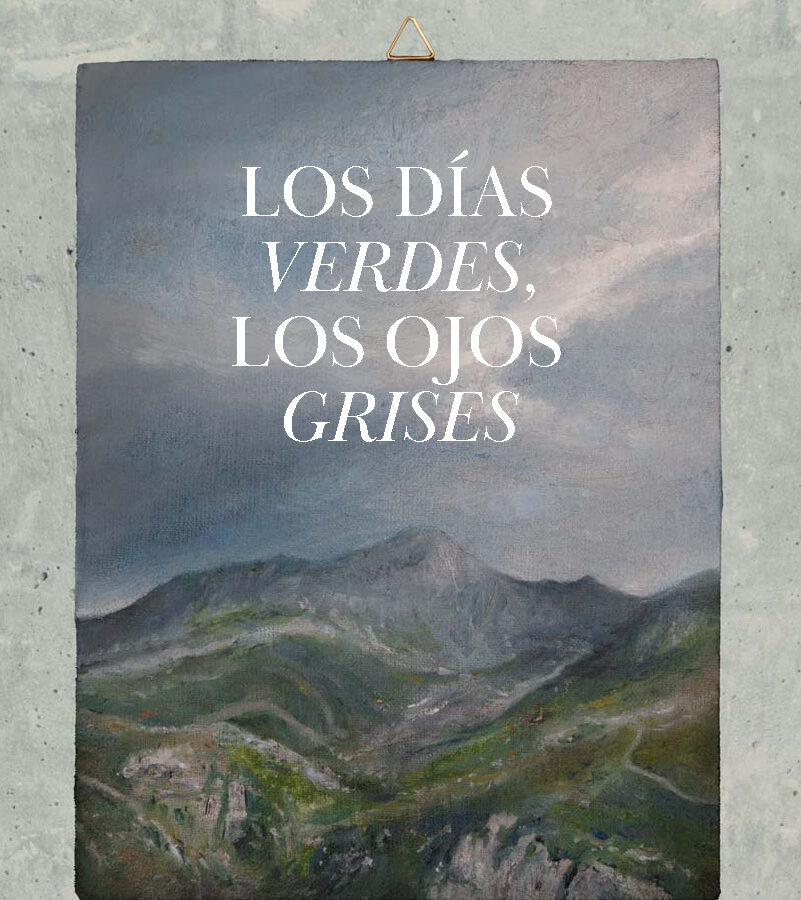
The protagonist of this novel holds a rather unusual trade: a descriptor and seller of landscapes. He dedicates his life to seeking places where writers can set their novels. Until one day, two paintings hanging on the wall make him question his vocation.
In this making-of Carolina-Laia Puigdevall explains how she wrote The Green Days, the Gray Eyes (FCE).
***
In one of the countless emails we have exchanged over the last few months, my editor, Marta Comensaña, asked me how the protagonist’s occupation (descriptor of landscapes) had come about, not knowing that while the answer to that question might be the most difficult to give, it is also what gives meaning to everything. Because the whole story begins from that point, and to explain it I would also have to tell you that even before the manuscript existed in its embryonic state, and even before I conceived the possibility of writing fiction, I had long been pursuing a concept that has always obsessed me: ekphrasis.
As an art historian and later during my specialization in art, literary, and cultural studies, I have never stopped thinking about the image-word relationship, and after concluding my academic journey—having just moved to Berlin in 2019—I considered pursuing a thesis on the subject. “Ekphrasis in Proust,” I thought. “Why not?” A topic as immense as it is demanding, given that I don’t know French. After discarding that idea, the UNED professor I was in touch with at the time suggested, quite in line with my interests, focusing on something more concrete: “ekphrasis / painting / landscapes / gardens”. And it made sense, but there was always a need to constrain it more and more. So I spent months researching on my own but never committing to starting. I delved into the theory of the matter. In the writings of theorists such as Henry Markiewicz, Jean Laude, Wendy Steiner, or Murray Krieger. I took countless notes. But life swept me aside. The pandemic, the job in Berlin, which demanded more and more time, the German language, writing my articles and pieces as a contributor… All of this, happening simultaneously, made the idea of starting a distance thesis fade away, until finally I abandoned it. And it was then, almost by inertia, that I began writing fiction and that entire academic research condensed into a single paragraph presenting a character who earns his living as a descriptor of landscapes. A character who seeks and inhabits places to narrate them to writers who are blocked and don’t know how to continue their novels, who sometimes resorts to the small trick of pictorial ekphrasis, who sells landscapes solely through words and who always works en plein air.
I began weaving a story slowly. I wrote with a very intermittent cadence between 2021 and 2024, in such sporadic and carefree fashion that some might say that what I did was less dedication than procrastination. And although throughout that time I never abandoned the idea of finishing it someday, I knew I wasn’t doing it because I was missing something, though I didn’t know what. Then I reached the second theoretical concept that threads through the novel.
It all started from something as ordinary as a commissioned article. I was asked to write a piece on the Avant-Garde for the monographic issue the magazine Jot Down was putting together, and I decided to focus on Dada and its subsequent influence on the rest of the -isms. As soon as I began gathering sources for what would be my article (Dada and Chance: The Floating Spirits of the Cabaret Voltaire), I stumbled upon the missing key I didn’t know I was looking for, and I felt it was a touch of destiny that it happened to be exactly what I needed to complete my unfinished story: chance. That chance became the underlying engine of everything I was telling.
“Let it all go (…) throw yourselves onto the roads”… That line from the manifesto Làchez tout by André Breton spoke to me directly and unleashed a phase of frantic writing, concentrated mainly on nights and early mornings (though it extended to every moment I could steal from the rest of the day) and resulted in the novel I had nurtured for years finally being finished in just a few months. The dadaist and surrealist tenets had brought me the solution personified in the protagonist as an antihero who flees, roams aimlessly, who discovers and describes the world around him almost automatically, easily, letting himself be carried along. Reading the avant-garde manifestos of the early twentieth century, I realized that this is how my characters move and meet, and this is how I move myself so often, both in writing and in real life.
After all, what is writing fiction if not expressing images with words and embracing the fortuitous?
—————————————
Author: Carolina-Laia Puigdevall. Title: The Green Days, the Gray Eyes. Publisher: FCE. Sale: All Your Books.