
A year ahead promises to be filled with novels, essays, and one-topic biographies. On May 21, 2027, five hundred years will have passed since the birth of Philip II. Few figures in our History offer such ground for research, controversy, and, of course, historical fiction. The Prudent King will occupy many pages once again.
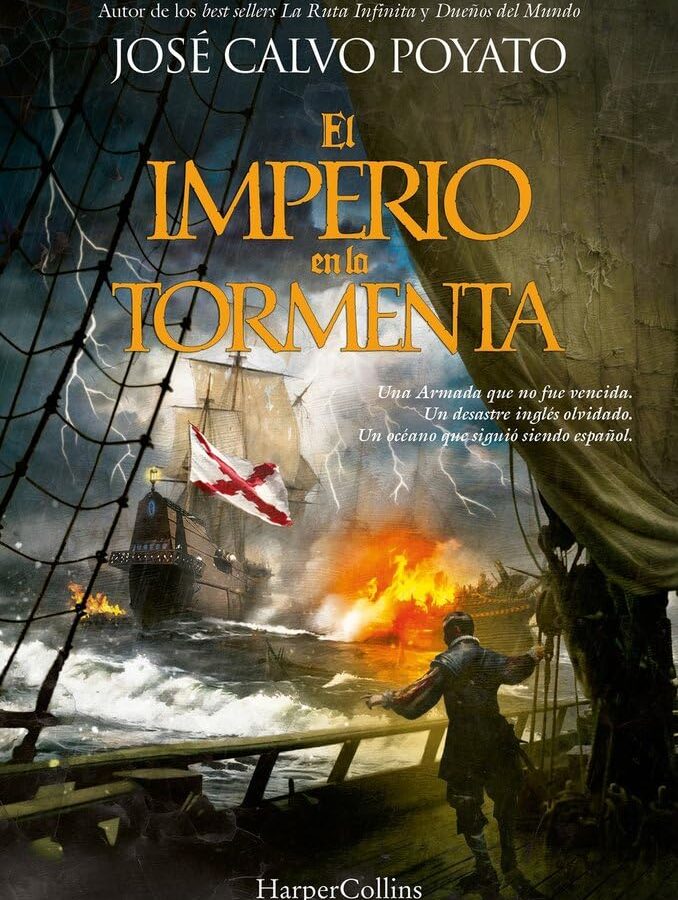
One of the forerunners of that trend is a well-known favorite among those of us who love History. I refer to the historian, publicist, and Cabra-born professor José Calvo Poyato, who publishes this September his historical novel The Empire in the Storm.
The action is set in February 1587. Two coded messages reach Spain, coming from Paris and England, sent by agents of Philip II’s formidable intelligence service. From that moment, Calvo Poyato guides us into a world of spies, counterspies, diplomats, clerics, conspirators, corsairs, soldiers, and sailors moving between Madrid, Lisbon, Rome, Paris, London, and Istanbul.
The king decides to embark on an extraordinarily complex enterprise: to lead a large armada to the English Channel, to deploy the tercios of Alejandro Farnesio, and to land in England. Behind lie years of English attacks against Spanish interests around the world, Queen Elizabeth I’s support for the Dutch rebels, and the execution of Catholic Mary Stuart.
But around that grand enterprise there move many other pieces
Negotiations with the Holy See to secure the promised funding; the Portuguese pretensions of the prior Crato, the bastard Antonio de Avis; the search for an alchemist named Lupercio, whom Philip II wants to prevent from falling into heretical hands; and, above all, a formidable war of intelligence and counterintelligence.
Because wars begin long before cannons roar
One of the most striking aspects is the description the author gives of the organization of the Armada in Lisbon. It is hard to gaze upon that administrative machinery without asking how a 16th-century Empire could coordinate logistics of such magnitude. Inventories, pay, provisions, crews, weapons, ammunition, victuals, ships, etc.
Everything was recorded
It was not a novelty. Since before the Great Captain, Spanish armies had developed a rigorous and efficient military administration. Those men left behind mountains of papers that today allow the historian to reconstruct what happened. The preserved documents continue to speak centuries later.
It is important not to forget that these archives have an extraordinary virtue: they are quite inconvenient for legends and devastating for lies.
José Calvo Poyato enters precisely there
In 1588, the Grande y Felicísima Armada failed in its main aim: to make possible the invasion of England with the objective of returning the islands to the shelter of Rome. It would be absurd to deny that failure in strategy and execution and the heavy losses during the troubled return to Spain, skirting Scotland and Ireland, were real; but to accept the image of a Spanish Armada annihilated by the English in a colossal naval victory is another matter altogether.
That is not what occurred. There were combats, detours, coordination problems, and painful losses. The expedition had to return to Spain. But England quickly understood that there was another battle it could win far more decisively: the war of narrative.
There, the English endured victory through the centuries
The very name of the “Invincible Armada,” which Spaniards still repeat, forms part of that propagandistic and derisive construction. It is hard to find a better example of how a term created to ridicule the adversary ends up being adopted by the descendants of those ridiculed.
Yet History wished to add an extraordinary epilogue
The following year, England launched against Spain an even larger expedition. They called it the Counter-Armada, led by Francis Drake and John Norreys. The plan was to reach Santander and destroy most of the Armada ships that were in dock being repaired, but the English could not pass Finisterre and ended up attacking La Coruña, where they faced unexpected resistance that repelled the assault. Beaten and defeated, they made for Lisbon. There they also failed to achieve their objectives. Don Antonio, the claimant to the Portuguese crown, could not fulfill any of the promises made to the Queen of England nor reach the targets set. The expedition ended up consumed by fighting, with thousands dead or wounded. Many ships were destroyed or in poor condition, and given the magnitude of the defeat on land, the English decided to flee and return to the Isles with a desolate balance: barely fifteen percent of the men embarked returned. Many ships did not have enough crew to navigate.
And here I find one of Calvo Poyato’s great insights: to treat both expeditions as parts of a single story. Because separating 1588 from 1589 makes the English narrative easier; joining them compels us to view the complete picture.
The Empire in the Storm, the new publication’s title, moves precisely between history and fiction with a revealing proportion: of the seventy characters that populate its pages, forty-seven are historical and twenty-three are fictional. We can see Philip II, Elizabeth I, Álvaro de Bazán, Lope de Vega, Martínez Recalde, or Arias Montano alongside characters born of the novelist’s imagination.
The author achieves something very difficult: he moves the reader with events whose outcome we already know
José Calvo Poyato proves that his mastery does not stagnate. On the contrary, maturity seems to have steered his historical writing toward greater naturalness. His prose — it is not the first time I say so — knows how to fuse formal beauty, historical rigor, and ethical depth. In his novels, knowledge, reading, and history end up forming an inseparable mosaic.
At heart, this novel also speaks to something fiercely contemporary: the power of deceptive propaganda
We tend to regard fake news as a product of our time; the author shows that it is not. In English we have plenty of words to say the same thing: hoaxes, fibs, falsehoods, lies, manipulation, propaganda. The rulers of Elizabethan England demonstrated more than four centuries ago that a lie repeated cleverly can survive for generations.
What is truly worrying, and I emphasize what has already been said, begins when those who were the targets of that propaganda end up accepting it as their own.
Calvo Poyato puts in the mouth of one of his characters a reflection that could have been spoken this very morning:
“we live in a time when lies are sold as truths and falsehoods run from mouth to mouth through squares and markets like rabbits across the fields.”
More than four hundred years have passed. It seems we have not learned much.
That is why The Empire in the Storm arrives at a particularly timely moment. On the threshold of the fifth centenary of Philip II’s birth, I also think it fitting to acknowledge Calvo Poyato’s achievement in turning this novel into a homage and vindication of the figure of the Prudent King. A monarch with successes, strategic missteps, and decisions that he preferred to devote to ruling and governing an Empire rather than refuting the innumerable falsehoods his enemies poured onto him and his achievements. Perhaps that silence was one of his great mistakes, because battles against lies should never be abandoned: history shows that a defeat can be redeemed; a lie turned into truth, embraced by someone who knows they are being slandered, can take centuries to eradicate.
Surely many great books will be published, but that of the “old professor,” Don José Calvo Poyato, will be among the most celebrated — though perhaps not in the United Kingdom — for his skill in exposing so many English fake news.
—————————
Author: José Calvo Poyato. Title: The Empire in the Storm.Publisher: HarperCollins. Sales: All Your Books.