
If there is anyone who knew about relatives shut up in attics or the upper floors of the family home, it was undoubtedly Shirley Jackson.
It is not surprising that the American writer crafted works like The Haunting of Hill House (1959) when one considers her peculiar female lineage. Raised by a domineering mother —or phallic, as scholars might say— named Geraldine, fond of tea-leaf reading, who taught young Shirley to use the Ouija board, she had herself been raised by a mother —Shirley’s grandmother— who practiced the spiritual healing rituals of Christian Science. The grandmother, who lived with the Jacksons, would slip into Shirley’s room at night whenever the girl fell ill, spending hours whispering in her ear that her mind, even with fever, held the power to heal her. Shirley’s mother, Geraldine, tried to keep that supernatural world hidden behind a bourgeois façade of respectability.
Every time she hosted one of her parties, she hid the grandmother on the upper floor. Thus, unknowingly, she was giving Shirley a domestic experience that, years later, would allow her to read Gothic fiction as a reference.
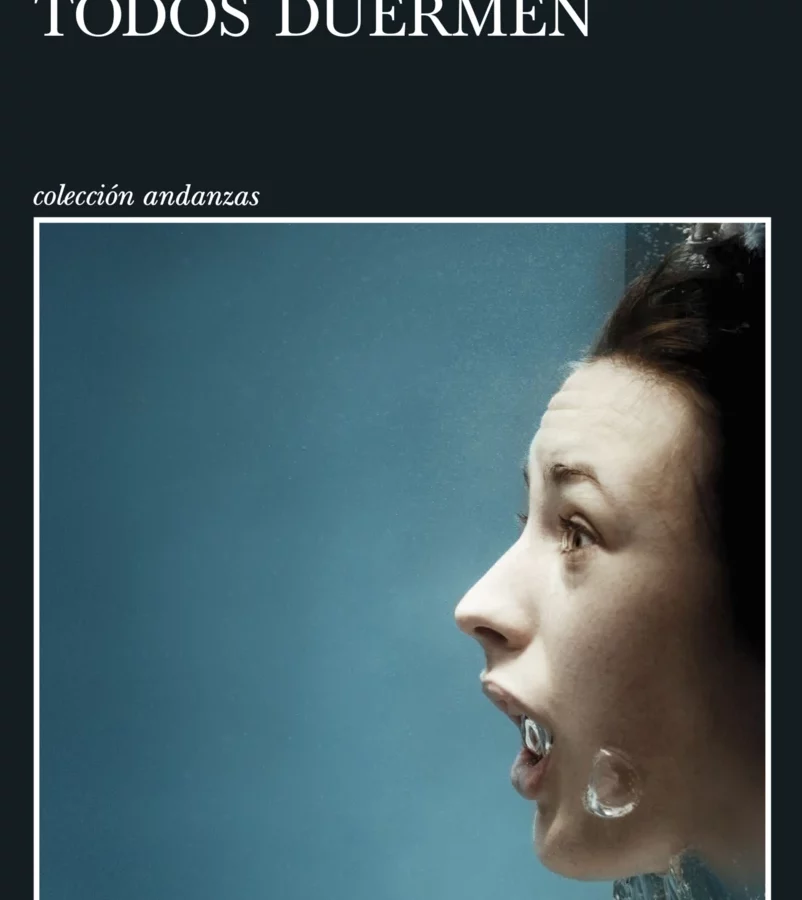
In that universe, long confined under the unfair label of ‘domestic writing’ and only vindicated in its full complexity with the then-not-so-recent Jackson revival, the reading of All Sleep (Tusquets, 2026), Rosa Ribas’s latest novel (born 1963), made me reflect. With scenes packed with gestures that brush against Hitchcockian, an atmosphere that updates the conventions of Gothic literature, a certain criminological layer —if we see Ana, the protagonist, as a researcher of her own family archive— and some character who might remind one of figures from thrillers like Sharp Objects (2006) —one must always be wary of those who watch us “too well”— Ribas, like Jackson, does something more interesting than a mere exercise in genre: she builds, through refined prose, a novel about trauma, resilience, and pain, but also about the need to disentangle what is one’s own, as if it were a translation exercise.
Ana and Elisa are two sisters who live with their grandmother in the family home they inherit after the death of their parents, following both of them drowning when their car plunged off a cliff. If one of Jackson’s recurring figures is the mad woman confined to the attic, in All Sleep it is Ana who occupies the upper part of the house, afflicted with agoraphobia since the accident. Ribas may unintentionally reproduce the Jacksonian scene when Ana, hidden behind the curtains, catches the glances directed at her by the neighbors from the street. A woman kept apart on the upper floor whom those outside have learned to see as the crazy woman of the house.
The door and the landing that connect the first floor —where Elisa and the grandmother live— with the second —which Ana cannot leave—become a threshold that determines not only what enters Ana’s space but what enters the novel itself. Elisa not only brings groceries to Ana, but becomes a kind of customs post through which news, people, objects, decisions, and versions of what happened in the outside world enter. Ana’s physical dependence produces a narrative dependence. Elisa possesses something that Ana does not have, nothing less than direct access to the world, which Ana already receives as narrated. From there, Ribas explores the uneasy proximity that can exist between care and power. If the grandmother in Jackson spent hours whispering to her granddaughter for healing, in Ribas’s fiction it is Elisa, the sister, who administers medicines, appears beside Ana when she wakes from a convalescence, and watches with a maternal, rather than fraternal, tenderness any disruption of her routines. And, while all these gestures are undeniably loving, there comes a moment when the novel begins to ask, in a very measured way, to what extent Elisa needs Ana to keep needing her.
For the moment when Ana begins to suspect that Elisa hides more than she shares, the reader has already learned, thanks to the grandmother —a figure left unused since the author discards her by placing her in a retirement home—that, as in every novel that probes the corners of the domestic and the familial, the parents carried with them a secret that threatens to surface at any moment. In this sense, Ribas’s decision to make Ana a professional translator is apt. All Sleep is built around a family mystery, but perhaps all family mysteries are, at heart, translation problems. Ana is not confined only to a house but also to a family story whose language she believed she knew. At one point in the novel, Ana speaks of the “vertigo of the things I know and don’t know what they are called.” Perhaps family stories generate a similar vertigo and have something of translations that are too free, in erasing the uncomfortable and trusting that no one will go looking for the original. The trouble with correcting them is that, at times, the error was precisely what kept the text together. And Ana, in addition to being agoraphobic, is a stubborn translator.
—————————————
Author: Rosa Ribas. Title: All Sleep. Publisher: Tusquets. Available at: Todos tus Libros.