
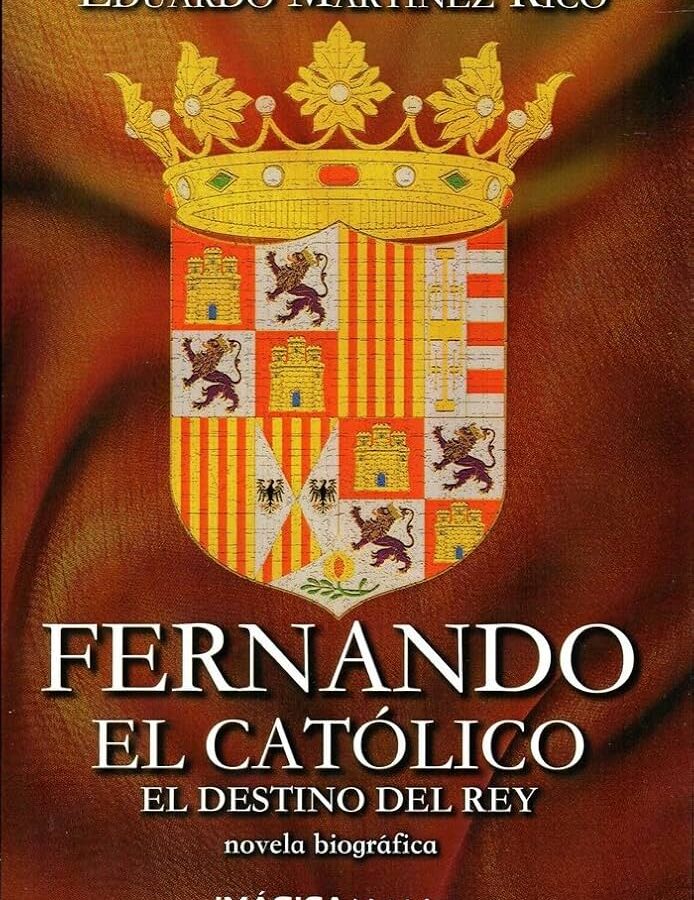
A comet streaked across the sky. Born is Ferdinand of Aragon, the man destined to become the first great king in the history of Spain. Ferdinand the Catholic, the man in love, the politician, the diplomat, the tireless worker and the controversial womanizer, the charismatic figure who turned his own fate into the fate of Spain.
We now reproduce the foreword by Raúl del Pozo to the work Ferdinand the Catholic: The Destiny of the King, by Eduardo Martínez Rico.
*****
Some time ago I said of Eduardo Martínez Rico that he possesses an irresistible vocation and that he treats literature as a passion. More than ten years have passed since I wrote that sentence, but I still think it. He began as a craftsman, which is the best way to become an artist, and he has become one. His books about Francisco Umbral or Pedro J. Ramírez already form something of a canon.
I think he has chosen me to write this foreword because we are very good friends and because he knows I am interested in the era of the Catholic Monarchs and that I am a great admirer of the writer Fernán del Pulgar, chronicler of the Kings, and of Machiavelli, who chose Ferdinand of Aragon as a model of the politician. Napoleon wrote: “Tacitus wrote only novels; Gibbon is a teller of tales. The only book that can be read is Machiavelli’s.” Eduardo knew that the Florentine turned Ferdinand into the supreme oracle of state reason. Fernán del Pulgar, the Plutarch of the Spanish Renaissance, depicts the blonde queen with eyes between green and blue, Isabella of Castile, and says of her: “She did not drink wine, she loved the King very much and jealously guarded him beyond measure.”
In his “Final Note” the author makes clear why he chooses Ferdinand the Catholic for his novel. He understands that he is a great character and that if we place him beside his wife Isabella he becomes a largely unknown figure. Indeed, Ferdinand the Catholic, who for many contemporary historians, such as Carmen Iglesias, is the best king in the History of Spain, turns out to be a figure little known to popular readers. The Catholic Monarchs, a prince of Machiavelli and a warrior of Castile, created the first State in Europe. Karl Marx believes that the material base of the Spanish monarchy was established in that marriage of two dazzling figures. “They transformed a feudal monarchy into an absolute one when even the English Parliament could not be compared with the Spanish Cortes.” They stripped power from the nobles and she pledged her jewels so that Christopher Columbus could prove that the Earth was not flat.
What do we encounter when reading Ferdinand the Catholic: The Destiny of the King? A highly documented novel, but a novel, as the author himself says, that is, written without fear of inventing, of imagining, even though it is historical fiction. It is written with the freedom typical of a novelist. Even though it is very well documented, the reader should not seek exact historical accuracy but the enjoyment of the narrative and the fluid, novelistic prose of Martínez Rico. Prose that does not pursue aesthetic beauty, but literary efficacy, and beyond that, the efficacy of the novel. It is prose put at the service of the story.
The reader will enjoy a very entertaining, straightforward book with plain prose that reads easily. Martínez Rico set out to make Ferdinand the Catholic known to a broader audience, to disseminate his figure, but at the same time to amuse the reader with this portrait, between History and legend, between History and imagination.
—————————————
Author: Eduardo Martínez Rico. Title: Ferdinand the Catholic: The Destiny of the King. Publisher: Imágica histórica. Sales: Todostuslibros.