
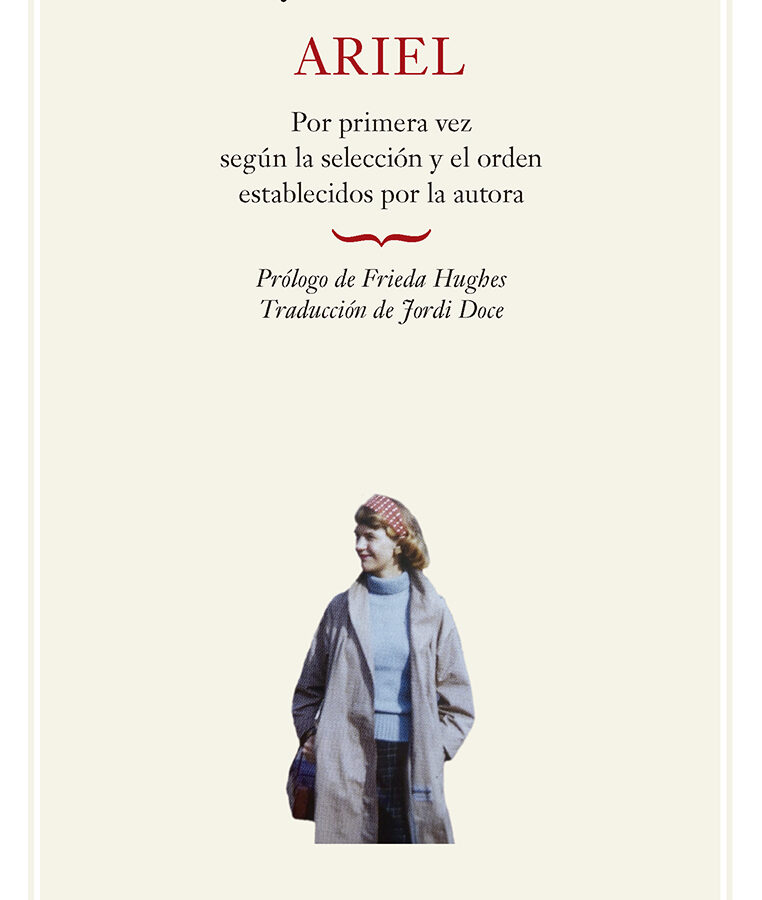
Since the publication of Ariel in 1965, Sylvia Plath has stood as a defining voice in contemporary poetry. Yet many do not know that the manuscript Plath left behind at her death differs markedly from the collection that later elevated her to legend. This edition restores the book to its original form, with the selection and order set in her time by the author herself.
At Zenda we publish five poems from this new edition of Ariel (Galaxia Gutenberg) by Sylvia Plath.
***
The Rabbit Hunter
It was a place of force…
The wind muffling my mouth with my own hair,
tearing at my voice, and the sea blinding me
with its lights, the lives of the dead
unfolding within it, floating like oil.
I tasted the malice of the toadflax,
its black spines,
the anointing of its papery blooms.
They were very beautiful and effective,
and extravagant as torture.
Only one fate was possible.
Boiling, perfumed,
the paths narrowed toward the hole.
And the traps tried to erase themselves,
zeros gnawing at nothing,
placed very close together, like the pains of birth.
The absence of screams
opened a hole in the heat of the day, a hollow.
The glassy light was a dense wall,
the brush kept silent.
I felt a mute application, a design.
I felt hands around a teacup, rough, blunt,
making the white porcelain ring.
And how they awaited him, those little deaths!
They waited for him just as lovers do. They excited him.
Also our thing was a relationship:
tense cables between us,
stakes sunk so deeply they could not be pried out, and a mind like a ring
slipping its clasp into something quick,
killing me as well with its oppression.
***
Lady Lazarus
I’ve done it again. Each decade or so I manage it:
a kind of walking miracle, my skin
gleaming like the glow from a Nazi lamp,
my right foot
is a paperweight, my face
a plain sheet of linen, unadorned.
Tear away the scarf, oh my foe.
Do I inspire terror?
Is the nose, the hollow of the eyes, the complete dentition?
This sour breath
will vanish in a day.
Soon, soon the flesh the dark grave devoured
will be in me again and at home
and I’ll be a smiling woman.
I am only thirty years old.
And, like a cat, I have seven lives to die.
This is Number Three.
What a waste to annihilate each decade.
What a million filaments.
The crowd with their bags of peanuts
crowds to see
how they unbind my feet and hands:
the great striptease.
Ladies and gentlemen:
these are my hands,
my knees.
I could be all skin and bone,
yet I remain the same, an identical woman.
The first time it happened I was ten years old.
It was an accident.
The second time I was determined
to reach the end and never come back.
I lulled myself until I closed inside
like a seashell.
They had to call and call me
and pull the worms out one by one like sticky pearls.
To die
is an art, like everything else.
And I do it exceptionally well.
So well that it seems like hell.
So well that it seems real.
I suppose one could call it vocation.
It’s fairly easy to do it in a cell.
It’s fairly easy to do it and stay still.
It’s the theatrical return
in broad daylight
to the same place, the same face, the same dull shout
and amused:
“A miracle!”
which leaves me out of breath.
One has to pay
to see my scars, one must pay
to hear my heart beat:
truly it works.
And one must pay, one must pay a lot,
for a touch, a word
or a trace of blood
or a strand of my hair, a rag of my clothes.
And well, Herr Doctor,
and well, Herr Enemy.
I am his work,
his most precious object,
the baby of pure gold
that dissolves into a scream.
I turn and burn.
Do not think I underestimate his great concern.
Ash, ash, ash,
that you move and probe.
Flesh, bone, there is nothing left.
A bar of soap,
a wedding ring,
a gold filling.
Herr God, Herr Lucifer,
beware
beware.
From the ashes
with the red hair I rise
and devour men as easily as air.
***
Tulips
Tulips are very impulsive; here it is winter.
Look, everything is so white, so calm, so much snow.
I am learning to be at peace and to keep still in solitude
as the light rests on the white walls, this bed, these hands.
I am nobody; I have nothing to do with any explosion.
I have surrendered my name and my everyday clothes to the nurses,
my medical history to the anesthesiologist and my body to the surgeons.
They have placed my head between the brow and the pillow
like an eye between very white eyelids that won’t close.
Dumb pupil, it must learn everything.
The nurses come and go without disturbing
and they’re like gulls that fly inland with their white headdress,
doing things with their hands, all identical,
making it impossible to tell how many there are.
My body is a pebble to them, cared for as water cares for pebbles over which it runs,
polishing them slowly. Their sharp needles bring me sleep, bring me lethargy.
I am disoriented and cannot bear this luggage:
my patent-leather case like a black pillbox,
my husband and daughter smiling from the family photo;
their smiles, tiny hooks, snag on my body.
I have let the things drift, a thirty-year-old freighter
that clings fiercely to my name and address.
By rubbing myself they cleared me of attachments of love.
On the green gurney with the plastic pillow, naked and frightened,
I watched my tea set, my books and my chest with the bedclothes sinking
beyond my sight, and the water rose over my head.
Now I am a nun; never have I been so pure.
I did not want flowers; I only wished to lie with arms raised and be empty.
How free one looks; you cannot imagine how free…
The sensation of peace is so intense it dazzles, and in exchange
nothing asks for a tag with your name, trifles.
That is what the dead take, after all; I picture them
taking it in the mouth like a consecrated host.
To begin, the tulips are very red, and they hurt me.
Even wrapped in wrapping paper I could hear them breathe
softly between white diapers, like an irritated baby.
The red of the flowers speaks to my wound and it answers back.
They are subtle: they seem to float, though they weigh on me,
countering me with their sudden tongues and their color:
a dozen red plumb-lines that hang from my neck.
Before, no one watched me; now I feel watched.
The tulips turn toward me, and so does the window behind me
where once a day the light broadens a little and then softens,
and I see myself as a flat, ridiculous silhouette of cut-paper
between the sun’s eye and the tulips’ eyes,
and I am faceless: I am the eclipse of myself.
The tulips, vigorous, feed on my oxygen.
The air was calm before they arrived:
it came and went, puff by puff, without upheaval.
Then the tulips filled it with a tumult.
Now the air becomes stagnant and surrounds them like a river
getting stuck and circling a sunken machine.
They already have my attention, which used to delight in play and rest with no obligation.
And the walls too seem to come alive.
The tulips ought to be behind bars like wild beasts;
they open like the jaws of an African feline
and I become aware of my heart: it opens and closes
its vase of red flowers in pure love for me.
The water they offer me is warm and salty, like the sea,
and comes from a distant land, like health.
***
Ariel
I lie inert in the darkness.
Then the blue spill, weightless, of the drive and the distances.
Goddess of the dawn,
how we come together, the hinge of heels and knees!… The furrow
cracks and falls behind, brother of the
the brown arch of a neck I cannot seize,
and the berries
with the eyes of a black one cast dark hooks:
biting blood, black and sweet,
shadows.
Something more
drives me through the air…
thighs, hair;
scales on my heels.
White Godiva,
I flay away…
dead hands, severe deadness.
And now I, I steam for the grain, a gleam of seas.
The child’s cry
melts into the wall.
And then I am
the arrow,
the dew that flies
suicidal, one with the impulse
that leads to the eye
crimson, the cauldron of the sunrise.
***
Daddy
Not anymore, not anymore, you don’t help me,
black shoe
in which I have lived for thirty years
like a foot, white and poor,
not daring to breathe or achoo.
Daddy, I’ve had to kill you.
You died before your time, before mine: heavy as marble, a God-filled box,
a terrifying statue with a toe
so large and gray as a San Francisco seal
and a head in the shifting Atlantic
where green Jewishness flows on blue
in the waters of the radiant Nauset.
I used to pray to recover you.
Ach, du.
In German, in the Polish town
crushed by the roller
of wars, wars and more wars.
But the site’s name is very common.
My Polish friend says there are one or two dozen.
So I could never confirm
where you set foot, nor the root,
could not speak to you.
The tongue clogged in my jaw.
It clogged in a trap with barbed wire.
Ich, ich, ich, ich,
to speak was impossible.
I believed any German was you.
And so language, obscene,
a train, a train, a locomotive
clack-clacking and carrying Jews.
A Jew on the way to Dachau, Auschwitz, Belsen.
I started to speak like a Jew.
Perhaps I must be something Jewish.
The snows of Tyrol, Viennese beer
are neither very pure nor genuine.
With my Gypsy blood and my strange fate
and my tarot deck and my tarot deck
perhaps I am something Jewish.
I have always feared you,
with your Luftwaffe and your gobbledygook,
with your tidy mustache
and your arias, pale blue pupils.
You, the Panzer-man, the armored one:
not God, but a black swastika
that makes no heaven appear behind it.
There is no woman who does not adore a fascist:
it’s the boot in the face, the brute
and brute heart of a brute like you.
Daddy, I see you here beside the board
in the photo I still keep of you,
the chin split instead of the cloven hoof, but
no less a demon for that, no less
that black man
who broke with one bite my red heart.
I was ten when they buried you.
At twenty I tried to kill myself
and so, to come back, come back, come back to you.
But they pulled me from the bed
and forced me to reunite with glue.
And then I understood what I must do.
I made a copy of you:
a black Meinkampf-man,
meant to be Meinkampf’s heir.
and devoted to the stud and the stick.
And I said yes, yes I want to.
So, Daddy, it ends here.
I have ripped the black telephone from its socket,
the voices can no longer slide through it.
If I killed a man, let it be two:
the vampire who claimed to be you
and drank my blood for a whole year,
seven years, since you asked.
Daddy, now you can rest.
There is a stake driven into your black and heavy heart
and the village people never trusted you.
They still dance and leap over you.
They always knew it was you.
Daddy, you bastard, enough already, it’s done.
—————————————
Author: Sylvia Plath. Title: Ariel. Translator: Jordi Doce. Publisher: Galaxia Gutenberg. Available at: Todos tus libros.
BIO