
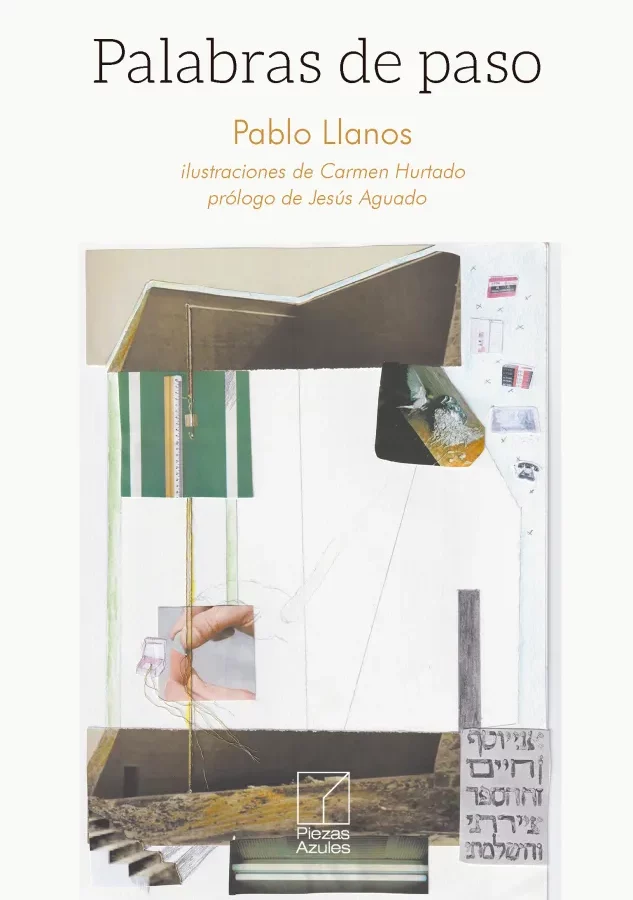
This poetry collection is a commitment to play, to language, and to the different selves that appear in poetic writing and in life. The book grows from poetry with a social focus toward the intimacy of fatherhood and the arrival of his daughter: because the world looks different when you offer it to another person.
At Zenda we present five poems from Palabras de paso (Blue Pieces), by Pablo Llanos.
*****
Nationality
At some point
of this walk
not as long as I imagined,
in the streets I walk
the cranes will build,
they rise,
they have ruined
the place where I was born.
*
Common Language
Tell me, when love dies and we part forever, how will we divide the language? Which words
for you, which for me? Will I tell someone
little thing? Perhaps you will keep
this word and I will have to
lower the following to more vulgar terms, like
queen or princess. And what will happen with idiot? Will you
also use it with others?
I want to believe they won’t be worthy.
Would it be possible to leave love as on the last day of school: tossing the notes in the air and burning the
language in the bonfires of Saint John. I fear that isn’t possible.
How many belong to each of us? Will we have to
measure the words precisely? Half for each: For you love, for me mylife.
For you hysteria, for me history.
For you wifi, for me disconnection.
For you cat, for me allergy.
For me memories, for you expectations.
For me patience, for you your mother.
How many will we throw away and how many will we donate to
a library or a reading club. It would be beautiful if
others tried to interpret them and voiced their thoughts and said what
they reminded them of, say, a passage from Love in
the Time of Cholera or from Hopscotch. I wonder how
to separate the words without breaking them:
I will keep lava and you dishes.
I will keep over and you everything.
I mono and you volume.
You bed and I león.
You hundred and I feet.
For you property, for me intellectual.
I printer and you multifunction.
For you coffee, for me only.
For you honey, for me moon.
And then, when each one rebuilds their own,
I will meet a cienleón and a solitary memory and a
moon printer. You will have a camapíes and a love
multifunction and honey of hysteria. It would be beautiful if
what remained of us were recycled words,
overvolume and cafetodo and monointelectual.
I want you to give me your word: when love dies and we part forever (just as we were going to
love forever), part of our language will stay in
shared custody:
jam
cardamom
affection
everything
will come out
all right.
*
Do poets dream of electric hendecasyllables?
And if the poet, tired of astonishment,
of mental synapses and oxymora
rests with a daily, ordinary dream,
simple, to carry in a backpack,
of income declarations
or solar calculators.
A routine dream, measured,
of the butcher’s shop from time to time,
of a weekly menu calendar,
of crossing a crosswalk,
of rebooting the router,
of discounted gasoline.
A clear dream, without interpretations,
in which the noise of a car engine
is no more
than the noise of a car engine
and biting into an apple would appease hunger
for a while,
to fool the stomach
and the subconscious.
A pleasant dream, of commonplace things,
in which the poet may delight in the scent of damp earth,
in a woman as beautiful as a rose,
with everything having been a dream.
A dream of a flat electroencephalogram,
without notebooks, nor pencils, nor metaphors,
nor a pun, simile, or ellipsis.
A restorative dream, in green tones,
like all restorative dreams.
A kitchen dream of making use of leftovers
that gives the poet the chance
to draw on his skills when
–in the morning– they ask him:
What did you dream today?
*
Verbalizing
We will walk out through the grand door of this silence
that bothers you so much. I will stop being a passive subject.
I will verbalize everything. I will not belittle my concerns. Come.
We will crystallize our futures. We will straighten the beds where our fears rise.
We will sharpen our frayed edges.
We will air-condition our most heated quarrels.
We will epicenter the tremors in our knees.
We will Eros Ramazzotti the sad songs.
Not because I’ll wake up earlier every morning by your side.
We will fry our breakfasts.
We will sauté all our misdeeds.
I will croquetize the leftovers of the banquet of your body while you
milanesas with your tongue.
We will canapé our tempests and afterward
we will tempest our calmer moments.
Here we go, it’s time to change the world within ourselves,
to mafalda-ize the constitutions,
to Homer-Simpsonize patriarchy,
to Maradona the left-handed poets,
to tree-ify the old furniture.
We will advance by compoting the components of the
parades
that do not sound right.
We will passport the undocumented
and we will sweet-talk the officials
and retire all kings
and indigenous the conquerors.
We will labyrinthize the shortcuts.
We will libelularize the drones.
We will infantilize our faculties.
We will bibliotecalize the gyms.
We will snail-tape the television talk shows.
And thus, once we have verbalized everything, there will be no
online translator capable of understanding us. We will crush the
predictive keyboards. The smartphone’s autocorrect will choke on its own hands.
You and I:
one single verb.
*
(Untitled)
I won’t have time to write when you are born, when
your cradle and your nightly cries and your need for love,
diapers and ergonomic pacifiers occupy the space where my geeky rants used to stand. I’ll have no room
to store failed poems. Nor will I have failed poems. Because having children is frustrating. I know this.
Don’t worry. I have a plan (really an excuse) (like almost all my plans). When the moment arrives
when I must answer for myself, I won’t hesitate to assure you that my great novel, my endless verse, my perfect scene, my spherical
tale, my definitive essay are already written. That life will find its own way, and you will be,
oh life, oh you, my contribution to the powerful drama.
***
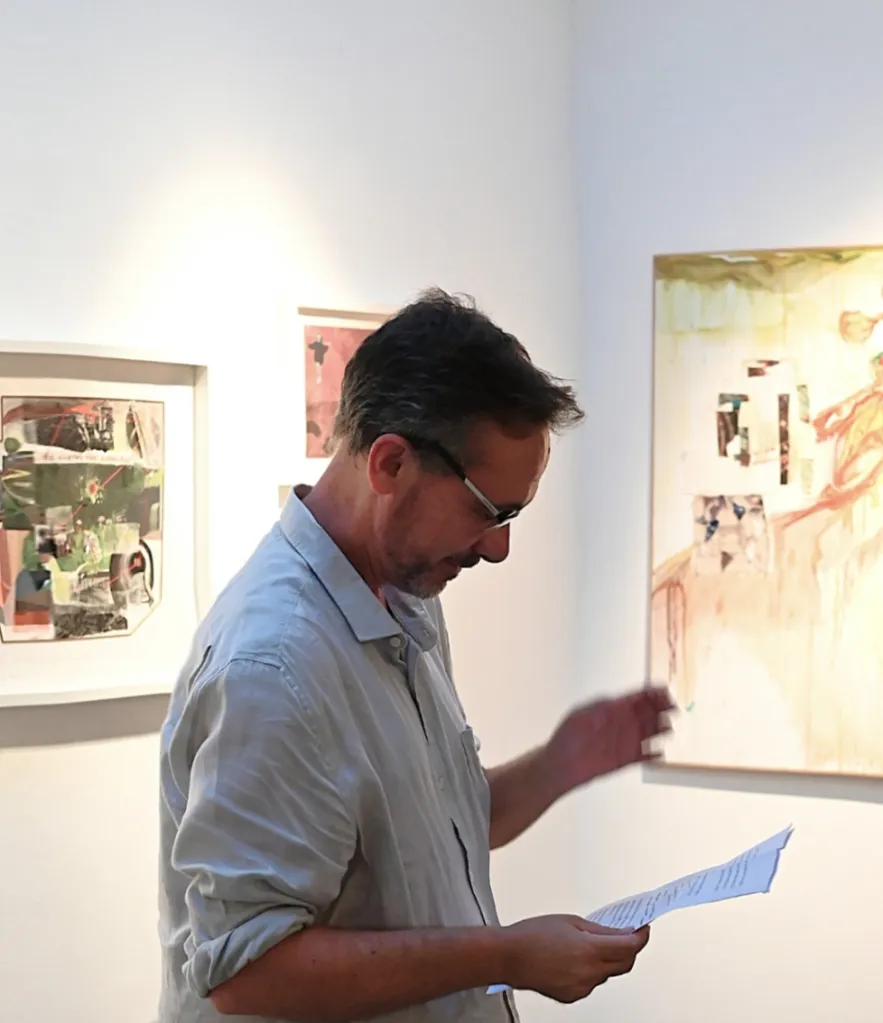
Pablo Llanos Urraca (Donostia – San Sebastián, 1974) grew up in Errenteria and lives in Badalona, where he works as an engineer for IBM. Meanwhile he has lived in Madrid for a physically indeterminate fraction of time. Despite his advanced age of maturity, he has not lost his curiosity. He is not finished with anything. He pursues intrusiveness as a poetic vocation. As a reviewer, he “hacks” books in several literary magazines: Quimera, Culturamas and Moon Magazine, among others. He has published a couple of short stories in Librújula and Orsai, and some say they have seen one of his poems dancing in the Eguratsak / Atmósferas anthology (Noski, 2024). In 2024 he won the Lekuona Fabrika Poetry First Prize. He is the author of the poetry collection Manual de Modelado de Corazones para Hombres de Hojalata (Cuadranta Ed., 2022).
————————
Author: Pablo Llanos. Title: Palabras de paso. Publisher: Piezas Azules. Sales: Todostuslibros.