
It is impossible to write a single line about the situation in Gaza without guessing — and even feeling — the scrutinizing gaze of the reader. The writer feels the weight or responsibility of measuring words because they know that before weighing what is argued in the text, the reader wants to know on which side you stand. Starting with the mere allusion to the problem: what concept should be used to describe what is happening there? Defensive reaction by Israel, punitive operation, revenge, war, extermination, ethnic cleansing? Do you hedge the label of genocide to characterize what the Israeli army is doing? Do you try to evade that this is a response to the massacre of October 7? Even the use of the word conflict is suspect, because it betrays a certain equivocation, as if one were trying to wash their hands by suggesting a clash between two communities, a sterile framing that many vehemently deny.
Although I know I will not satisfy —nor even convince— many, I propose in the following lines a different approach to Gaza, free from the permanent political burden of the backpack. At least in principle, and to be consistent with the driving force of the book we are going to consider. Yes, I know that without politics nothing makes sense and I do not intend to say we should forget it, but simply that we leave it in suspense or in a discreet secondary plane for a short while to examine what happens in that territory from an empirical perspective: let us focus solely on concrete facts. I ask you for a moment to take a ground-level look.
Imagine that suddenly —we do not know how— we find ourselves there. Like a dream, or rather, like a nightmare. We do not know which side we belong to or whom we support. Whether we are armed or unarmed. Only that we are there. And we open our eyes. What do we see? What do we hear? What do we smell? Dazed by the detonations, by the smoke, the dust, the heat, by the destruction here and there, we observe around us hundreds, thousands of human beings like us, young, old, women, children… Cries, looks of terror, thirst, hunger, despair, explosions, flights to nowhere. Open your eyes, nothing more.
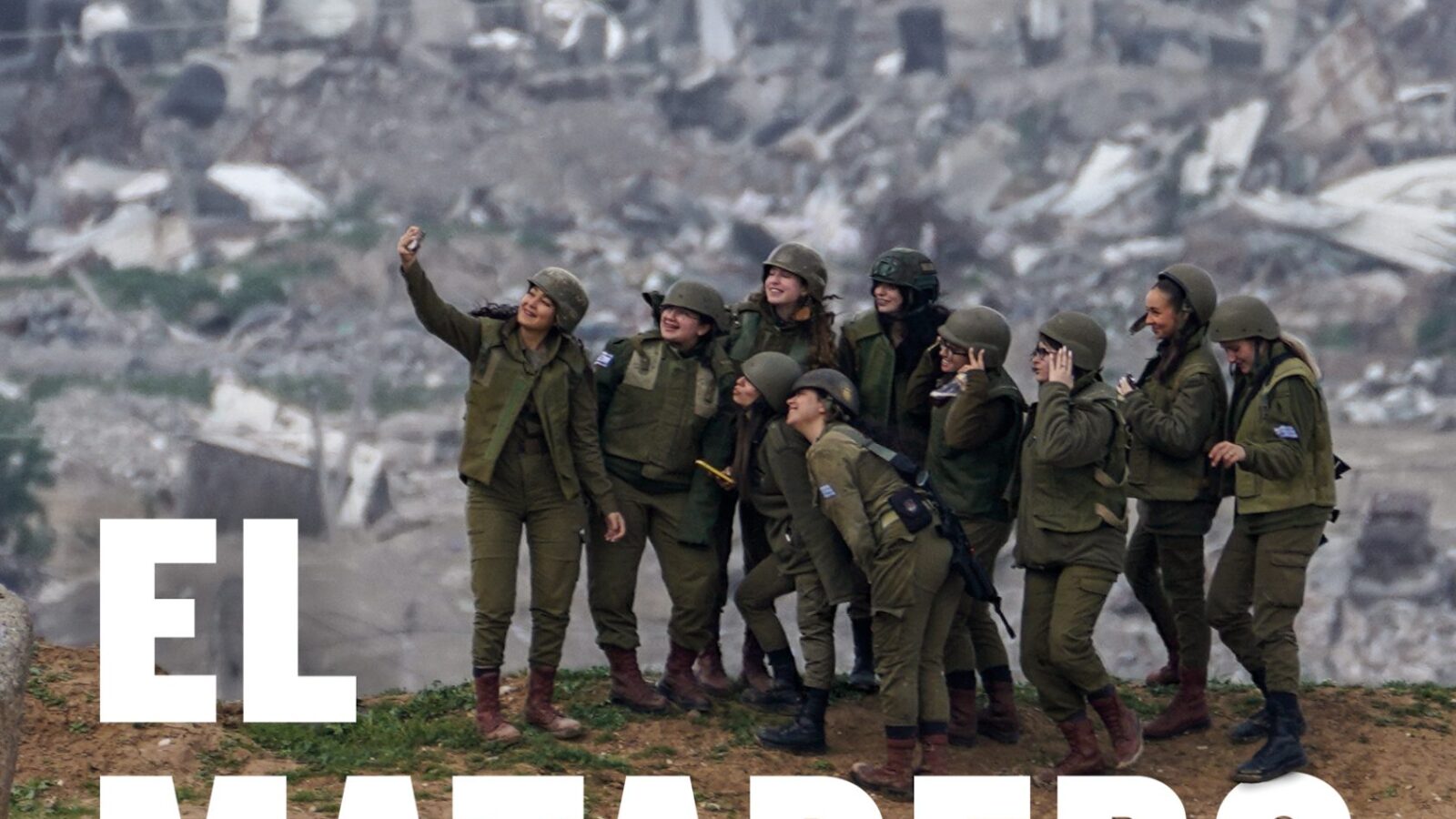
No, I am not performing —or attempting to perform— a mere rhetorical exercise, a discursive acrobatics. It would be frivolous on my part, given what this is about. What I try to do is make mine (and convey) the intention, the pulse, and the gaze that, as I understand it, underlie and give meaning to the moving testimony of Mónica G. Prieto in The Slaughterhouse. The subtitle of Gaza or the Unbearable Minutiae of Evil leaves no doubt about what one may find in these pages. And in this sense, the cover image is as devastating as it is anticipatory of what will be found inside: a group of young Israeli soldiers taking a collective selfie against a backdrop of bombed houses, a scene of destruction that appears almost apocalyptic. It seems that all of them (they appear to be girls) smile casually, almost happily, as if they were on a paradise beach.
At this point I should also say a few words about the author of these pages. The name Mónica G. Prieto should not be unfamiliar to anyone who follows current affairs, especially on the international stage, and more precisely to anyone interested in following the behind-the-scenes history of the major conflicts of recent decades. For this is what Prieto has been conveying in her dispatches since 1995. From Mexico (Chiapas) to Chechnya, from Georgia to the West Bank, from Afghanistan to Syria and Ukraine. One could almost say, without exaggeration, that there has not been a significant war in the last thirty years in which the Spanish correspondent has not been present.
And I do not mention this merely to give a brief biographical sketch of the author of the volume, but, in essence, for a more powerful reason. Prieto is a veteran journalist, hardened by dozens of wars and, therefore, a well-informed witness to the most abominable situations that produce those confrontations, especially among the most defenseless civilian population. For this reason, the content of this book and the tone it uses gain particular relevance, significance, and meaning. This is already visible in the title itself — Gaza is a vast Slaughterhouse (the author always capitalizes) — but it becomes even more evident in the stark, unvarnished way the journalist contemplates horror with horror.
To be more precise. Prieto gazes into «the rivers of blood, the bodies deformed by the weather, the babies amputated, the children volatilized, the human wreckage devoured by dogs, the starvation, the non-anesthetic amputations on kitchen tables, the victims of bombardments whose collarbones jut out as their bodies shrink to bone and skin». I hope it is clearer now what I suggested earlier: before hell there is no room for disquisitions or political boasts in one sense or another. In the face of hell, one simply has to be moved. There is nothing that can justify something like this. To relativize it makes us, if not as guilty as the perpetrators, at least complicit to some degree. Silence has no place here, nor turning away.
This is one of the main ideas that, in my view, Prieto intends to communicate in writing this volume. Because Gaza, she tells us, is not a one-off episode, not merely a temporary war. Gaza is something more, much more. Delving into the Slaughterhouse becomes an “exhausting and perverse” experience because here there is not only a conventional aggression, but a destruction wielded with ferocity and apocalyptic overtones. That is why Gaza becomes the touchstone of our morality and our civilization. “We will have to admit that our world will never be the same, because allowing the Slaughterhouse de facto normalizes and legitimizes evil.”
I must admit that, as I was reading the book, page after page, my mind grew fuzzy, as if I were stepping into the makeshift hospitals, the destroyed schools, the homes razed, and, above all, so much blood, so much pain, so much ferocity of one human being against another, often against children and even babies. That life, if one can call it that, makes death seem desirable, because death is a good if it ends so many atrocities. The author has the skill of not lingering on these global concepts, which lose their sense (as is well known, when deaths are counted by the thousands they become cold statistics), but rather of detailing and documenting everyday realities. That is why I spoke earlier of a ground-level perspective. There lies the irrefutable force of this indictment that confronts us all.
However, another thing happens when the reading ends. When you close the book, beyond the disturbing scenes it documents that stay in memory, one wonders what can be done in the face of such execrable reality and a world that allows and even justifies it. As should be clear from everything said, Prieto —without renouncing politics: the explicit condemnation of Israel— adopts a resolutely moral perspective in her analysis. But it is also a moral condemnation that leads to a cul-de-sac. The last two lines of the volume make it clear: “Gaza will not come out of hell. The question is whether Israel can drag the rest of humanity into hell.” We arrive at powerlessness and perplexity.
It is here that the reader who, after the shock, regains a cool rationality, might wonder whether Prieto’s persistent insistence over five hundred pages on such a detailed description of cruelties from a constant moral interrogative stance might ultimately have a perverse effect, contrary to the author’s own intentions. I do not intend to imply anything, because I do not have a clear answer myself. But the truth is that the mere presentation of horror does not take us anywhere, as we have seen. Therefore, beyond the mere shudder, it is legitimate to ask whether one could take a further step and introduce other elements into the analysis. And here would enter the political dimension — cold, self-interested and detestable politics, but also the inevitable, effective and indispensable politics. Although, of course, that would have to be… another book.
—————————————
Author: Mónica G. Prieto. Title: The Slaughterhouse: Gaza or the Unbearable Minutiae of Evil. Publisher: Debate. Sales: Todos tus libros.