
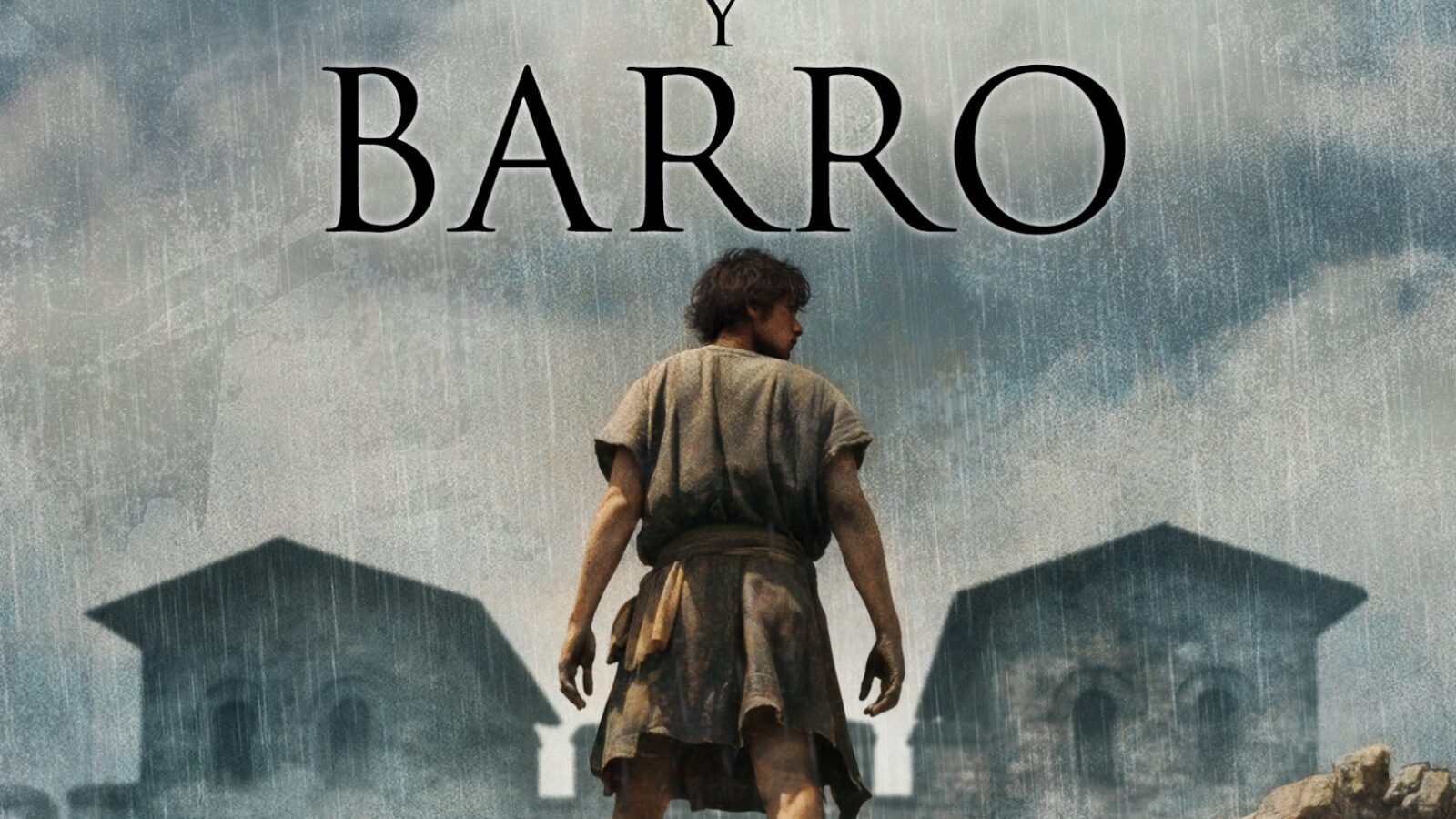
The year is 38 CE in the city of Histria, a jewel perched on the shores of the Pontus Euxinus. A man plagued by debt faces a decision that could spell disaster for his family. He alone will be responsible for his son being condemned to the brutal mines, for his daughter being thrust into slavery, and for his wife to languish in solitude.
In this making of Miquel Fornera recounts how he wrote Chains of Iron and Mud (Edhasa).
***
As I always explain in literary presentations, I belong to the “Gladiator generation.” Yes, the same one that encountered The Lord of the Rings through the films before the books. It was therefore inevitable that this would happen.
My generation has been marked by epic films, Roman series, and the rise of a new wave of fantasy
. When I was a child I would reenact battles against dreadful barbarians along the riverbank near my town. Sometimes, when the confrontation seemed lost, we would throw stones until one of our parents, strolling by, decided to scold us for how foolish we were and how dangerous it was to play that way. That said, if we happened to tell at home that so-and-so’s father had scolded us for being at the river throwing stones, we would pay the price again and fall asleep heated.
During those tender years, the idea of writing already hovered in my head. I began devouring Roman and Greek novels by the dozen. It wasn’t until three years ago that I reached saturation. The historical novel about Rome seemed repetitive to me, always with the same tropes. Nothing different, nothing original. Until I concluded that there were three recurring features in all of them:
- The setting: Rome or, for our national authors, the Iberian Peninsula.
- The theme: war. The majority of books about Romans have war as the main premise, or at least a secondary one, the military conflict.
- The characters: great personalities, politicians or generals. Caesar, Scipio, Hannibal, Alexander the Great…
I challenge readers of these lines to rummage through their memories and try to find any Roman novel that does not meet, at least, two of these characteristics. If you discover one, contact me and recommend it.
In short, if I wanted a Roman historical novel that was different, I would have to write it myself. Thus was born Chains of Iron and Mud.
The plot unfolds in Histria, a city founded by the Greeks on the shores of the current Black Sea. The incursions of Thracians and Getae and their constant looting force this city and its neighboring polities to rely on Rome for protection. And contrary to what these lines might imply, the novel is not about war, but about its consequences. It takes us to a moment of postwar poverty and social crisis. And with a family trying to survive in this harsh situation. It is, then, the story of humble and ordinary people, like us, who strive to overcome the terrible adversities of their time.
Through its eyes, we will learn what life was like in a little-known corner of the Roman Empire, which I myself overlooked until by chance I found an article in Dialnet that blew my mind. How was it possible that no one exploited that context to develop a novel? The mélange of peoples and cultures that coexisted there did not always stand in conflict; they fed off one another and mutated due to the influence of one upon the other.
That said, it should be clear that this historical novel is not the typical Roman story. Especially because we shift the three fundamental pillars on which most works of the genre rest. That said, there is no need to know anything about history to enjoy it. Because it narrates the events experienced by a family as ordinary as any of ours, and we only have to empathize a little to understand that, faced with the same dilemmas, we would act in the same way. The death of a son, the loss of a mother, the feeling of injustice or the thirst for revenge affect us in the same way now as two thousand years ago. It was necessary to talk about them, and about them. I had no option but to give them a voice.
Author: Miquel Fornera. Title: Chains of Iron and Mud. Publisher: Edhasa. Availability: All Your Books.