
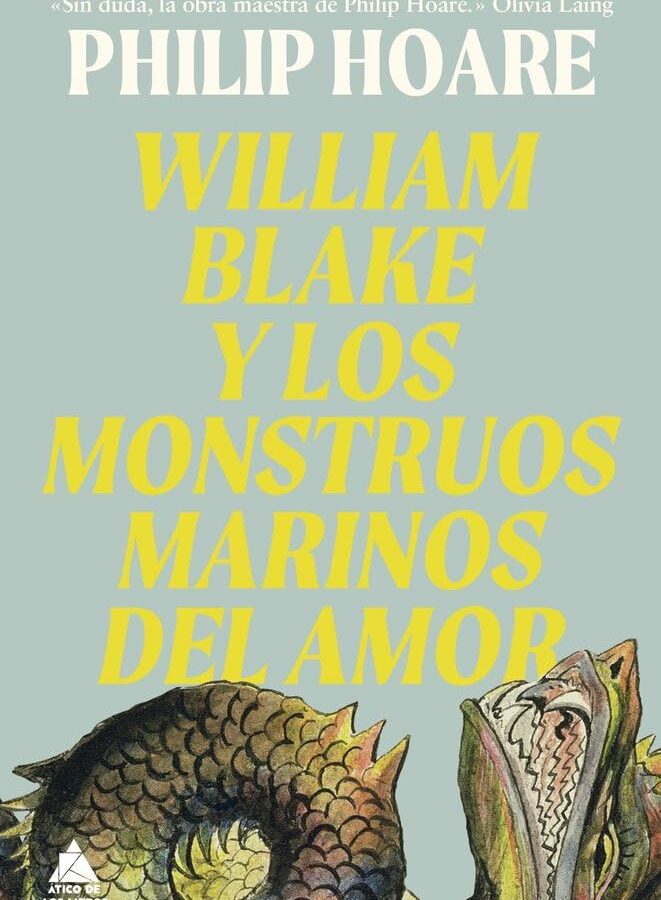
If you have ever paused to study the engravings and paintings by William Blake (1757-1827), you know they are among the most powerful, intricate, and enigmatic images in the history of art. Blake forged a unique mythology of his own: fantastical creatures, depictions of the soul’s degradation, figures of redemption and conflict, apocalyptic beasts, deities… His thoughts on God, imagination, and freedom have inspired and continue to inspire a multitude of creators. Also to Philip Hoare in this essay translated by María Alberdi for the Ático de los Libros publishing house.
The book, in its five hundred and fifteen pages that include some photographs, drawings and illustrations in which writers, painters, landscapes, maps or fantastical creatures appear, moves forward beneath underwater currents and free associations. One image leads to an artist, this to a memory and this to an idea of William Blake that unfolds freely like the motions of the sea.
The essay deals with artistic creation, the connections between creators and the bond between the natural world and the spiritual world. It is not an easy book. It is to be read slowly, to skip pages, to return to them, to read without a required chronological order. It is like a vast, unfinished sea, a mass of thoughts, works, and creators that move up and down around Blake’s work and life. The sea and William Blake. The sea and Philip Hoare. The author of the essay, right at the start, confesses:
“I believe in the sea, I place all my trust in it. If we knew what God is like, we would know what to expect.”
Perhaps that has been the motivation of the essay, a poetic odyssey where art history, nature, personal memory, and cultural chronicles blend to immerse us in the mystical and subversive universe of the English poet, engraver, and painter, and with which we play the game of creation, that is to say, of imagining. “Imagination is not a state: it is human existence itself”, William Blake once said.
The book opens with filmmaker Derek Jarman and painter Paul Nash fascinated after first encountering Blake’s works. Yet on the pages of the book there march, among many others, Oscar Wilde, Albrecht Dürer, Virginia Woolf, Iris Murdoch, James Joyce, Andy Warhol, David Bowie; and many, many, many more.
There is a symbolic ending. Hoare manages to access the library where Blake’s Notebook sits. As he reads it, he thinks:
“I dive into the diary of a magician, containing all his spells; cryptic, arcane, conspiratorial, a long incantation that invites you to intone it.”
“It’s impossible to know what came first, the images or the words; where one thing begins or ends. They merge into a single body, a tense echo of the intensity of his visions.”
Don’t think I’m giving away spoilers. The truly interesting things unfold through the chaos of the pages. Read the essay without a numerical order; it doesn’t matter much. That said, prepare to hear the sea during the readings. With Philip Hoare, the sea is always present.
A book for scholars and the curious, but above all for lovers of art, the sea, and imagination. Here you won’t find a mere biography of William Blake. There is much complexity, even a whirlpool. At the same time, the reading provokes a certain addiction because it explores the perspective that motivates artists. A book that seeks God in the sea as a symbol of the love that drives every creative impulse.
“I still know nothing about him.”
—————————————
Author: Philip Hoare. Title: William Blake and the Sea Monsters of Love. Translation: María Alberdi. Publisher: Ático de los Libros. Available at: Todos tus Libros.