
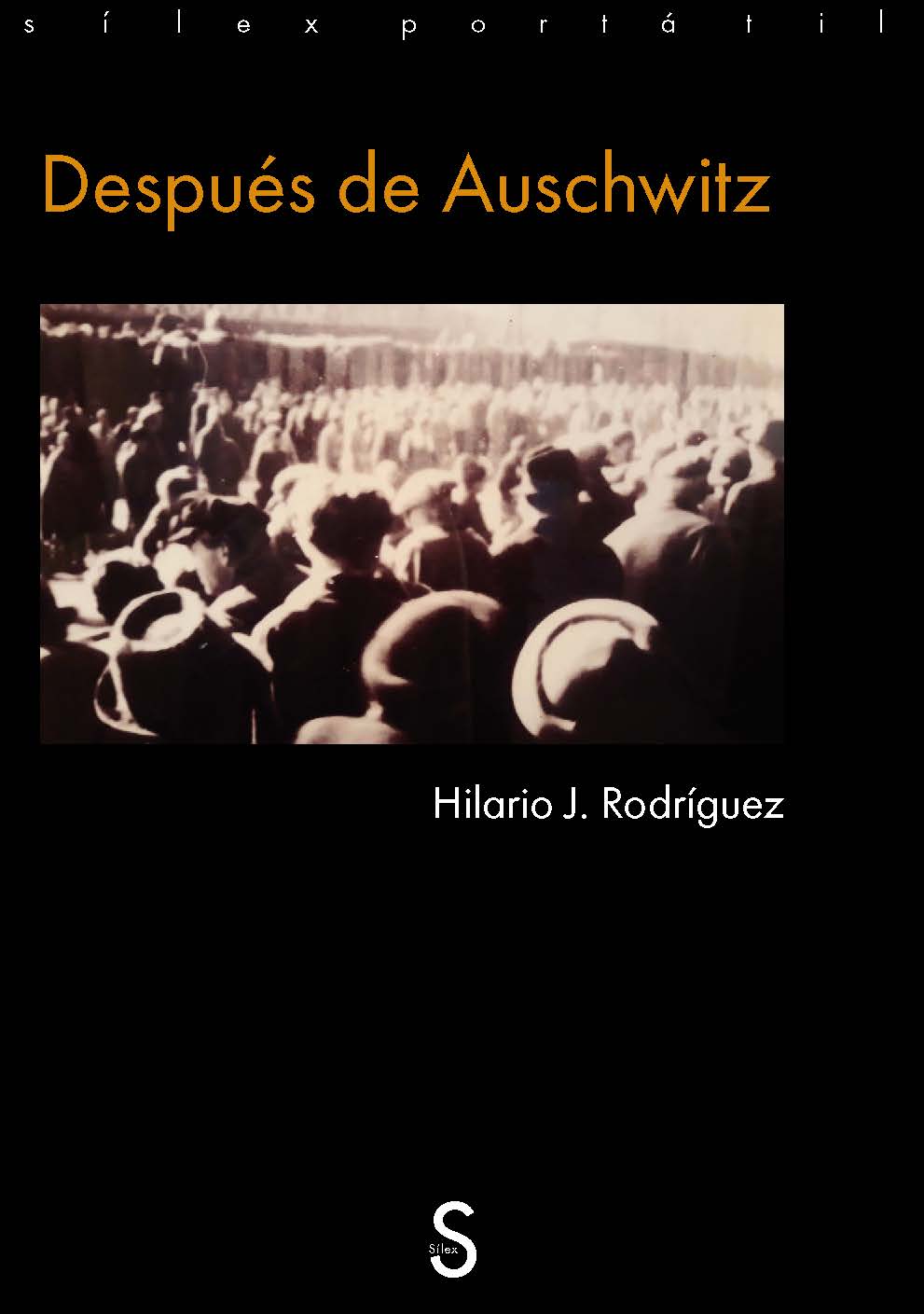
Hilario J. Rodríguez has penned a book, After Auschwitz (Sílex), which serves as a comprehensive manual of narratology. Behind the façade of a survey of the history of literature and cinema surrounding the Jewish Holocaust, the author scrutinizes the consequences of that verdict by Theodor W. Adorno that, after the Nazi extermination, composing poetry becomes an act of barbarism. Through the pages of this miscellany-like essay, filmmakers such as Claude Lanzmann and Péter Forgács, and writers like W. G. Sebald and Robert Walser, appear, along with a long list of indispensable references for understanding the cultural trajectory of a continent—the European one—that for an entire century has become the great cemetery of History.
*****
—In After Auschwitz you blend different genres (interviews, film criticism, literary review, etc.) to explain how the Holocaust transformed the way we tell stories. In fact, the book’s title could well be The Art of Narrating After Auschwitz.
—The germinal idea of After Auschwitz emerged in the late eighties, when, having completed my studies in philology and following the counsel of Isidoro Reguera, I approached philosophy. I understood then that what interested me in that discipline was more the plastic dimension than the methodological one, that is, that I preferred authors who tackled philosophical concerns through memory or fiction. That path eventually led me to Primo Levi, whose work If This Is a Man triggered a genuine upheaval inside me. That book made me acknowledge that Europeans bear a responsibility toward the memory of the Holocaust. After Auschwitz is born from that discovery. It is not a study of the Holocaust, but a book about the art of writing: about how to narrate after the enormous change that Auschwitz caused in our History.
—The book traces two trajectories: on one hand an analysis of how cinema and literature have represented the Holocaust, and on the other a study of how that catastrophe reshaped the art of storytelling. In the first axis you raise a fundamental question: the cinematic appropriation of the Holocaust and its transformation into spectacle. Because it is not the same to shoot Shoah as Inglourious Basterds. To what extent has cinema trivialized Auschwitz?
—It is evident that around the Holocaust an entertainment industry has arisen that we can call the Auschwitz industry. But we must also recognize that we cannot compel future generations to bear forever the weight of that genocide. The question is what we want to preserve and how we want to transmit it. There is an extreme, yet intriguing, example: the Nazi propaganda film shot in Terezín, bearing the abhorrent title The Führer Gifts a City to the Jews, intended to present to the world a false image of the detainees’ living conditions. Terezín was a transit camp from which many prisoners were sent onward to Auschwitz-Birkenau, yet the film sought to prove the exact opposite: that it was a wonderful place to live. And there lies the essential issue: to what extent can an image distort reality and to what extent are we able to distinguish truth from fiction.
—That worry also appears in the interview you conducted with Claude Lanzmann at the time.
—Yes, Lanzmann himself asked how we should produce and display images of the Holocaust. We can create fictitious images and endow them with a semblance of truth, but we can also employ documentary footage and show it without indicating its authenticity. And I find that very dangerous. It would be like showing in a film the real death of a person without warning the audience that what they are seeing is indeed real death: there is a moral difference that the viewer needs to know.
—We can no longer trust cinema.
—One of the aims of the book is to restore to cinema its power to intervene, a force that was extraordinarily potent in the sixties and began to wane in the seventies. I also want to remind readers that there was a time when we ourselves were viewers quite different from who we are today.
—Reading After Auschwitz gives me the sense of following the cultural biography of an entire generation: those of us who are now in our fifties. Your book features Primo Levi, Robert Walser, W. G. Sebald, and so many other authors who shaped our relationship with culture. And that makes your book, in a sense, the obituary of a way of understanding literature.
—Our generation maintained with literature a relationship similar to what new generations have today with social media or video games. We inherited a historical legacy through literature and cinema and then transformed it into a way of life. A clear example is that we enjoyed traveling to the places where the plots of the stories we devoured took place, or where their creators had lived. In that sense, After Auschwitz also speaks of an individual who has traveled through space and time. For me, being a good spectator implies being a good traveler: approaching the places where the images were born and questioning them from there. Those of our generation wanted to speak with the dead just as mediums did before. We were mad scientists who mixed reality and fiction to the point of not distinguishing one from the other. And from that emerged a literature that asks about the very power of literature. That way of joining art and life no longer exists. There is another way to relate these two, but not that one.
—In your book you say: “There was a time when being in an image was also like being at home.”
—Exactly. There was a time when we did not know that images could lie and we treated them as the scaffolding of true dreams. We wanted to share the epic of those westerns in which James Stewart or John Wayne traversed prairies and deserts. We wanted to test ourselves against the world so that the world would accept us. We wanted to tell reality: “We are here, and we deserve to be here.” Until one day we discovered that some images were not innocent, that they could be distorted, that they could be dangerous… And everything collapsed.
—Earlier we spoke of the need to travel in order to uncover what images and narratives conceal. Does that relate to what you call the “Benjaminian detective”?
—The Benjaminian detective is, in fact, the flâneur: a figure who roams the streets without a specific purpose. Benjamin understood that cities, as they began to take shape at the end of the nineteenth century, would end up colluding with a consumerism that, ultimately, would rob us even of the liberty to stroll without a determined aim. He, and later Guy Debord and the Situationists, sought an alternative way to move through the world. I am convinced that in the future there will be generations that long for movement. Now we can access everything without needing to travel, and that is a deficiency. The Benjaminian detective is thus someone who goes out, investigates, and seeks that which has yet to be domesticated by repetition. Someone who longs to find their own destinies and experience the unprecedented, that which has not yet been corrupted by repetition on social media. There remain countless places we can reach with the sense that almost no one has stepped there.
—In the face of that ever more uniform and predictable reality, you also champion the Renaissance concept of the “heterocosm” as a possibility of escape, a way to view the world from another perspective.
—Exactly. Heterocosms begin in childhood. Your mother tells you to get up, but you stay in bed imagining that between the sheets arise the tentacles of a giant octopus dragging you to the depths of the sea. That capacity to transform the everyday through imagination is one of humanity’s greatest powers, and we must recover it. Our will and our fantasy are immensely powerful tools: with them we can domesticate, transform, and renew reality, preventing the world from being reduced to a single version of itself.
—The title of your book inevitably echoes Theodor Adorno’s famous dictum: “To write poetry after Auschwitz is an act of barbarity.” You argue that the phrase has been repeated so many times that we now misinterpret it.
—That phrase functions almost as a curse, as well as a reminder: since the 20th century we bear responsibility for what we say and how we say it. Our relationship with history has changed and demands new responsibilities. That is why I am drawn to books that do not simply explain a matter but ask how to write about that matter. That is what I aim for in After Auschwitz: not to explain what the Holocaust was, but to question how we can write about it. Adorno’s line reminds us to take responsibility for our words and to acknowledge that we speak from our own position: “The only truth I can offer you is my truth.”
—Do you think the Gaza genocide will generate a literary and cinematic corpus that guarantees its memory?
—The Hamas attack triggered an immediate wave of solidarity with Israel, but when we perceived the disproportion of the response, perception changed. The outcry movements that emerged then, many led by young people, demonstrate that there remains a commitment to truth, even if expressed in forms different from those of previous eras. That said, and turning to the narrative question, I believe the chances of Gaza generating in the West a cultural memory comparable to that of the Holocaust are much smaller. I say this as a hypothesis, with great caution. The memory of the Holocaust consolidated thanks to a powerful testimonial, literary, cinematic, and intellectual tradition, and to a community with a strong historical self-awareness. The Arab world is enormously diverse and possesses other mechanisms for constructing and transmitting memory. Add to that that today cinema depends on platforms, production companies, and large financing structures that determine which narratives manage to circulate internationally. Surely there will be extraordinary films and books about Gaza, created by Palestinian, Arab, or Western authors, but I find it hard to imagine they will reach the centrality that the Holocaust bibliography achieved.
—More and more voices contend that travel is no longer what it used to be, that travel has lost the deep meaning it once carried, that today stillness can be more intellectual than movement. You are an incurable traveler. In fact, in September you publish The Art of Traveling Without Moving (Bamba). Do you think tourism has wrecked everything?
—In Europe we are losing the desire to understand the world that has characterized us since our earliest Greek-influenced origins. When asked what Europe’s language is, I always answer that our common tongue is translation. Being European should mean being a citizen of the world, believing that you can go anywhere and relate to people different from you without feeling threatened by their differences. Today, however, we live in a society that reawakens fear and rejection of the other. At the same time, our affluent society is beginning to deflate and the planet shows signs of wear. That should make us more responsible and humble, but no less courageous. We must continue seeking new ways to understand reality.