
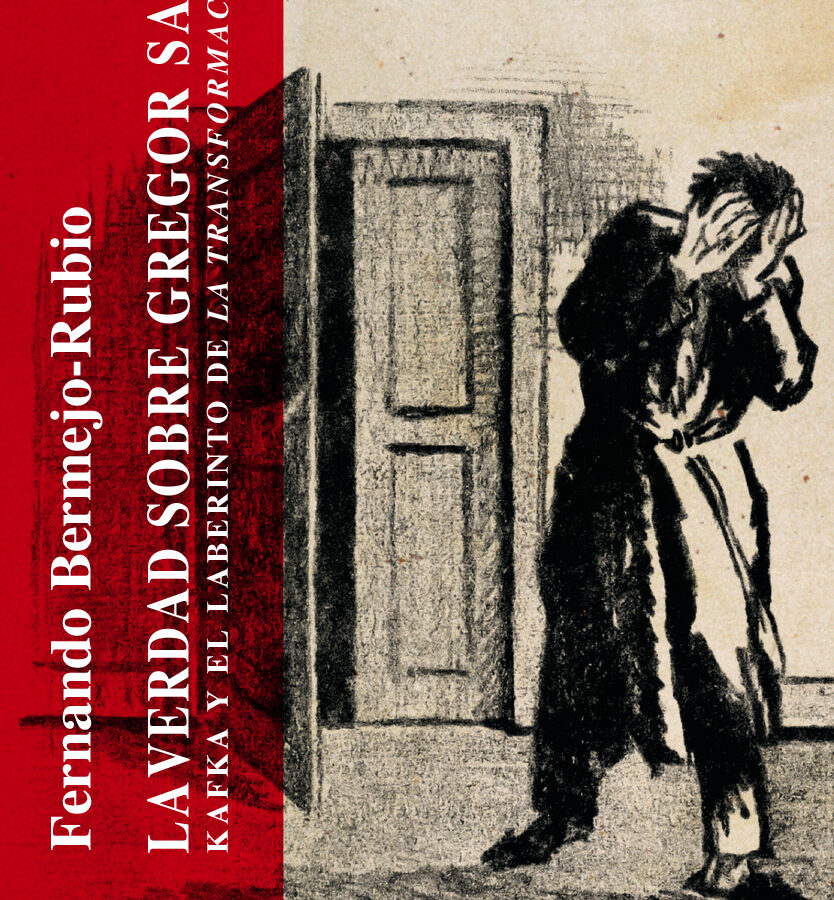
This book presents a reading hypothesis never before contemplated about The Metamorphosis. Half essay, half detective inquiry, the volume in the reader’s hands unravels Kafka’s most enigmatic text, while also offering the key to understanding others.
In this Making Of, Fernando Bermejo-Rubio explains how he arrived at the hypothesis presented in The Truth About Gregor Samsa (Akal).
***
Everyone knows that the longest tale Franz Kafka wrote is titled, in Spanish, The Metamorphosis. Some also know that its German title is Die Verwandlung, whose translation should be more accurately rendered as The Transformation. But what almost everyone ignores is that literary critics and Germanists themselves claim that the work, despite all that has been written about it, is ultimately “uninterpretable” and “incomprehensible”.
My first contact with this famous tale goes back about thirty-five years, when I read it, in translation, in the company of my closest friends. Like them and like millions of readers, at that moment I understood nothing. Yet, this misunderstanding spurred my curiosity. Thanks to a friend who gifted me a copy of the work in German—the language in which Kafka wrote—I began to devote more time to a careful reading of the text and to acquiring as much as I could of what had been published about the tale in the major European languages.
To my surprise, I soon noted that literary criticism, despite having poured rivers of ink over Kafka and, in particular, over The Metamorphosis, was unable to answer my questions or dispel my bewilderment. In fact, it was already in those years when I learned that the very specialists, whose works I expected to clarify my doubts, were mired in perplexity — though only a portion of them dared to confess it openly.
This intriguing situation, far from discouraging me, served as a spur. It is through careful readings that I began to realize that the tale contains two distinct and irreconcilable versions of the narrated events: one, in which the protagonist turns into a monstrous bug; another, in which he is at all times a sick human being, a victim of abuse and neglect by his family. According to the first version, Gregor is a despicable and dangerous being, while his family members are morally spotless individuals, victims of an aggressive “bug”; according to the second, Gregor is a person who has spent years sacrificing himself for his family and who, upon becoming ill and ceasing to be productive, is rejected and mistreated by his relatives, ultimately leading to his death.
Tirando del hilo, averigüé que el narrador de la obra, aunque en apariencia omnisciente, no lo es en absoluto, pues su perspectiva es limitada y coincide en gran medida con la del propio Gregor Samsa (esto lo habían visto ya algunos especialistas alemanes e ingleses). Ahora bien, si el narrador no es fiable y él es quien desde el principio sostiene que el protagonista se ve transformado en un bicho, hay razones de peso para desconfiar de lo que nos dice y para poner en cuestión las apariencias.
My interest in Kafka did not stop at The Metamorphosis, but extended to his biography and the rest of his works. It is precisely the reading of other tales, novels, and aphorisms that allowed me to find a through-line across several of his texts. It concerns the victimization mechanism—the device by which communities create scapegoats—and that twist in which the victimization of a human being is so intense that the victim ends up internalizing the perspective of her persecutors. In this situation, the victim, instead of resisting persecution and destruction, reproduces the persecutory discourse, causing the truth to be displaced by falsehood. One of my most decisive findings is that Kafka possessed a keen awareness of the existence of this phenomenon, which I have named “perverse objectivity.”
And it was then that I grasped the literary feat Kafka achieved with The Metamorphosis. This work is not the story of Gregor Samsa’s metamorphosis into a monstrous bug, but something far more realistic, more complex, and more revealing: the tale is the literary reflection of the process of forming a situation of perverse objectivity, in which the events are told from the perspective of a victim who has internalized the demeaning image that his abusers hold of him. This hypothesis makes it possible to read — for the first time since the work was published in 1915, now one hundred eleven years ago — the entirety of the narrative in a unified, coherent, and enlightening way.
The first version of what I wrote dates back about three decades, but for various reasons neither that version of my manuscript on Kafka nor later ones saw the light. After all, at the time I had earned a degree in Philosophy, was pursuing a PhD, and later studying a Master’s in the history of religions, after which I devoted much of my energy to research in that field. My priorities were elsewhere for many years.
Yet, between 2010 and 2013 I found time to publish seven articles in English, Spanish and German in journals of German philology and literary criticism, in which I shed light on various aspects of The Metamorphosis that Kafka scholars describe as “incomprehensible”. Although some German-, Austrian-, and North American specialists took note and spoke highly of some of these articles, my reading collided head-on with the reigning entomological paradigm — according to which Kafka narrates Gregor’s metamorphosis into a bug and reflects the “absurdity” of existence —, which is why most literary critics remained silent.
What is astonishing, dear reader, is not that in Kafka’s longest work he tells of a human turning into a monstrous bug. What is astonishing is that he does not do it and that virtually everyone still asserts the opposite today. The Truth About Gregor Samsa explains, in full detail, why. What this situation means is something that will give any thoughtful person a lot to think about, who—fortunately—will take much less time to read my book than I took to think about it and to write it.
—————————————
Author: Fernando Bermejo-Rubio. Title: The Truth About Gregor Samsa. Kafka and the Labyrinth of The Metamorphosis. Publisher: Akal. Available at: All Your Books.