
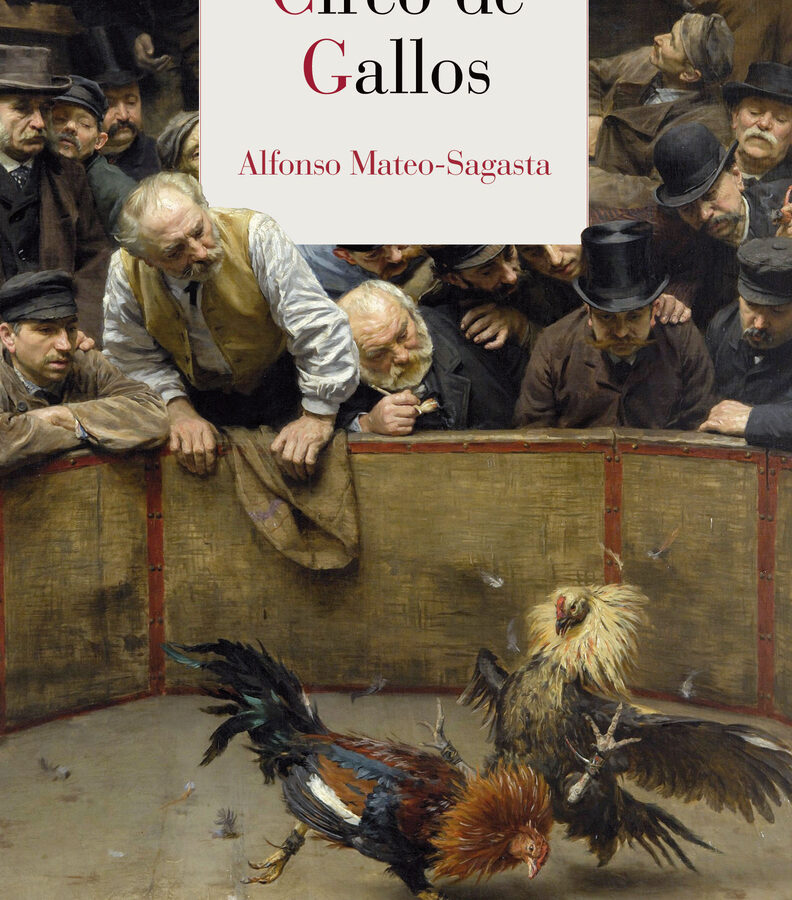
Sentenced to death by tuberculosis, Colonel Francisco Querol, who had just returned from the Cuban War, receives from Nicolás Salmerón, the President of the Republic, the task of freeing Castellón from the Carlist threat. This novel earned the Letras del Mediterráneo 2026 Award.
In this making of Alfonso Mateo-Sagasta explains how he wrote Circo de gallos (Reino de Cordelia).
***
I think the construction of a novel can be compared to that of a dresser. First you manufacture each of its parts: legs, top, drawers… Then everything is assembled, varnished and sanded until the surface shines like a mirror.
In my case, one of the key pieces is the choice of the historical frame in which the events that will form the heart of the novel unfold. I don’t believe authors write the same book over and over again, but
Stephen King is right when he draws attention to recurring themes, and in my case, understanding History is one of them.
Perhaps that is why the complex Spanish First Republic fascinates me so much, and I am surprised to see how few novels address that era, despite how dynamic it was, full of passions, intrigue, action and adventures. The year 1873 was a huge crater in which many of the political and social movements that had been simmering for years erupted explosively.
Having fixed the frame, I set out to decide where to place the action, and I realized that the right setting was the province of Castellón, since in the summer of 1873 those two great peninsular conflicts coincided within its territory. Starting from its base in the Maestrazgo of Teruel, the Carlist brigadier Pascual Cucala, under the orders of Infante Don Alfonso, invaded the province from the north, while Francisco González Chermá, an uncompromising federalist, established the cantón in the capital. Francisco Querol, the protagonist of our story, will be entrusted by the Government with solving both problems.
The other pieces of the furniture were gradually added during the documentation process. The first was a duel. I am very struck by duels and the complex paraphernalia developed to regulate offenses, rudeness, mockery, fame and above all to judge intention. I thought it would be a good idea for the entire story to revolve around a duel and its dramatic resolution.
The second was the one that gave the novel its title: Circo de gallos. Cockfighting circuses, the cockpits, to which people were so fond at the time and which attracted all kinds of people. In Madrid there were at least two, and since I read about their structure and operation I found it impossible not to play with the simile between the cockfighting rings and the Parliament.
For me another important theme was the republican clubs, their origin, their intense educational function, their vocation of service to the community and the fundamental role played by the women who, although excluded from active politics, led without hesitation the movements advocating social demands.
I was also interested in addressing the emergence of professional photography studies and the new bourgeois fashion of gathering albums in which they kept family photos and those of famous people of all kinds, from bullfighters, artists, politicians and, of course, aristocrats. There was no elegant house without an album, and the Querol family had to have one.
The fifth piece of the furniture is the opium dens. In the era they were common in Paris and London, but there is no reference—at least I have not found—to dens in Madrid, neither historically nor literarily. However, I do not think it crazy to suppose that opium was also consumed in Madrid, especially considering our ties with Asia through the Philippines, and I thought it a good idea to establish a discreet opium den in Arganzuela.
The novel continued to fill with curious details of the era, of the way of living and of understanding the lives of its characters, but none is as striking when compared to our own time as health. And in that respect I was greatly struck, and I have not been able to stop using it: the discovery of a strong anti-vaccination movement in the second half of the 19th century, although on this occasion the cursed vaccine was the smallpox vaccine.
That is, in broad strokes, the world through which the novel’s characters move, both historical and fictional, though at bottom they are all fictional once filtered through the author’s mind. Among the supposedly historical figures are, of course, Salmerón —who holds the presidency at that moment and assigns the mission to the protagonist—, Pi y Margall, Castelar, Francisco González Chermá, Martínez Campos, Villacampa, Pascual Cucala, Roque Barcia, Alfonso of Bourbon-Austria-Este, Francisco Savalls, José Escobar…
I found the protagonist of this story in the memoirs of Fernando Fernández de Córdoba. The general and minister includes a letter that speaks with astonishment of an officer stationed in Cuba, terminally ill with tuberculosis, who refused to leave the front to go to the hospital because he had decided to die there. What I did was bring that character to Spain to fulfill such an absurd and risky mission that only a man facing a terminal fate would undertake. A mission for a man with no future. What he had not foreseen was that the past would come forward to demand accounts, nor that you would read his story.
—————————————
Author: Alfonso Mateo-Sagasta. Title: Circo de Gallos. Publisher: Reino de Cordelia. Available at: All Your Books.