
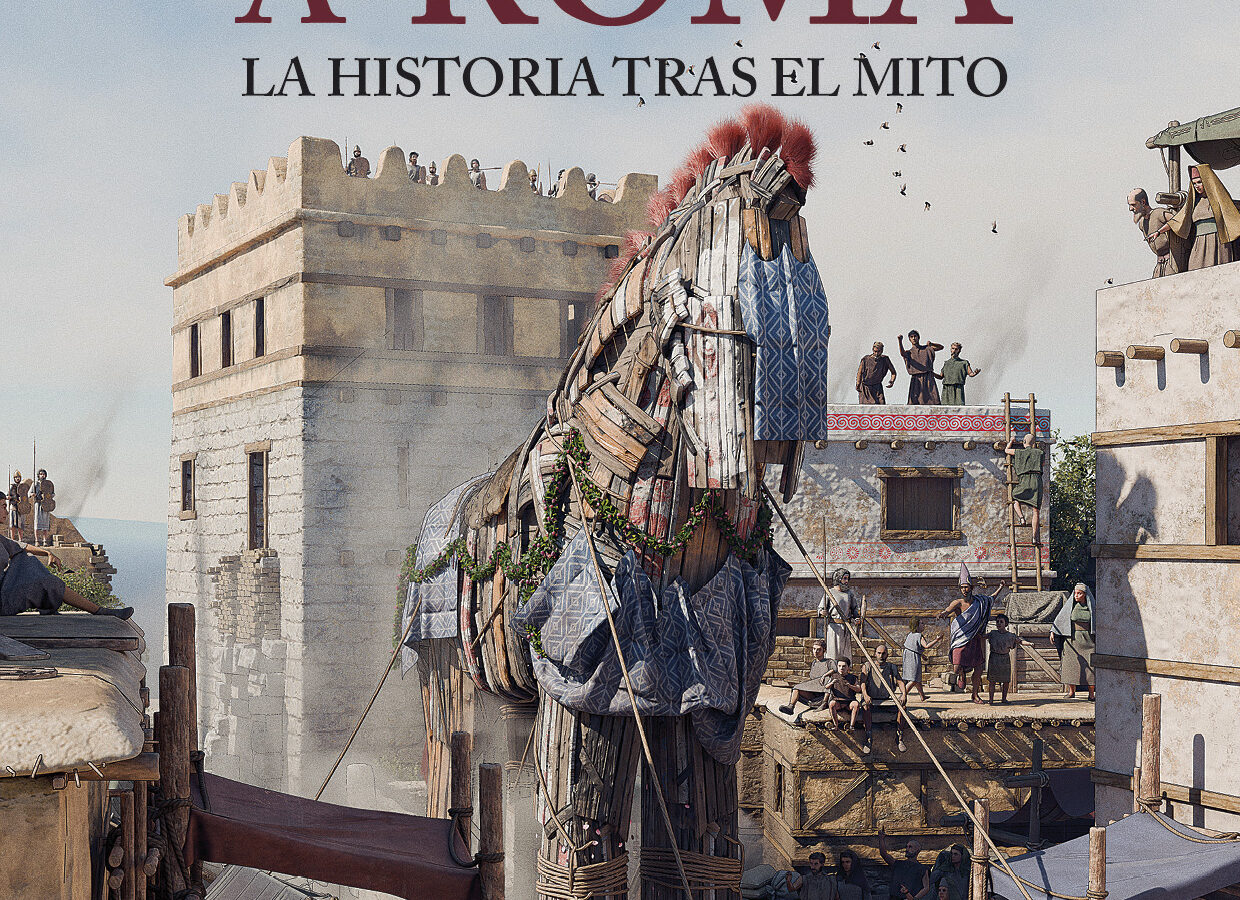
This book journeys through, via illustrations and 3D virtual reconstructions, from the burning of Troy in the Bronze Age and the founding of Rome in the Early Iron Age to the splendor of the classical world and the Eternal City of the emperors.
In this making-of Néstor F. Marqués and Pablo Aparicio explain how they wrote From Troy to Rome: The History Behind the Myth (Desperta Ferro).
*****
As we stroll through the streets of Rome, we can feel the weight of history resting on its seven hills. Grand palaces, millennial ruins, or simple blocks of marble and travertine scattered throughout the city’s corners seem to speak to us of the complexity of this great archaeological and historical lasagna, if we permit the divulgative license, which is Rome.
Nevertheless, on this occasion, we have wanted to go one step further. Long before the great modern avenues were opened, but also before the papacy dominated the city and even before the Roman emperors ordered the construction of grand temples and monuments, there existed another Rome far more humble and modest. The Rome of origins, the one that would give rise to all the others, is what Pablo Aparicio and I have wanted to reveal in our latest book.
As we did with The Rome of Constantine, this is a work with more than two hundred illustrated pages in which we have aimed to recover the knowledge of an era in which history is often relegated to the background in favor of legends, those that the Romans themselves would tell after themselves and those that others recovered from oblivion. And the origin of the Romans goes back to a time centuries before their own existence and on the other side of the wide sea. It was the fall of Troy, so fashionable thanks to the new cinematic version of the Odyssey brought by Christopher Nolan, that propelled the origin of the Roman lineage. By the hand of Aeneas, the hero who always put his people and his gods above his own interests, the defeated Trojans managed to perpetuate the memory of their people in a new land: Italy.
From this story, with its lights, shadows, doubts, and uncertainties, arises the idea for our From Troy to Rome: The History Behind the Myth. It is worth noting that studying such an ancient period and making it appealing to the general public is a complex task. Not because of the implications of rigorous research, but because it is easy to fall into the comfortable arms of myths, with their comforting narratives. Therefore, we set out to examine this ancient origin story of the Romans not only from the perspective of those mythical narratives, but we have sought to uncover the real histories hidden behind them. And to go further, archaeology has also helped us confirm or, on occasions, refute, what myth and history have transmitted to us.
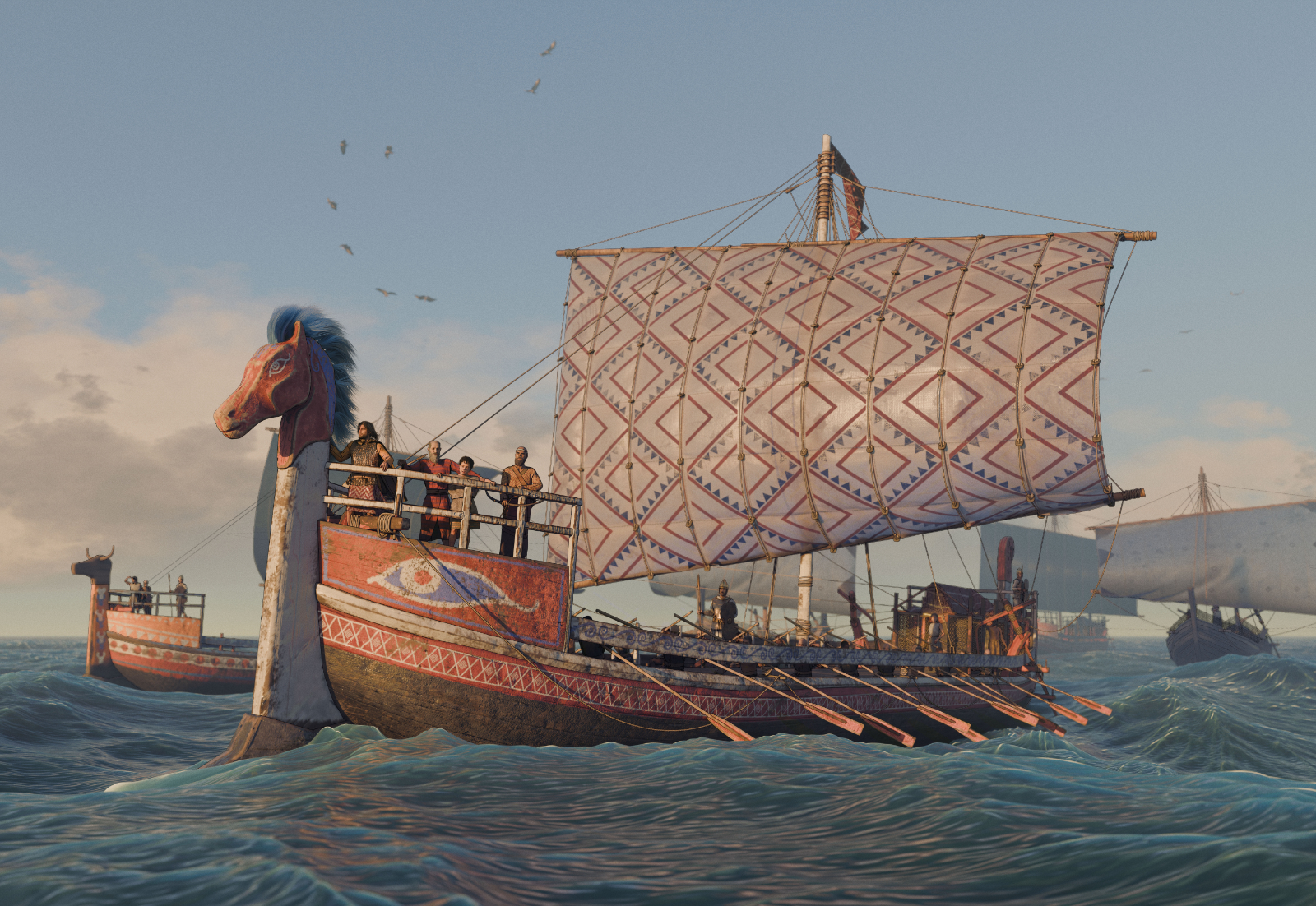
For all of this, the book is the account of a journey, divided into three clearly defined blocks. In the first, we witness the destruction of the sacred Ilium and accompany the Trojans in exile; the second shows the arrival in the new land and the life of its descendants, and in the third we observe the founding of Rome as a city and civilization. Each of these blocks features three well-defined chapters. One to address the myths, as transmitted by the ancients —marked in orange to emphasize their distinction—, another to seek the truths and lies on which they rested, and a final one so that the archaeology of three key cities — Troy, Lavinium and Rome — reveals everything that no word has been able to convey to us. A tripartite structure of three times three chapters that would not only have delighted the more religious Romans and numerology enthusiasts, but also allows any reader approaching the book to carry away a clear and organized, engaging and rigorous understanding, bringing topics of high academic complexity closer to all audiences.
The work of historical illustration, always supported by the most advanced 3D technologies, completes the other half of the soul of this work. It is a rigorous, artistic, and controlled undertaking in which we have aimed for the 3D and 2D design techniques to complement each other, the former contributing metric precision and the latter giving rise to a visual finish already characteristic of our works, with which we believe we can better convey to the reader our image of Antiquity. From the outset of the project we have worked toward this goal, side by side, combining active research into the archaeological origins of Troy and Rome with the formulation of graphic reconstruction hypotheses that would allow us to build this true illustrated journey into the past, always from scientific rigor that does not shy away from spectacle.
mockups-design.com
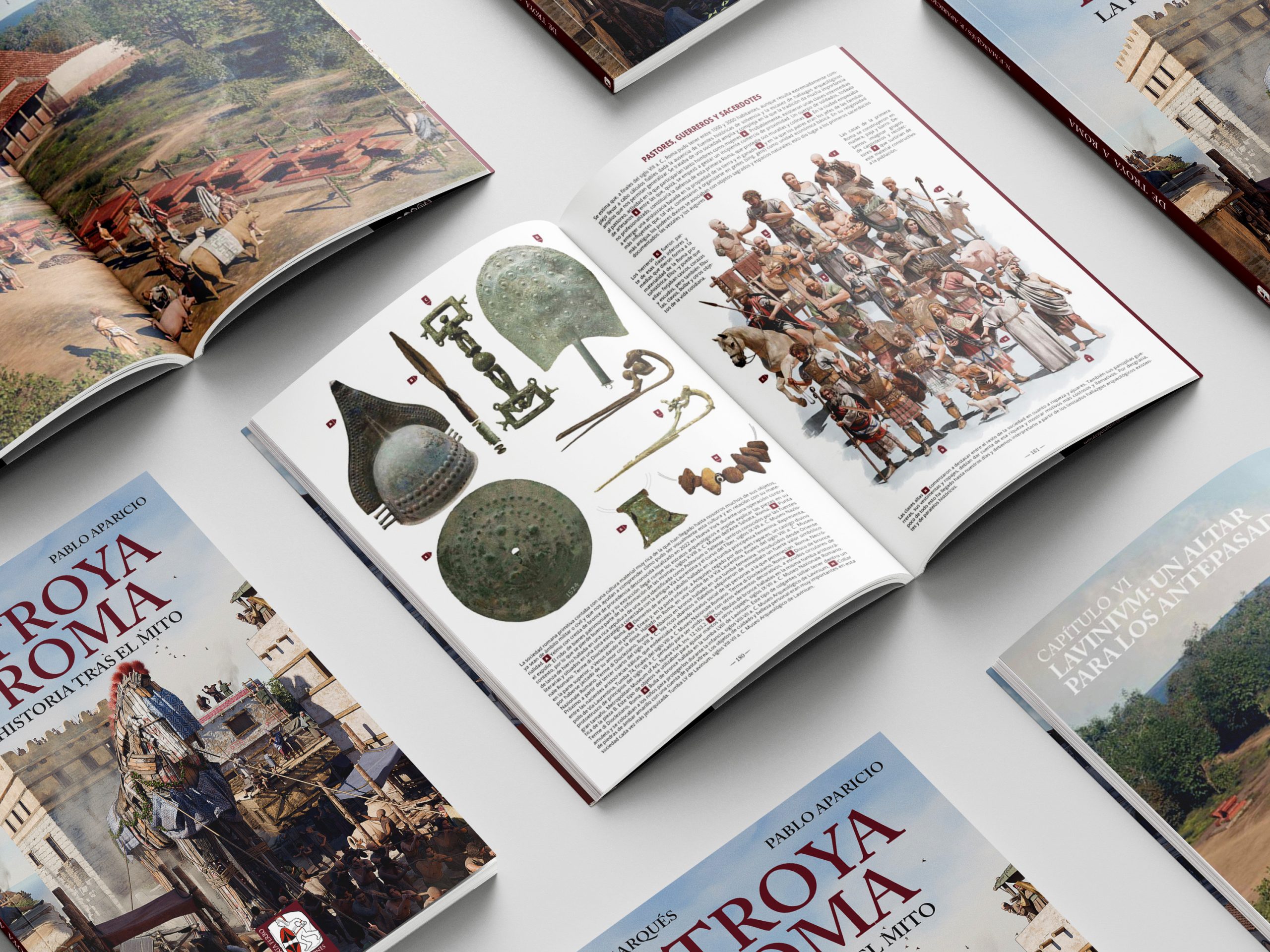
If in our previous illustrated book, The Rome of Constantine, which is already navigating the publishing seas in its fourth edition, we especially pursued a careful architectural and urban reconstruction, in this case we have gone one step further. From Troy to Rome offered us the perfect opportunity to carry out historical illustrations that, in addition to exploiting the architectural rigor of structures as little-known as the huts of Rome in the 8th century BCE or the Trojan houses, could construct an even more empathetic window between the viewer and our shared past. Thus, we have designed two large infographics of Trojan society and early Roman society, respectively, that allow us to look eye to eye at people who could have existed thousands of years ago: peasants, artisans, spinners, potters, warriors, ranchers, aristocrats, priests… All of them are recreated in 3D from archaeological and iconographic sources that also help us to critically compare different cultures of our past. Moreover, this new book opened the door to carrying out another type of virtual reconstructions: scenes from mythology inspired, mainly, by the Aeneid and other legends of Rome’s origins. Here, imagination can reach higher heights of creativity, escaping historical rigidity. From Aeneas’s ship to the Lupercal, including Queen Dido and the king-priest Numa, we render them in images while ensuring they wear the garments and hold objects archaeologically associated with the contexts in which their legend drew inspiration.
A book like this, in which illustration and text must be so well intertwined, also requires almost a curatorial effort in which we put ourselves in the shoes of a kind of exhibition curators to create the work that the reader ends up holding in their hands. Thus, to the illustrations and texts there is added a careful joint selection of photographs of artifacts and archaeological sites that allow the viewer to observe firsthand the remains related to the historical-archaeological narrative through which they are traveling. If we add to this the fabulous maps that accompany the entire narrative, we are left almost with a total editorial work, a true sensory journey to a past such as that of Aeneas and Romulus that allows us to discover, in many ways, the history hidden in myths. We hope that readers enjoy this journey as much as we have enjoyed steering it to a successful port, aboard Aeneas’s ship toward Latium.
***
Pablo Aparicio Resco is an art historian, archaeologist, and specialist in heritage virtualization. For more than ten years he has worked, through PAR – Archaeology and Virtual Heritage, on virtual reconstruction and digital illustration projects that combine art, heritage, and technology. He is the author of Windows to the Past: The Reconstruction of History with Images (Akal 2025) and co-author with Néstor F. Marqués of the illustrated books The Rome of Constantine (Desperta Ferro Ediciones, 2024) and From Troy to Rome: The History Behind the Myth (Desperta Ferro Ediciones, 2026).
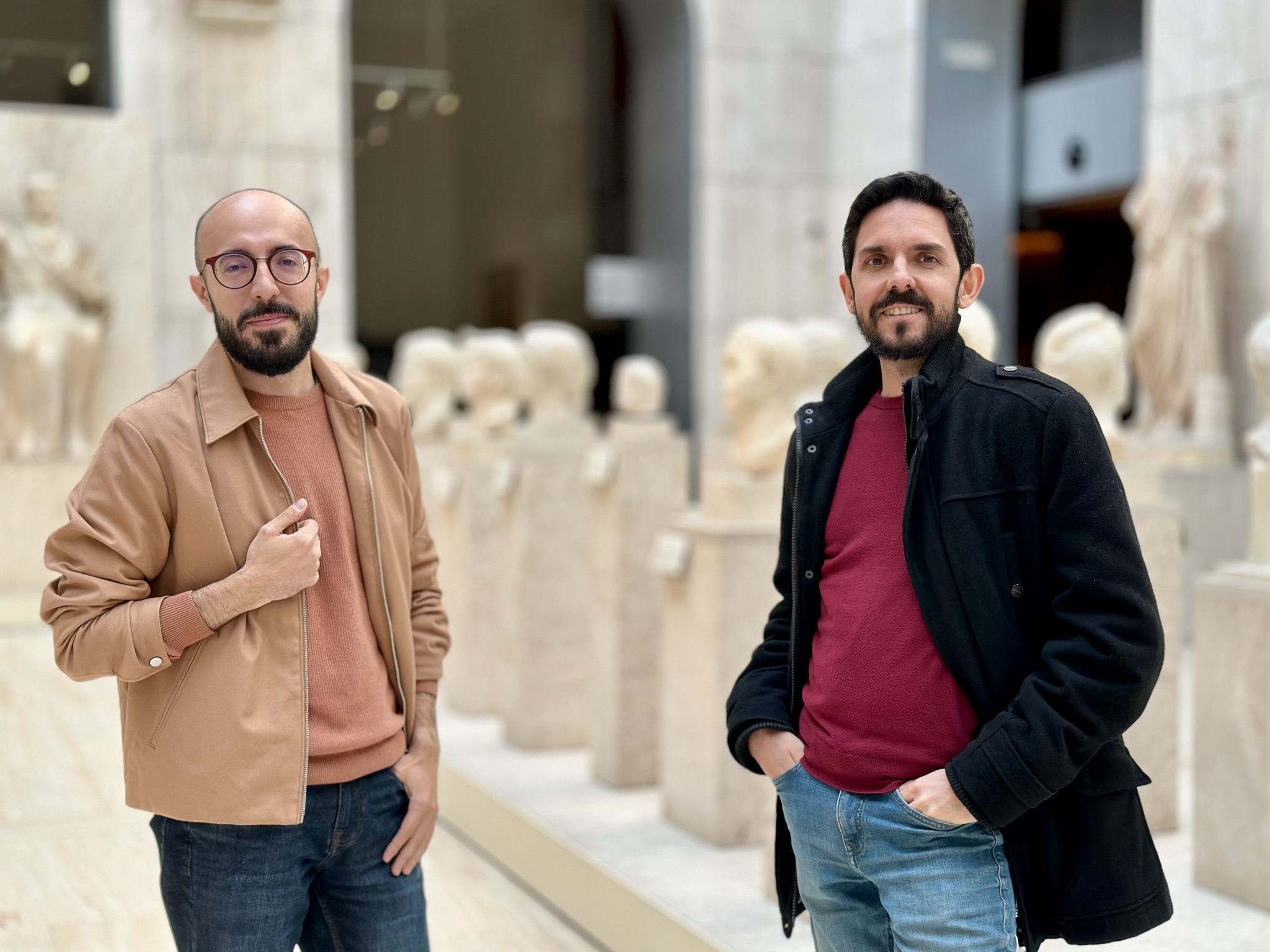
Both authors combine their passion for heritage and technology in their various roles as partners since 2021, alongside Miguel Fernández Díaz, of the company 3D Stoa – Heritage and Technology, a pioneer in the comprehensive application of heritage virtualization techniques. They also jointly promote since 2018 KORÉ – Online Training in heritage and technology, an educational project through which students from around the world learn 3D design techniques applied to heritage and other related projects of virtual reconstruction, digitization, and 3D printing and dissemination in various formats.
——————
Authors: Néstor F. Marqués and Pablo Aparicio. Title: From Troy to Rome: The History Behind the Myth (Desperta Ferro).Publisher: Desperta Ferro. Sales: Todostuslibros.