
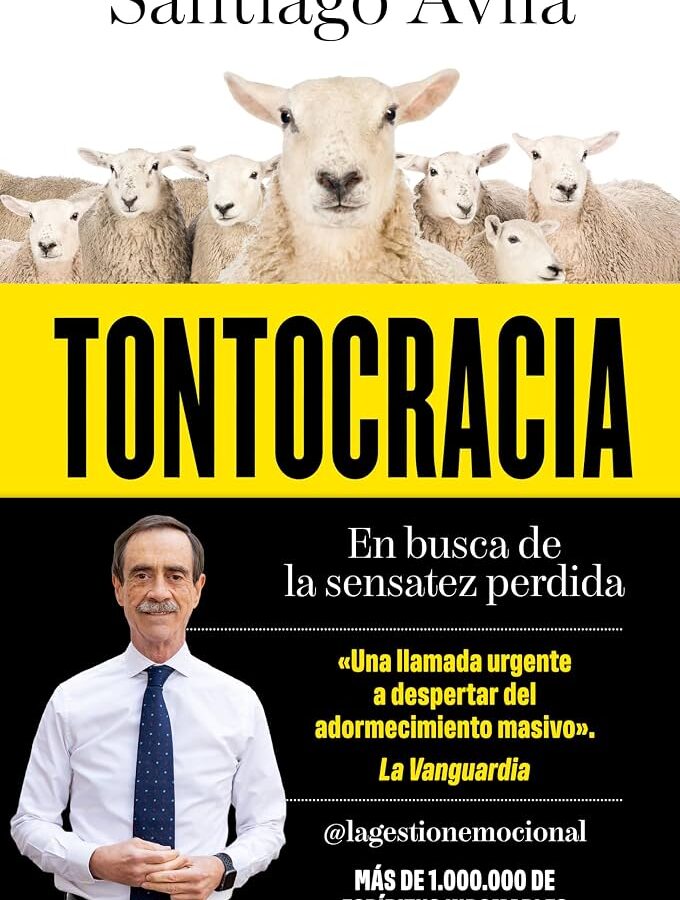
What I never imagined is that this idea, born almost by chance, would end up connecting with thousands of readers and becoming a shared conversation about some of the contradictions of our time.
Too often it is circumstances that push us to walk paths we had never imagined traversing. I had not planned to write Tontocracia. It wasn’t among my immediate plans, nor did I even contemplate doing it in the future. It was life, embodied in a publisher, that ultimately made it possible.
Indeed, the ideas, the characters, and the settings sustaining its narrative had been simmering in my mind for years. That deadbeat boss who hid behind the smoke of his pipe; that dean who, like a ballet dancer, tiptoed around every hindrance; that “consensus seeker” who could never quite please himself. All of them waited in the wings of my thoughts. Perhaps that is why I had spent years feeling the need to unmask the protagonists of a tragicomedy that, despite its appearances, contained far more tragedy than comedy. Only missing was serendipity to do its work and give it a name: Tontocracia.
Yet something was missing. A spark capable of turning that amalgam of experiences, intuitions, and reflections into a publishing project.
That spark had a name and a surname. But allow me to keep its identity until the end.
I recall that she asked me for something seemingly simple:
“Santiago, propose an outline. Put your ideas in order and let’s see your proposal.”
What appeared was Tontocracia.
The curious thing is that the book did not begin when I started writing it. It began much earlier.
Perhaps it began gestating during my years in the corporate world, continued through my teaching career, and kept growing as experience allowed me to view all those situations with a broader perspective.
In that life journey, there was something that never quite fit. I saw how common sense seemed to be absent from too many places. Mediocrity managed to prevail over merit; appearance displaced essence, and reputation yielded ground to popularity. It wasn’t a matter of isolated episodes.
The same phenomenon appeared again and again in very different spheres.
I saw it in a teaching sphere increasingly worried about shielding students from frustration rather than preparing them for life: education turned into an emotional spa.
I saw it in organizations where proclaimed values were not practiced: the company transformed into pure theater.
I saw it in a society fascinated by showcases and shortcuts: a society turned into a vast trompe-l’œil.
And I also saw it in a politics that, too often, turns frivolity into argument and noise into proposals.
The same question kept returning to my reflections. It appeared in all kinds of scenarios with different faces and outfits, yet it always summoned the same perplexity:
How have we come to normalize the lack of honest standards and healthy ambition?
This question ended up becoming the true origin of the work.
Perhaps that is why the concept of tontocracy resonated on social networks even before it became a book. That word, born from intuition, seemed to name a feeling shared by many people.
Paradoxically, when I published my early works, I was the one who had to knock on publishers’ doors. This time the opposite happened. The publisher knocked on mine.
The proposal arrived at the right moment.
What began as a conversation ended up becoming an invitation to organize years of observations, doubts, and lessons. And, curiously, also into friendship. But that would be a story for another book.
The result was a work populated by characters easily recognizable. Some fit classic archetypes, such as the fool, the foolhardy, or the mediocre. Others arose from observing certain human behaviors repeated time and again in different contexts. The shouting boss or the salesman of smoke. Characters recognizable in any organizational setting, who, without belonging to anyone in particular, belong to all of us.
Tontocracia does not intend to ridicule anyone. Nor to assign blame. Its purpose is simpler and at the same time more ambitious: to invite reflection on certain behaviors we have ended up accepting with far too much ease.
Because societies do not deteriorate overnight. They do so little by little, each time comfort replaces judgment and appearance defeats truth.
That is why the book ends with an appeal to hope.
Not naive hope that expects miraculous solutions, but the one that arises from individual conduct. It does not call for heroism but for humanity. To preserve one’s own judgment and to defend what deserves to be defended.
It is not a closed narrative. It is open for you to complete its pages with the characters you have encountered in your own life.
We will not always be able to change the world. But we can always decide who we want to be within it.
We will not free all battles. But we can free some. The truly important ones.
We need you. Because without you, that spark, remember, which one day sparked my editor Berta Moreno, would not have found the meaning for which it was born: to become something shared.
Let’s talk starting from its pages. That is where the true story begins.
—————————————
Author: Santiago Ávila. Title: Tontocracia. Publisher: Vergara. Sales: Todostuslibros.