
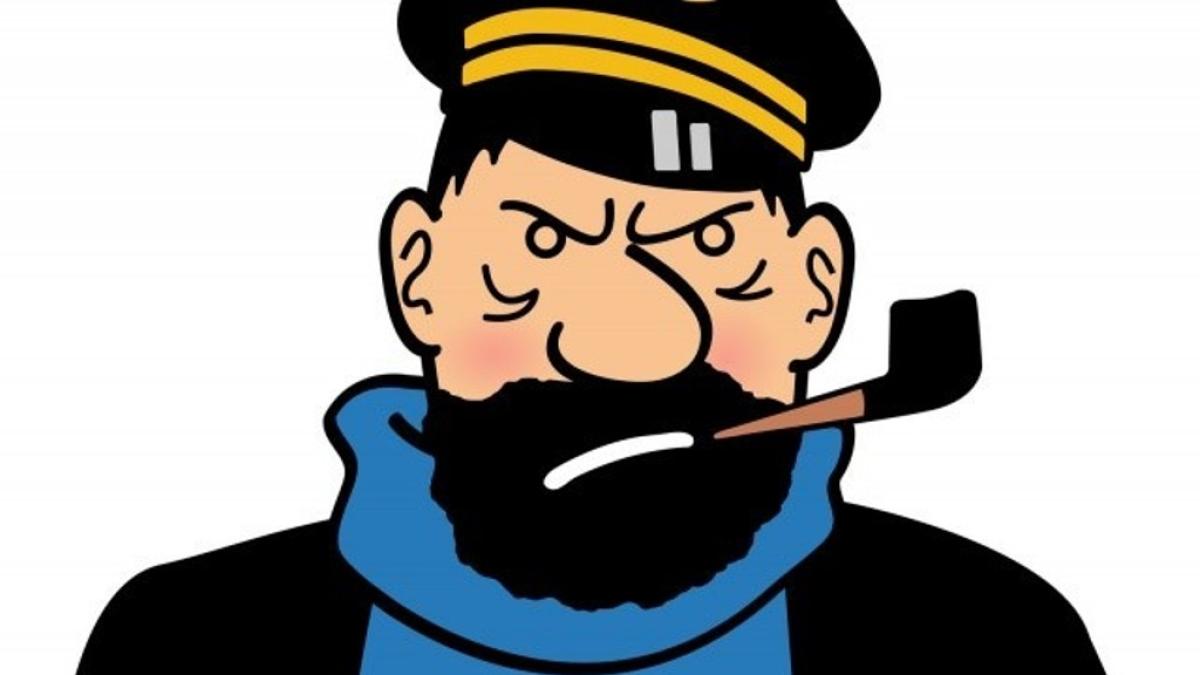
My children wear a tattoo of Captain Haddock. They bear it on the arm not only as a tribute to the brilliant and irascible sailor from Hergé but as an explicit and direct homage to their father. That is what they told me, at least, because they claim that their foul-mouthed father bears a strong resemblance to the character who served as the counterweight to the idealistic Tintin. They didn’t manage with that ploy to fund the tattoo artist’s work, but now I can confess that it wasn’t a bad guess. When I boil over, I am capable of uttering as many insults as I can conjure on the spot. Some of them, in fact, have achieved a certain endogenous celebrity among my circle of friends; we cycle through them for the pure pleasure of folklore and to remind ourselves, in passing, that flesh, besides being mortal, covers the skeletons of more than one asshole.
Insult, the profane word, and a timely outburst have on more than one occasion taken root in my newspaper columns. Naturally, I have paid one digital rebuke in return from those who have the immense deference and infinite patience to read me. I admit that, at times, a slight remorse creeps in because of the job and that thing of not blotting 125 years of history of ABC with my blasphemous babble. But that remorse doesn’t last long. Most of the time I reaffirm my use and enjoyment of the swear. Essentially, because I believe it is one of the most beautiful, imaginative, and devastating contributions of our language to the world.
We live suffocated by a global order dominated by Anglo-Saxon dullness. That crude culture and its limited insult repertoire — which does not go beyond the monotone fuck and the bland bitch — which, also, forces us to lean more on cynicism, irony, and sarcasm, isn’t bad either. What is ours, the Spanish language, is something else. It is a lexical slash that cuts you from top to bottom. We have the language so dominated, so embedded in the marrow, that a single word is capable of enclosing the most absolute contempt or triggering the most ardent admiration. Because in tone, in the pause, and in the malice of the exact moment lies the true art of the insult.
Our tradition is rich in these skirmishes. We do not invent anything. Already Francisco de Quevedo, who wielded the pen like a Toledo stile, flayed his enemies — with Góngora in mind — calling them “executioner and scribe” or accusing them of having a “superlative” nose, which in the seventeenth century stung more than a slap. Or Camilo José Cela, who elevated the expletive to the category of Fine Arts and gave us an implicit treatise on carpetovetonic insult, reminding us that the swear word is not dirt, but idiomatic muscle.
Swearing in Spanish is varied, lyrical, and torrential. There is so much to choose from that, often, I shield myself with it when I go out there; in that outward display where everything is “to know how to behave” and posturing, where not being matters more. What can I tell you, to me there seems to be more truth, more light, and more catharsis in a thunderous, heady insult spoken in the exact moment and with the right phonetics, than in all that syrupy pretense with which we exchange polite greetings. It’s as if life were a Versailles minuet and not what it truly is: a beautiful, loud, and barefaced struggle.
Now that an electoral period looms ahead, I beg our champions to make a little extra effort. Yes, I know it will be the dirtiest campaign in history, but at least let it also be so in contempt, caricature, and height-of-derision for the rival. From San Millán to Madrid’s current corrala, our marvelous language has given us a thousand ways to verbally rake the duelists. Let them be as merciless as the occasion deserves but let them also be adept so that what is merely a cut of flesh seems like a stiletto thrust. The object of our invectives deserves that we do not dismiss them with a dull “you’re stupid” if we can devote to them a apollargao, sinsorgo, gaznápiro or chorlito. What homeland politics would gain.