
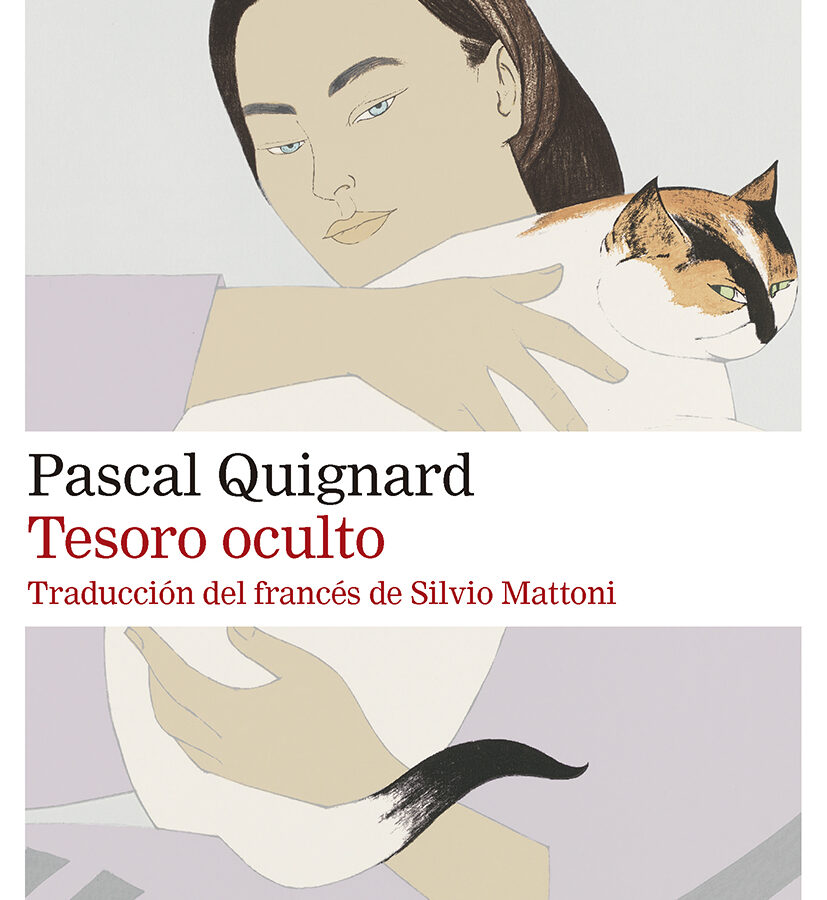
I am not sure whether Pascal Quignard has read Las coplas por la muerte de su padre, but it seems clear that Tesoro oculto — published by Galaxia Gutenberg — upholds the old idea propounded by Manrique, that “our lives are the rivers that flow into the sea.” I am not entirely convinced, however, that Quignard would agree with the fate implied by that illustrious elegiac couplet. I invite you to accompany me on this riverine and literary voyage in which we will try to glimpse the sea and discover whether death awaits us there.
And indeed Tesoro oculto is all water
. It springs from the banks of the Yonne when the protagonist buries her dead cat there, and it will dazzle us with its inexhaustible lyric reflected in the waters that wash the islands of Procida and Ischia. Louise will meet Louis there. Just as the lovers’ names threaten to fuse into one, Quignard alternates narration between first person and second person. The reader may not quite grasp how these shifts in perspective operate, but soon will suspect that Louise and Louis and the very fabric of the novel behave like deep currents that mingle where the eye cannot reach.
The book by Quignard flows laden with verses, with allusions to nature — cats from different generations recounting Louise’s life — and with references to classical culture. Indeed there is something of a melancholy epic in its pages, which almost without us noticing draws us into very brief passages that are nothing more than pools of exquisite poetry. The story nudges us toward Manrique’s verse, toward death, a persistent theme throughout the work, but the author handles his craft so deftly that he can write against the current without letting us drown in the process.
Between memories of living cats and dead cats — their motionless eyes are mirrors as the blank page is to a writer, both reflecting the most intimate sentiments of those who hold them — Louise will continually swim in loss. The loss of Louis, of her father, of her child’s grandfather, of the family house, and of the life promised within the walls of an old Italian villa. Memory and the passage of time ride atop a shapeless present, almost devoid of time. The book of Quignard envelops like a cleansing, purifying, gentle ablution, avoiding the practical details of writing a novel. The outline of a melodrama about family life barely hinted at becomes nearly an encumbrance.
I’ve read to Quignard that, like cats, he seems to flourish best in the night’s darkness. Toward the end, Tesoro oculto adopts a hazy, metaphysical, fragmentary tone. The narrator appears aware that the mouth of the river is near and embarks on digressions that grow increasingly intricate. With a few urgent ellipses, Quignard accelerates toward the finale of Louise, sending her back to the banks of the Yonne where she found the hidden treasure that changed her life. And despite everything—the solitude and the ghosts of the dead that are her sole companions—there is no pessimism, no defeat. The feline shade is only a prism from which to observe the world more clearly.
Our lives — and Tesoro oculto too — are rivers that lead to the sea. When you finish this book, you step off the boat at the point where the river loses its name. To our surprise, Quignard achieves the even tougher feat. His novel ends as an inverse catharsis, like a birth in reverse, subtle but luminous, something magical and gray and strange, difficult to define, yet in any case not the death that Jorge Manrique warned us about.
—————————————
Author: Pascal Quignard. Title: Tesoro oculto. Translation: Silvio Mattoni. Publisher: Galaxia Gutenberg. Retail: Todos tus libros.