
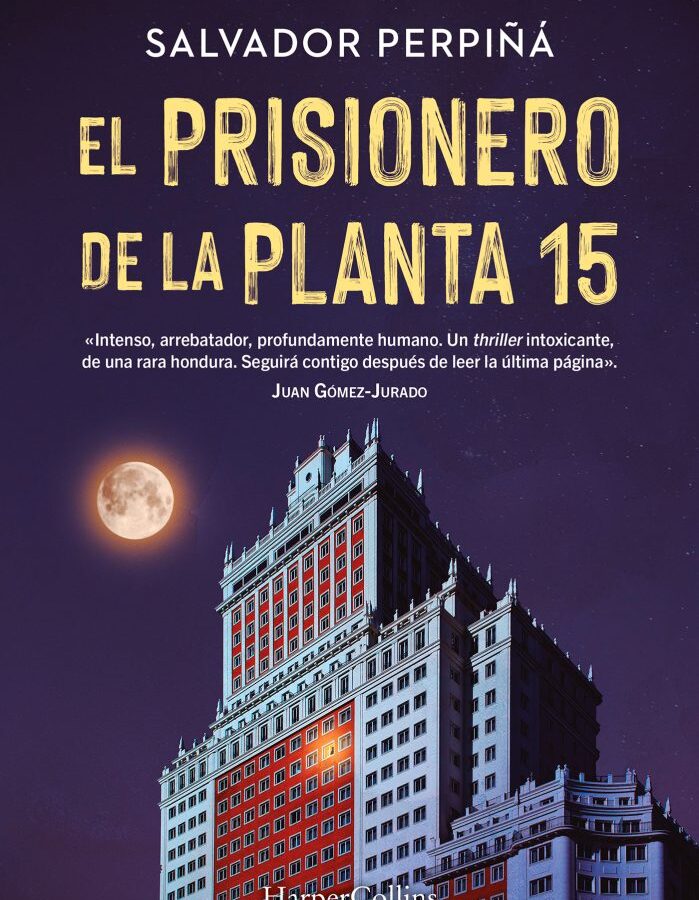
Madrid, 1966. Víctor Cano, a former Blue Division fighter, a former private investigator and morphine addict, lives like a recluse in an apartment in Edificio España, where inside he will confront a disturbing secret that will call into question everything he had believed about himself.
In this making of Salvador Perpiñá explains how he wrote The Prisoner of the 15th Floor (HarperCollins).
*****
This novel is the fruit of the fortunate encounter between a ghost and a monstrous deserted building. The life of a screenwriter is filled with projects that never reach production; in his folders and files lie the lives of beings not yet born. Víctor Cano inhabited that limbo. He was only a secondary character, but for years I could not shake the memory of that Blue Division veteran, disenchanted, melancholic and morphine-addicted. There was a time when I lived in Madrid, and sometimes, returning home at inconvenient hours, the night-time view of the Edificio España, virtually abandoned then, scared me. It was easy to let the imagination roam through the interior of that vast liminal space.
One never knows how these things happen, but the connection came much later and I realized that Víctor Cano should live in that sinister labyrinth. Then, after years perfecting the craft of screenwriting and the art of writing stories, I understood that at last I had a novel in hand.
The term making of makes me feel a little uneasy, with its whiff of industry and show business, when in reality the alchemy of a novel is a secret and intimate process. One starts from a barely sketched idea and from there must build a world, populate it with living and beating men and women, must play with their destinies and intertwine them. All writers know that sensation of fear, intoxication and omnipotence.
Yes, of course, to research. Read everything that came into my hands to help me with that imagined world I had to construct: from the Russia diaries of Dionisio Ridruejo to the invaluable Everything I Had Inside, by Servando Rocha, about the street gang phenomenon, through the highly documented books on drugs and nightlife in our country, by Juan Carlos Usó. Devour information about the Edificio España and sleep a couple of nights in it. It helps that I grew up watching Spanish films from that era, that I know the Sixties pop songbook, that I have read Marsé, Aldecoa and Ferlosio, and that a world very close to the one that appears in the novel forms part of the most distant memories of my earliest childhood. In truth, I have spent my whole life researching to write this novel.
Now I have to convince you that the process of writing it was fascinating, but it is something that no one would say, because from the outside you only see a stern, disheveled man seated at his computer, drinking liters of coffee or wandering the streets lost in thought, nothing different from those around him. But inside the head… what mental adventures, what storms. Attending the birth of new characters, seeing them emerge from nothing, like stars, and shaping them over months. And the perplexities, the indecision about which paths to take — after every novel there are as many as could have been, parallel to the one that finally prevails, because it had to be that way —, or that restraint of shouting with enthusiasm in the quiet of the night at an unexpected discovery, so as not to wake your loved ones. The fervors and the collapses. And to ensure that all layers of the novel coexist happily: the orthodox genre novel, the portrait of an era, and the somewhat hallucinatory existential odyssey that has arisen because one cannot renounce being who one is.
But it’s all over now. Sometimes I browse its pages and it’s as if another person had written them, but it was me. I have accompanied Víctor Cano in his strange fate, I have watched over his insomnia and his steps through the streets of a Madrid that no longer exists, I have seen Estela falter upon returning to the solitude of her apartment, and I know the tender disorder of her bedroom. I have wandered the corridors of that labyrinth that was the Edificio España and I know every sound that echoed in the silence of its nights. I wrote the final pages in one go, with my eyes wet. I have understood and finally loved every one of those characters, even the vilest. Now that I must attend to other matters, all of them, rich and poor, good and bad, are in your hands.
—————
Author: Salvador Perpiná. Title: The Prisoner of the 15th Floor. Publisher: HarperCollins. Sales: Todostuslibros.