
*****
—Does an adopted child ever stop feeling their condition of abandonment?
—I don’t think so. You never stop feeling that you are abandoned; what happens is that, depending on the moment of your life, it can hurt more or less. When a person learns that they are adopted, the feeling of abandonment explodes; it hurts for a long time and then eases depending on how each person handles that trauma. But it doesn’t disappear, and I believe it shouldn’t disappear. It’s a mark that we, the adopted, carry, and we have to live with it.
—Dimitri Vladíminovich Dulov is the name your biological parents chose in Russia. How much of Dimitri remains? How much have you learned about him?
—I have managed to discover most of my Russian biological family and also most of my Armenian biological family. The name Dimitri was given to me by my mother because it was the name of her brother. And I think it was a way to preserve memory or simply to paste someone else’s name and forget. I have uncovered many stories, from different people, about that Dimitri from 1991 who could not continue his life in Russia and went to Spain. In the end, it has been a process of reconstructing nearly a century of a family’s history to understand why Dimitri had to live that abandonment, and why others before me lived it as well.

—The cover photo is from his family album.
—When the editor told me that several editorial proposals for the cover would be sent, I told her that I would be in Santander and I would take the opportunity to go down to the basement and rummage through the family albums. I started looking for photos and found that one, which is very representative because it shows my adoptive father, my father, walking toward the Kremlin with me in his arms. It must have happened on one of those days when the families were allowed to come and go from the orphanage during the wait for the adoption’s approval. It is a photo in which we walk forward; that is partly what the book wants to communicate, a different way of creating a family.
—In the book he unravels his genealogy, and in that process we encounter people like his grandmother Alison, who also experienced a kind of abandonment.
—My grandmother was born in Africa, in the British colonies, in Tanganyika, because her father worked for the British Empire. She had studied veterinary medicine on a scholarship, and a way to repay that help was to work abroad. My grandmother was born in Tanzania and then they returned to England at the start of World War II. She didn’t have awareness of that period because she was very young when they returned to England, but she later emigrated very young to southern Europe, to Spain, where she met my grandfather. I think she always wanted to return to her country, England. You change country, but you always want to go back to where your memory is. What can I tell you, I now live in Chicago! (Laughs) The winter has just begun and will end on June 15; nine months of subzero temperatures. Many of those days I ask myself: “Why did I leave my home?”. And yes, I have seen in my maternal grandmother that sense of uprooting with which I identified when I was adopted.
—There is a line where your grandmother Alison appears that stuck with me: she recounts hitting her head, being taken to the hospital, and her mother not visiting her because she was not one of her preferred daughters.
—In that era there were lots of children, and she was not her mother’s favorite. One day she told me, and she did it as if she were saying that yesterday she was at a supermarket buying a pack of cookies. She hit her head and her parents did not visit her for weeks. Imagine absorbing such a strong trauma, such a deep emotional wound. Many from that generation, born after the end of World War II, lived with a total lack of affection and of support in the family. Those grandparents are the pillars of our entire society.
—The adoption process was complex. His aunt Vera played a significant role in it.
—Vera is my mother’s sister. She was set to work as a journalist for several Spanish outlets to cover the fall of the Soviet Union. She traveled through several Eastern European countries until she became a permanent correspondent in Moscow. Between 1990 and 1991, the USSR dissolved and the Russian Federation transformed. At that time there had already been several international adoptions of Russian children, but mine was the first from a Spanish family. Perhaps there were earlier ones from Ukraine or other Soviet republics. The adoption process lasted four months, from spring 1991 to August of that same year. I think for her it was an utterly terrifying and traumatic process; she bore the indirect responsibility of obtaining a child for her sister and brother-in-law.
—Her aunt Vera worried that her sister would be assigned a child with brain damage or a Chernobyl-related cancer.
—Yes, because that is something that sadly happened in those years. The Chernobyl disaster left thousands of pregnant women, whose children had serious health problems not immediately visible. Radiation damages the body from within, not outwardly. She was terrified at the idea that it wouldn’t be a healthy child, that he might even die before leaving Russia. There were many cases of families who were deceived. This was one of the major fears of parents who adopted in Russia.
—Her adoption became news. It appeared in the media with full names and without blurring her face. You were the “pioneer” for the press.
—There were no privacy-protection laws back then. The yellow press pulled several pranks on my family. My father had to get serious; he told them that he would grant interviews as they wished, but to let us breathe; they had just had a child. It was a widely discussed news episode because no one had undertaken that adoption process before. The press showed the positive side of the story, and that encouraged more families who wanted to adopt.
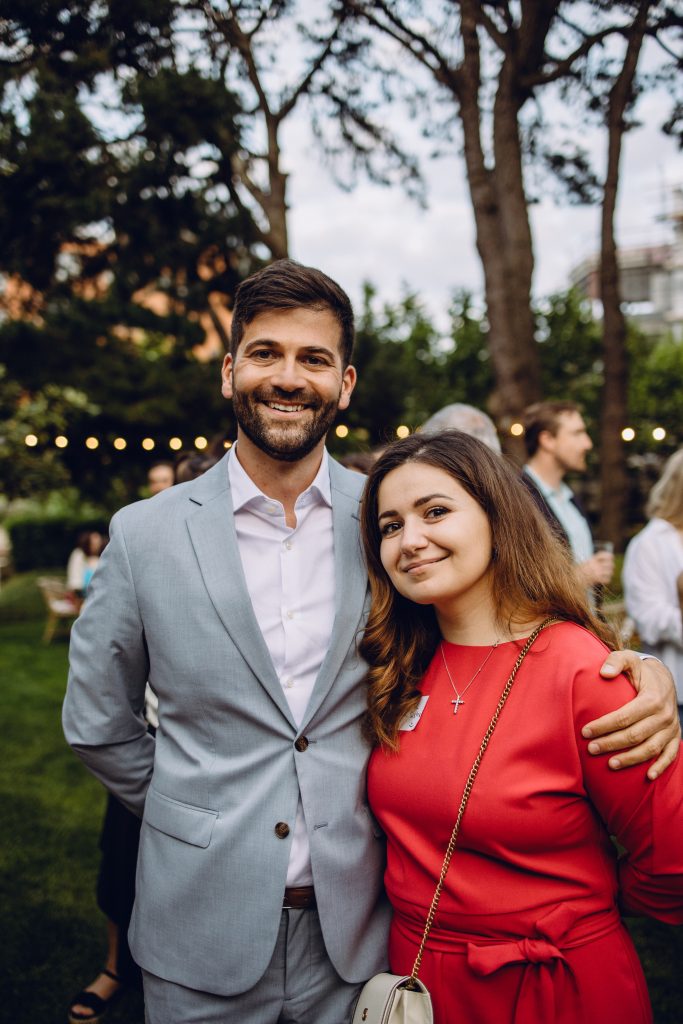
Iván with his biological sister
—On social media he found a path to begin searching for his origins, but often what he received were disdain and threats.
—Yes, I think social networks are useful for searching. I now professionally help others in their search for their family. In that process, social networks are essential, but there is a bit of everything. I think 80% is garbage and 20% is true. When you contact people from other countries, with a different language, another culture, people you know nothing about, anyone can slip in and pretend to be your father or your mother or your cousin. They tell you: “Give me 500 euros and I’ll tell you things”; you send it, and then you’re in the same place. Actually, worse, without the 500 euros. (Laughter) I know cases of people who have been scammed for years, who maintained relationships with people who later turned out not to be from their family. Now in 2026 we have more ways to verify who is on the other side of the screen. When I did my research, between 2008 and 2010, there wasn’t, but I never paid anyone, because I always distrusted everyone.
—And the reverse happened: your biological sister distrusted you when you found her on Facebook.
—Yes. That was crazy. We have the messages saved and the screenshots. I had been sending messages to everyone I found with my father’s names and surnames. His name in Armenian is like calling yourself Miguel Pérez in Spain. Then I had a hunch: “This must be her: by birth date, by the photo, it must be her.” And she was the only one who said: “Don’t write to me again, leave me in peace,” or something like that. After a few weeks she wrote back: “Sorry, but I think we’re siblings.”
—The name of your biological mother is Elena. What did you feel when you heard it for the first time?
—It’s something I don’t remember because I learned it as a child. The adoption papers were always there, but I had a total disconnection with my birth family. Thank God, her name was in the documents and then I could reconnect with her.
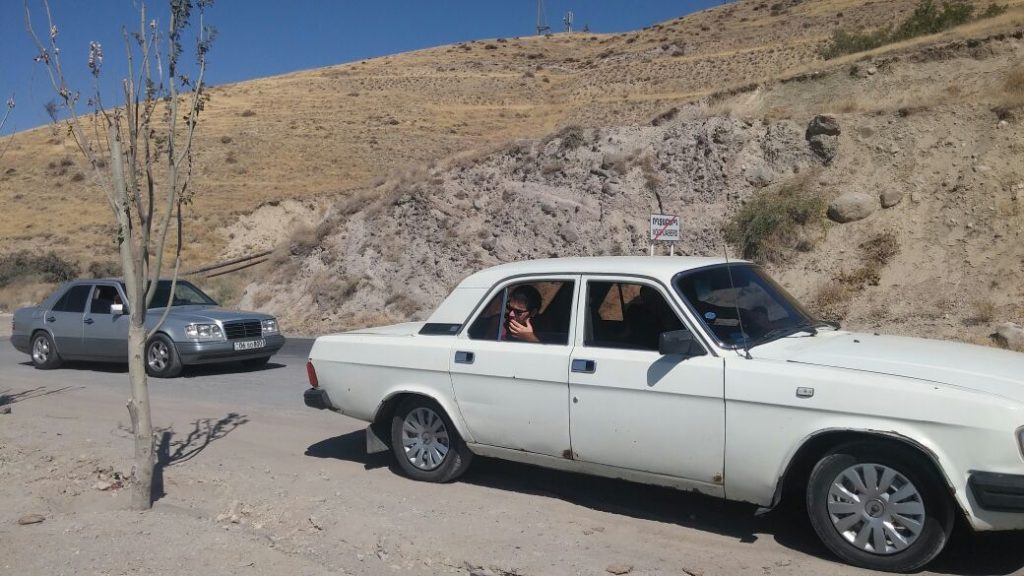
Looking for my father. Armenia, 2017
—The last great revelation that occurs in the book, the final section, is the name of your father and his origin, it’s like the last piece missing to fit the puzzle.
—Yes. This was the final revelation. I had no idea that my father’s origin was in Armenia, although he had been living in Russia for years. And indeed it was a shock, because, of course, I had spent my life thinking I descended from a completely Russian family and I discovered, as I recount in the book, that it is a whole swarm of origins.
—Why an essay and not a novel?
—I tried the novel many times, but I didn’t have the tools, the training, or the practice to write it. In reality it was much easier to write fiction than non-fiction, because I could invent everything, but I couldn’t manage to write a novel; it seemed very complex. In the end, I told my story from non-fiction when I received the editor’s call to the person I had sent the manuscript to. She told me the story was wonderful, but that I should tell it from reality. That conversation made me shift my perspective.
—We’re done. Does the wound of abandonment ever heal?
—The wound of abandonment does heal, but it never entirely disappears from the body. The scar stays, and the pain does not disappear either. That scar reminds you of what happened, and sometimes it hurts, but I think it’s necessary; it should never disappear.
***
A few days after speaking with Iván, I receive a WhatsApp. It’s my friend Berna González Harbour. “You’ve interviewed my nephew.” I don’t get it. I review the latest ones I’ve done: Rosa Montero, Eva Cosculluela, Agustín Fernández Mallo… Iván Gastañaga! Suddenly, as in the finale of a mystery series, all the pieces fit together: Aunt Vera is Berna. She handled the adoption when she was a correspondent in Moscow. Grandmother Alison also appears in one of her books… My mind returns to that Caribbean beach. I was once again listening to the account of Nacho Ferrando and watching her. The first and the last. The Ouroboros. The perfect circle. The present devoured by the future and consumed by the past.