
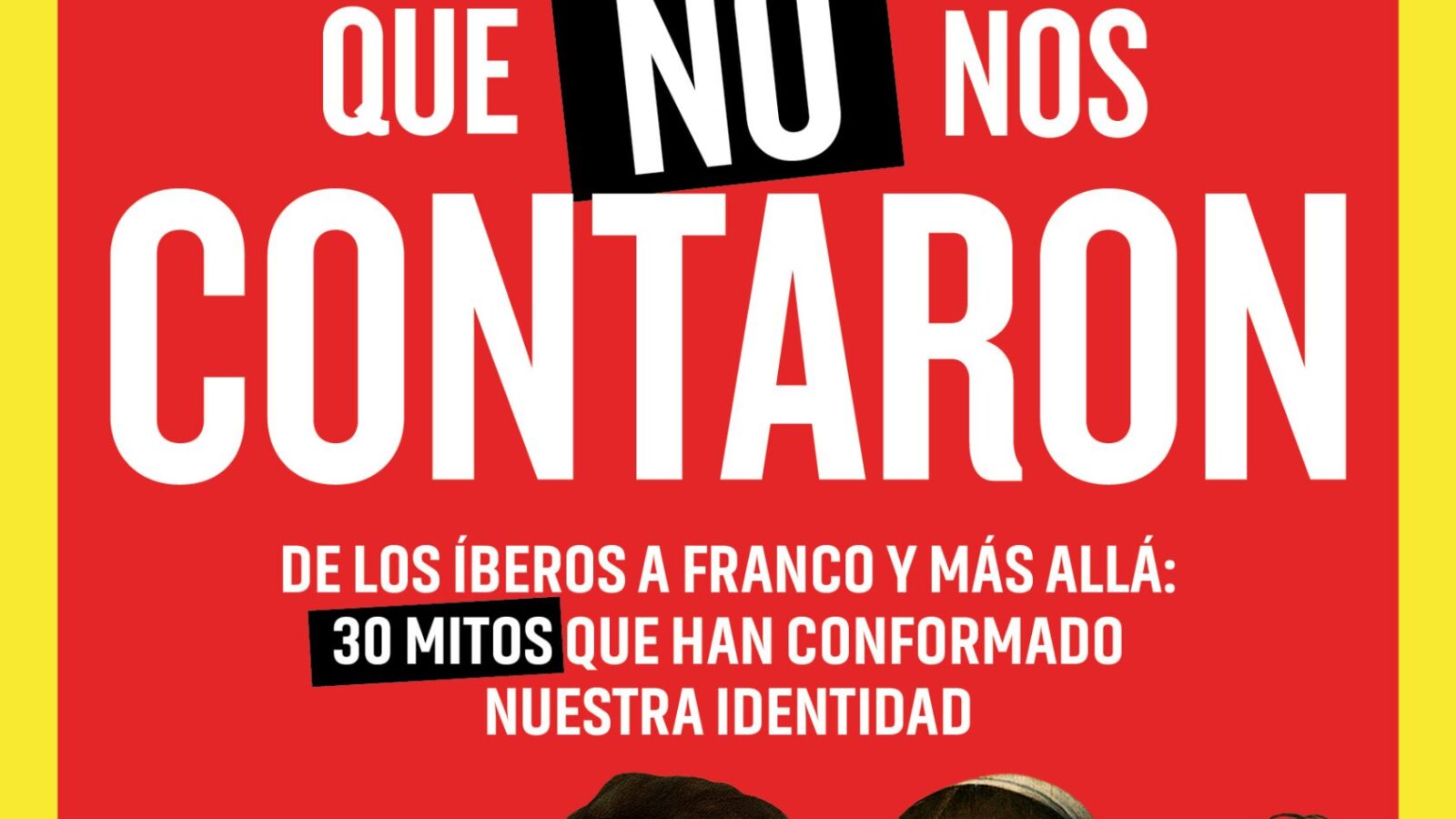
This book travels through more than two thousand years of history to confront thirty of the great myths that have helped shape our idea of Spain. And it does so with a question that runs through the book: why do we keep believing certain stories even when historical reality was far more complex?
In this making-of Belén Bricho explains why she wrote The Spain They Didn’t Tell Us (Bruguera).
***
Don’t take offense just yet. Wait until the end. Perhaps you will discover that José Luis is also you. I, for one, have certainly been him at times.
Four-thirty in the afternoon. A Saturday in May. The neighborhood bar, the one that has always been there, begins to fill up. At a table they are laying out a game of mus. A coffee and a shot of anisette. Orujo or cognac. The conversations, almost always about the same topics, end inevitably when someone flings out their boast:
—If only life under Franco had been better.
It may seem like a meme, but it’s an anecdote. Unfortunately, I don’t know how many times I’ve had to hear this refrain. This, and many others, of course. That Muslims invaded us, that Juana was completely crazy, that Spain is bullfights and flamenco.
Enough. I don’t want more rumors, I don’t want more clichés, and I don’t want to hear the same phrases again when I know, because I have studied and cross-checked, that all of that is a lie.
He had a strong desire to do something like what I’ve done. And, modest as I am, I think that right now, in these times, this book is as useful as it is necessary to dismantle the myths we’ve believed over and over since the nineteenth century, when the image we have of today’s Spain began to take shape.
From the outset I knew that I had to invent a character: the brother-in-law of Spain. A genuinely endearing character, in truth, who repeats maxims, quotes, and slogans very often. But obviously, he hasn’t paused to consider whether what he says is (or was) really so, or if simply the force of repetition has made it an immutable reality in his imagination.
And, even if there are phrases meant to hammer the history book into your face, José Luis is a good guy. He just needs to stop, read a little, and listen (and learn) a lot.
José Luis, moreover, is a character we have all been at some point. If there are political parties that, with as much nerve as ignorance, defend that the autonomies should be abolished, how could ordinary people not have thought the same?
And the truth is that we don’t really know how our country works, and we are proposing solutions that seem like panaceas for all ills, but if we look a little more closely, we would see that the situation is actually far more complex than it seems.
Because history teachers failed to explain to us the most important topics of the curriculum. Perhaps due to lack of time, perhaps because they feared that some sharp student would counter with ideology what historical science has been studying for years, and, indeed, knowing. But when an ideology confronts science, the former, more passionate and visceral, ends up prevailing.
One of my history teachers, though she doesn’t know it, was my mother. There isn’t a day that goes by without a Cecilia song on her phone. One of the greatest and best singer-songwriters this country has had. She dared to sing against a regime she detested and she left long before she should have left, without having fought even a quarter of what she would have fought.
And it was she who wrote and sang “My Dear Spain.” For a long time I listened to it as you listen to your parents’ songs: not asking too many questions about what lay behind those words.
Until I discovered that Cecilia had originally written: “This Spain alive, this Spain dead.” And that dead Spain wasn’t the one that made it into the recording. In 1975, still under the dictatorship, censorship forced the substitution of those verses with the ones that ended up becoming famous: “this Spain of mine, this Spain of ours.”
For a long time I trembled when I heard this song. Perhaps because it speaks of something that goes far beyond Cecilia. It speaks of the way we tell a country. Of what we decide to remember and what we prefer to soften. Of the words that survived and of all those that someone decided could not be spoken.
I won’t say that writing this book was easy because dismantling the myths we’ve internalized is a tedious task.
What was easy, though, was finding these myths. What wasn’t so easy was refuting them. And it’s that when a lie is repeated a thousand times it ends up having a veneer of truth. And in that, historians sometimes err as well.
Relying on primary sources should be the dogma of every historian. And consulting some manuals —which, by the way, I discarded— made me realize that many who study history overlook this crucial step.
Once primary sources have been consulted —or at least the authors who did consult them— it has been incredibly easy to dismantle these myths.
Another matter is whether the reader has the humility to pull these myths from their imagination. And telling the history of Spain is a sea of nuances in every direction. Because when a matter seems clearly debatable, a nuance appears that no one had ever paused to consider.
This work does not pretend to be a History of Spain. It only aims to make the reader reflect on what we believe, teach them why we believe it, and shift their view on some of the most important chapters of our history.
Spreading this knowledge, at least to me, seems essential in these days when we appear so enclosed within our own certainties. But to be honest, I think changing the opinion of those most on the edge of this polarization is impossible. Yet attracting those who keep a critical spirit to the correct (and proven) side of history seems a sufficiently hopeful reason to have written The Spain They Didn’t Tell Us.
No matter how many of us are José Luis or how many José Luis we encounter along the way.
I hope you enjoy it.
—————————————
Author: Belén Brico. Title: The Spain They Didn’t Tell Us. Publisher: Bruguera. Available at: Todos tus libros.