
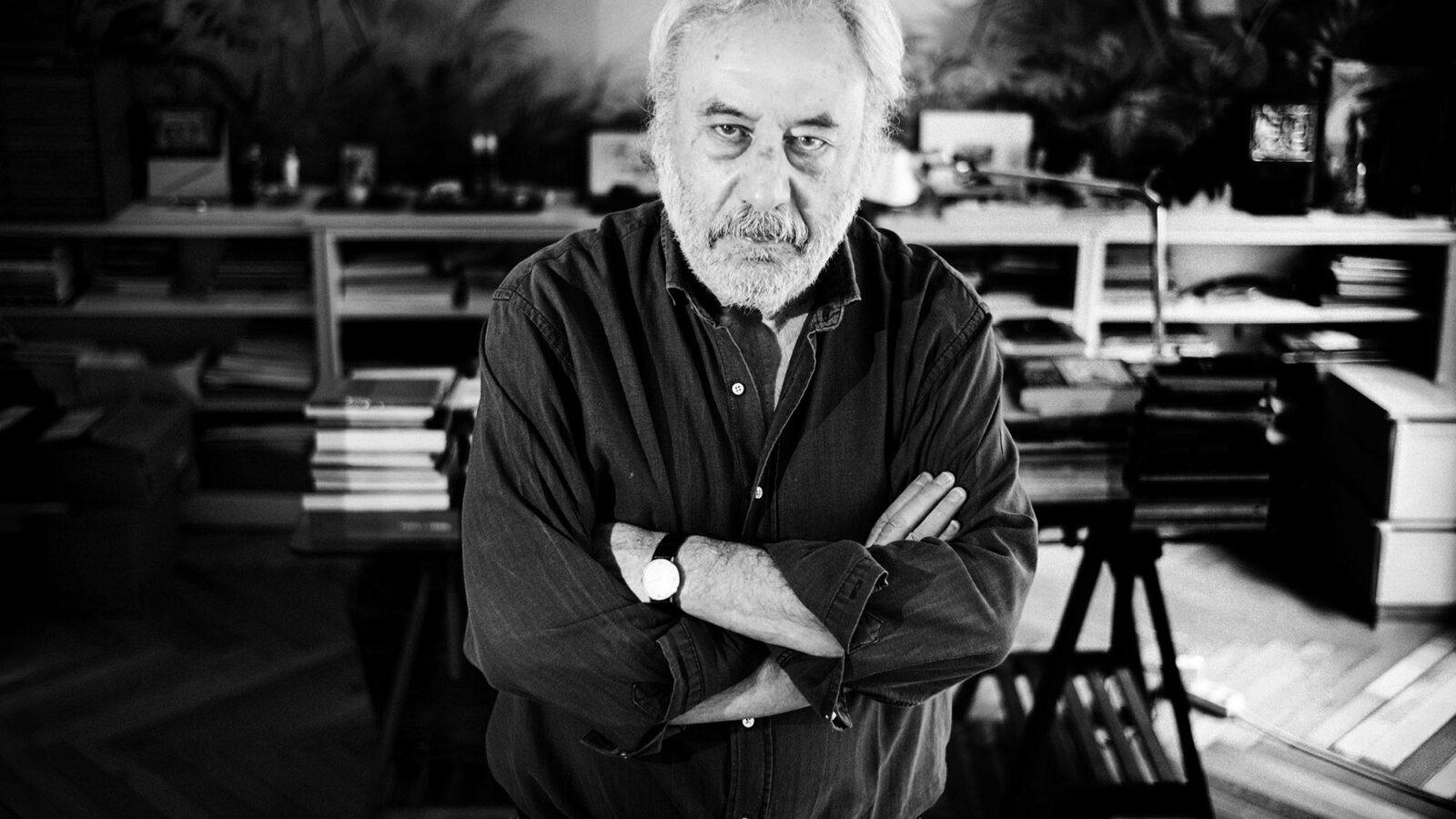
Julio Llamazares (poet, novelist, born in León in March 1955) is one of Spain’s great writers. He began with poetry, which he has never abandoned, even when he writes prose. His latest book is a journey with his father (The Journey of My Father, Alfaguara), which, as a very young man, his father fought in the civil war. That book earned Julio the National Narrative Prize. With that in mind I spoke with him, and this is the result of what he told me.
—To what extent do we all live that war?
—Someone said that a civil war takes a century to overcome. The Spanish Civil War is now 90 years past, and it does not seem that it will happen so quickly. There are debates in Parliament or on television talk shows. There are those who have tried, for political or personal reasons, to invisibilize the war and the dictatorship, but they continue to loom. And they will keep plotting for quite some time, until those wounds that remain open—like the families of the one hundred thousand disappeared who lie in mass graves, many without identification—are finally closed. Now the far right comes to stir up hatred. It doesn’t seem that authentic reconciliation is near.
—What has that memory of the war and the memory of your father meant for your life?
—They go hand in hand. Like many Spaniards of my generation, I grew up listening to stories of the war and feeling the fear of the elders. That meant I did not know much about what my father lived through, firstly because, like most fighters, he spoke little about what he endured, and because I, like all young people, didn’t want to know much about his stories. Later you regret it.
—Who has influenced you? What does that era still tell you, even though you did not live through it?
—I’ll name two Portuguese writers. One is Pessoa, who said that writing was his way of being alone, a line I identify with, and the other is Miguel Torga, who answered a journalist who asked him if he returned to his village in the Trás-os-Montes region to draw inspiration, saying that he did not return to be inspired, but to receive orders. “Orders from whom?” the journalist asked. “From my ancestors,” Torga replied. I share that statement: writers receive orders from our ancestors, from Homer to our grandparents.
—Was childhood shaped by what life gave you?
—That’s how it was. And not only in childhood. I feel I have been writing the novel of my life as I lived it. That is why my biography and my literature are so entangled with each other.
—Now do you still feel that the poet who follows you is the one who dictates your writing?
—I’d like to think so. Above all I consider myself a poet; a poet who also writes novels and stories, because I need to write all the time and poetry is a very brief illumination—intense but brief.
—Which of all your works, before the book about your father, best explains your literature?
—I wouldn’t know how to say. My literature is already condensed in my first two poetry books, The Slowness of the Oxen and Memory of Snow, which I wrote many years ago, but all the later books develop that poetic discourse, which is also a moral discourse, or at least that is what I aim for. So each and every one of my books is important to me because I needed to write them, not because they are better or worse.
—What consequences has The Journey of My Father had for you?
—No consequences, except that perhaps this prize I have just been awarded for it. In any case, what it has meant is that I have reconnected with my father and, above all, understood him a little more, him and his entire generation.
—Did the Spanish Civil War come back to you when you wrote the book, or has it never left your generation’s memory?
—The war has always been there, looming over Spaniards, whether we talk about it or not. It is natural: the war has been the most important historical event that Spaniards have lived through in the last century and a half.
—Is this Journey of My Father the book that best represents your view of the country’s history?
—That is what I aimed for in writing it. Beyond a journey of personal redemption, as a journalist once described it, the book is a plea against war, against all wars, and a tribute to those who must live through it, to their misfortune.
—Does literature explain Spain better than the writing that represents it?
—Literature is the memory of a country. It explains its history, but in the long term, not like journalism, which tries to do so in real time and is subject to immediacy.
—Is this moment Spain is living through right now the most delicate one?
—I think so, but not only for Spain, also for Europe and for the entire planet. Beyond conventional wars that are confined to specific territories, we are witnessing others that affect us all and relate to the climate or the misuse of technologies. And above all, a resurgence of fascism that we did not know since the twentieth century. Let us hope humanity takes stock, because it is playing with fire.
—Spain is living through a very unexpected era, not only due to the serious train disasters that have caused so many deaths. What consequences could immediate elections have for the country in light of this grave event?
—Spain has been living for some time with political tension that does not match its economic or social reality. For that reason I doubt very much that the election results will change that atmosphere. The question is how long people will endure this situation without the social fabric breaking.
—Literature is your passion, and poetry has always been your way of explaining what you live and what you write. Right now, is literature the best way to explain the current moment of this country?
—I don’t know. As I told you before, literature is written from memory, and memory needs time to take shape.
—This conversation will be published in Argentina. What are, for you, the unforgettable memories of that country?
—I have only been to Argentina once and a long time ago. But it is a country that forms part of my life. I grew up idealizing it through the letters my uncle—who had emigrated to Argentina after the war—wrote to my parents, and through the stories he told us when he began visiting Spain toward the end of the Franco regime. And, of course, through its writers, many of whom I had the chance to interview while working in television: Sabato, Abelardo Castillo, Osvaldo Soriano… For me Argentina is more than a country; it is literature.
—You have experienced the presence of unforgettable writers, many of whom were exiled here, and many Spanish exiles there. What does Argentina say to you now?
—As I said, I have only been to Argentina once and a long time ago, so I am not really in a position to judge it. But if I speak of a feeling, it is that it is a country that has little in common with its best days, those times when it was an example of tolerance and hospitality on a global scale.
—And what do Argentines who sometimes come here to explain what is happening say?
—There is a fundamental courtesy rule: you cannot go to someone’s house and insult the owner. And that’s what Milei does every time he comes to Spain with the president, who—let’s not forget—has been elected by the Spaniards, so insulting him insults all of us. From there, I can say little more.
—And what happens to us?
—What happens to Spaniards is the same as what happens to Europeans: we have lost the memory of where we come from. And that is always a danger. Moses Finley, the American historian, explained it well when he said that history is not so much to know the past as to understand the present and imagine the future.
—————————
3/5