
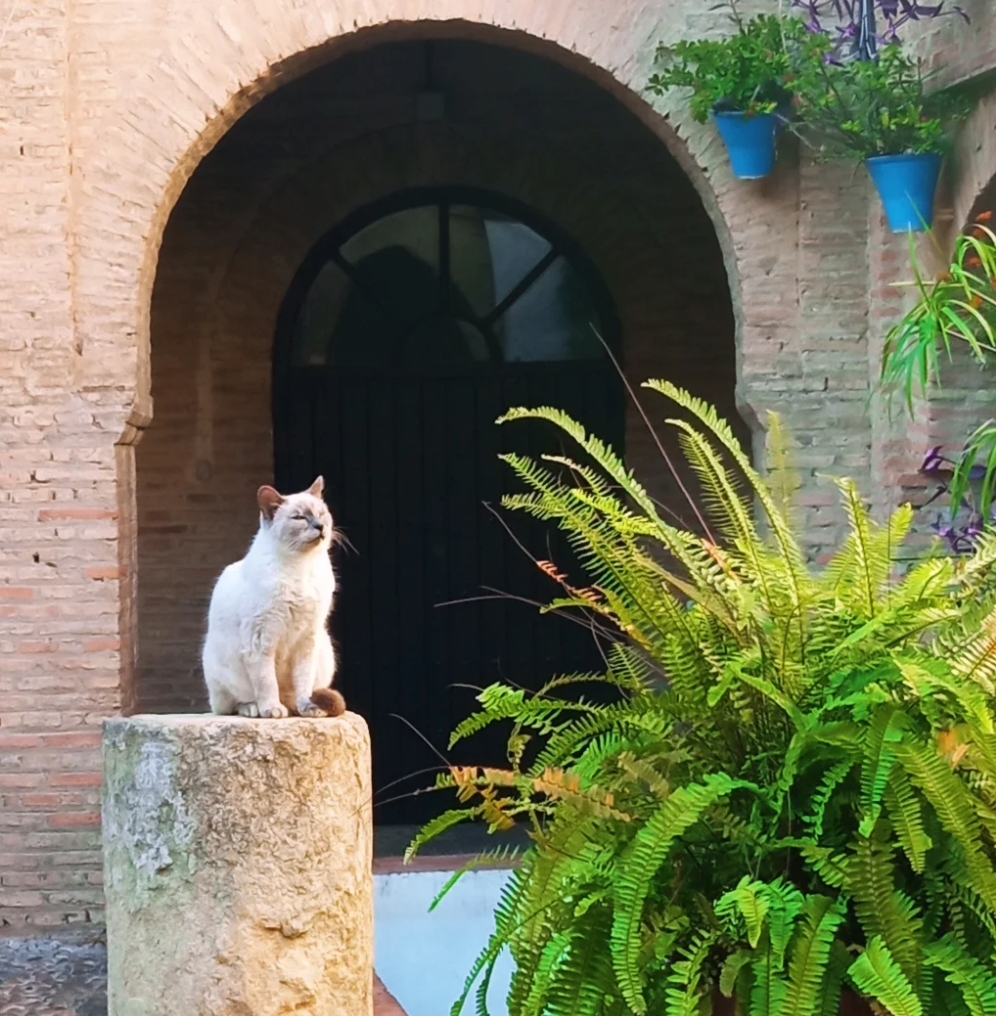
Two years ago, during a trip to Córdoba, I had the opportunity to stumble upon one of those moments that, unintentionally, linger in memory. We roamed the city with a guide who spoke of its history, customs, and monuments. On one of those visits we entered an Andalusian courtyard, adorned with pots, plants, and a central fountain. Yet my attention wandered away from the ensemble to settle on a detail that seemed insignificant: a cat sitting on a pillar.
The animal remained calm, unaware of our presence, as if the visitors and their explanations were nothing more than a distant murmur. While the guide continued with his tale, I watched the feline, which appeared to share with us the contemplation of the place.
There was something solemn in its stillness, a way of inhabiting the space that made it, in my eyes, a kind of divinity, a kami guarding that corner. I was fortunate enough to photograph it. At one point, the cat rose and directed its gaze toward the vegetation. Just a few seconds, a minimal gesture, but enough to transform that scene into something worthy of being remembered. The photograph accompanying these lines captures precisely that moment.
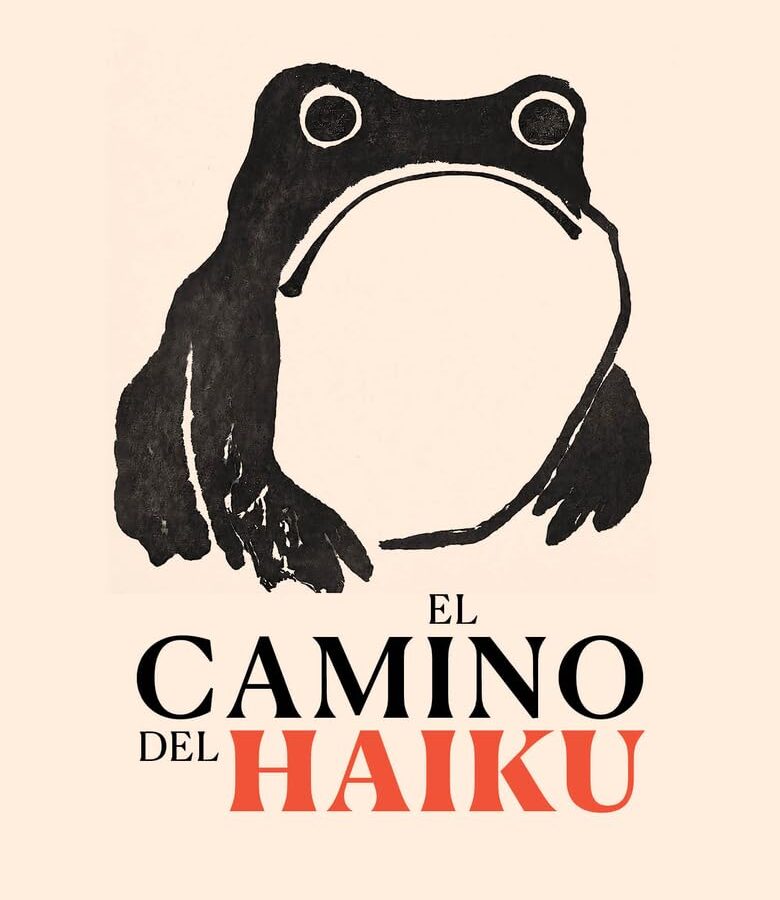
Reading The Way of the Haiku (Satori, 2026), by Carlos Rubio, somehow brought me back to that experience. The author recounts a similar encounter during one of his kyūdō (Japanese archery) practices at Engaku-ji temple in Kamakura: a caterpillar appears right in the gap between bow and string, slowly crawling across the smooth floorboards. There, too, the animal acquires a singular presence, almost sacred. Two distinct scenes linked by a common intuition: sometimes you only need to pause and look to discover that the extraordinary lies in what, at first glance, seems insignificant.
It is precisely this disposition of the gaze that makes haiku approachable, one of the most recognizable forms of Japanese literature. In this new essay, Rubio proposes a journey through its origins, its evolution, its main authors and its aesthetic keys. Yet the book is not limited to explaining a poetic composition that appears simple. Through twenty-two stages, it invites us to understand a way of relating to the world: paying attention to the present, perceiving its nuances, and recognizing beauty—and also pain, humor, or the grotesque—in the small manifestations of existence.
Carlos Rubio is one of the reference voices in making Japanese literature accessible in Spanish, with a career marked by the aim of bringing Western readers a literary tradition of immense richness. Among his works stands out Mil años de literatura japonesa, a survey of the history of Japanese letters in which the contribution of women also becomes prominent. Likewise, alongside his work as an essayist, he translates, contributing to foundational works of Japanese narrative such as Kokoro, by Natsume Sōseki, or the great medieval epic Heike Monogatari.
In The Way of the Haiku, Rubio turns his attention toward poetry and unravels the mechanisms of a literary form whose apparent simplicity conceals notable complexity. The traditional structure of three lines, associated with the five-seven-five morae pattern, constitutes only part of its identity. To understand haiku, one must attend to the tradition from which it derives, its historical transformations, and the sensibility that sustains it.
The early chapters bring us close to that background and show how haiku acquired its characteristics from an earlier poetic tradition, deriving from the waka and the tanka. Then, it delves into the resources, themes, and expressive possibilities. The Toledo-born writer reminds us that this is not merely about constructing a beautiful image, but about capturing a concrete moment and making it meaningful without needing to spell it out completely.
This conception helps to understand the importance of the present in haiku. Faced with a poetry that can lean on narration, description, or the development of an idea, here the gaze is focused on a minimal event. The poet—the haijin—observes what happens around him and finds in it a way of knowing. He does not necessarily intend to explain the world: he seeks to show it, to let the moment speak for itself. Being, not merely existing.
That sensitivity also explains haiku’s appeal in the West. Its influence can be traced in authors such as Juan Ramón Jiménez, Federico García Lorca, and Jorge Luis Borges, although the relationships between their respective works and the Japanese tradition take different forms. Conciseness, suggestion, and attention to sensations have found affinities with various currents of Western poetry, from symbolism to the avant-gardes.
Likewise, Rubio leads us to some of the great names of this tradition —such as Matsuo Bashō, Kobayashi Issa, Yosa Buson, and Masaoka Shiki—, and examines the elements that contribute to defining its writing. Among them he highlights the kigo, the seasonal reference that places the poem at a moment in the natural cycle and ties it to a concrete time experience. Added to this are the religious and philosophical influences of Buddhism, Taoism, and Shinto, as well as reflection on the power of the word — kotodama — and its capacity to evoke a reality that exceeds what is expressed.
The author also incorporates examples from his own poetic practice, so that the theoretical exposition is accompanied by a beautiful and personal experience. This combination allows approaching the genre from two complementary perspectives: the scholar who knows its history and codes, and the poet who faces the challenge of turning a fleeting perception into words.
One of the book’s greatest strengths lies precisely in that will to make a complex subject accessible without renouncing rigor. Rubio explains, contextualizes, and exemplifies, but he also conveys the affection he feels for a literary tradition to which he has devoted a large portion of his career. The result is an approach that does not stop at offering knowledge, but invites practicing another form of attention, following the path or dō.
Because haiku is not only a metric structure nor a repertoire of images tied to nature. In its verses can be found love and suffering, humor and the grotesque, the familiar and the strange. Its strength lies in the capacity to condense an experience without closing off its meaning, to suggest much with very little and to leave space for the reader to complete what the poem barely hints at.
In this sense, The Way of the Haiku can be read as an invitation to reconsider our relationship with time. We live surrounded by stimuli that constantly demand our attention, but we rarely pause in front of what is before us. Haiku proposes precisely the opposite: to suspend the rush for a moment, to observe, and to recognize the link that binds us to nature and to other living beings.
I return, then, to the Córdoba cat. That animal, seated on a pillar and oblivious to our tour, did not need to do anything extraordinary to become the center of my attention. Its presence was enough. Perhaps there lies one of the most valuable lessons of this poetic form: to understand that looking does not consist solely of seeing, but in granting the world the time it needs to reveal something of itself.
Carlos Rubio again demonstrates in this essay his knowledge and his passion for Japanese literature. His book offers tools to understand haiku, but it also opens a door to a broader experience, in which poetry becomes a way of being in the world. As with other Japanese disciplines, learning it does not end with the acquisition of a technique: it requires practice, patience, and a constant willingness to keep learning.
The Way of the Haiku is, in short, a reading for those who wish to approach this poetic tradition and for those who already know it and want to deepen its foundations. A book that reminds us that, at times, literature begins when we stop seeking grand events and learn to pay attention to a single instant.
—————————————
Author: Carlos Rubio. Title: The Way of the Haiku. Publisher: Satori. Sales: Todos tus libros.