
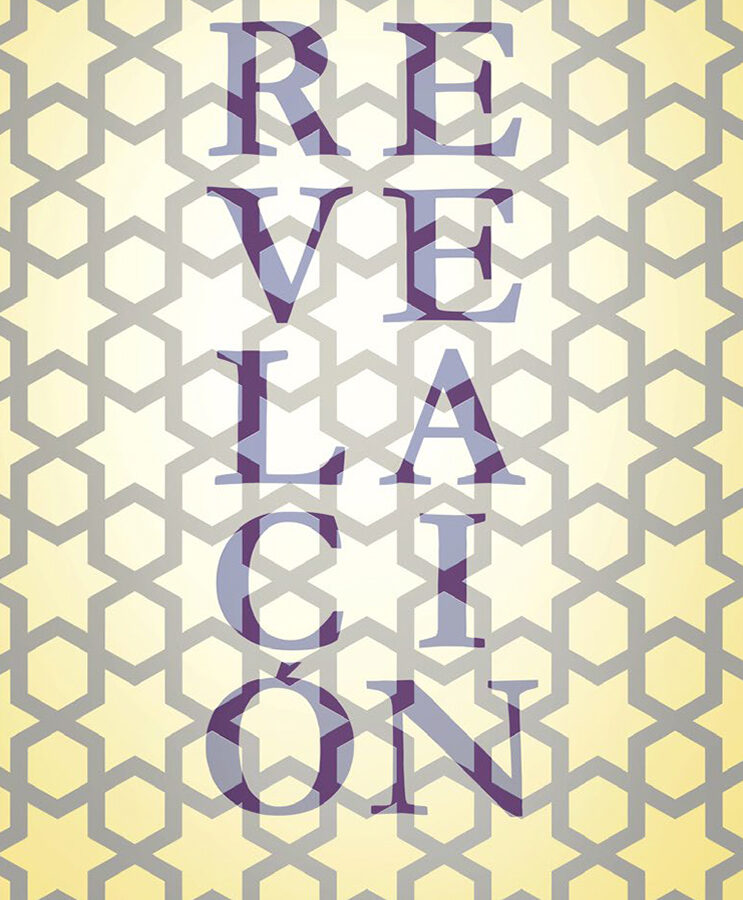
I think about when and how I encounter my novel Revelación (its other name now is its secret). Was the question first, or the experience? Or were they born together among the sparks of an encounter with questions, like when you discover a stranger you will grow to love?
I wondered: How does a long-distance relationship, sustained and nurtured through the screen, affect our sense of truth? Are we aware of the subtle game of fiction that slips into friendship or love? Do we perhaps live safer now among fictions, ignoring that we often control what we say, but not what the other understands (as Lacan suggested)? Messages that lack not only tone and intention but also the facial expression that only the face provides—aren’t they capable of abducting us and drawing us toward addictions with more force than a real meeting in a cafe? And that passion they evoke, doesn’t it dangerously resemble the delirium that a political leader or a soccer team stirs in their followers? Perhaps what is imagined is more intense because it awakens our secret longings.
I see images of political party followers, faces lit with exultant gazes, their blind faith when they triumph in elections, their ferocious joy akin to that of football fans who celebrate a victory, how they raise banners that, when you think it through calmly, are even contrary to what they individually defend. Somehow we endure micro-deliriums that hijack reason and common sense; yet they are willingly embraced with enthusiasm.
But the characters in my novel appear at the same time as my doubts. And my impulse is to narrate. In that corner of creation, the adventure of a photographer who is kidnapped upon arriving in Istanbul while fleeing from an addictive love to cover a report on a false messiah of the sixteenth century unfolds.
I roam the fold of my times and several trips to Istanbul appear, and with the density of the years they seem like one, though I think there were three. I found in Istanbul a new beauty, beyond the familiar, thanks to Orhan Pamuk. I don’t remember the dates. I don’t remember why I went.
I remember scenes.
I visited Istanbul with several writers. I recall that Marifé de Santiago, Mercedes Monmany and I wandered discussing books, about the contrasts of the Bosphorus. We were taken with the whole group to a mosque, asked to enter a room, were we ten, fifteen? They asked us to sit on the floor. At first it seemed original, pleasant, but the wait for the spectacle we were meant to see grew incredibly long. Ten minutes, fifteen minutes. The light in the room grew bluish. All I could hear was a distant murmur. I joked that they had kidnapped us. We laughed. After another half hour we weren’t laughing as much. Then they invited us into a spacious room with soft, welcoming light. What began there was something more than a spectacle: a harmonious, authentic ceremony, an offering. They were whirling dervishes (or semazens, in Turkish), and their mystical ritual dance is known as Sema. Its internal rhythm, the dizzying spins, enveloped us in the transgression of a dream.
A reading at the Cervantes in Istanbul coincided with a riot. Taksim Square. Tear gas. Jorge Benavides asks me if it’s my first time surrounded by gas. I answer that it is. He says: “We should put on a damp cloth.” We don’t have a cloth. The white smoke walls off the square.
On another occasion, with a group from several countries, this time Sephardic, we met at an event. The city was on alert. Again, demonstrations in the square. Hundreds of young people marching, shouting in Turkish. I asked a young woman with red-painted lips what they were saying: “Freedom”, she said. They seemed happy. Hopeful. Then nothing. Newspapers said our group had instigated the riot.
Thus Istanbul appears.
A journey.
Magnetic Field
The process.
When I begin the project/process of writing a novel, a state of openness is generated. A Whole-Becomes‑Place. Listening, the street, the books I read acquire new meanings that join the other dimension, the fiction. I surely decide on a chapter scheme, a page count, I dialog with characters, another/fiction, I need to do this to follow a thread that will keep me grounded in what is known and safe. I wrote what I called the “last page” when I had reached thirty. From there on, the dialogue with fiction feels like arriving in a new city where neighborhoods, allies, adversaries, and a renewed sense of self unfold. One listens and observes from the distance of the creator. Departures sting, but words are the scars of pain. In that open, expansive place—laboratory or home—scenes and dialogues grow, an organic development of characters and stories.
My protagonist is a photographer; photography becomes intimately linked to the character, she looks through the camera. I think of photographer friends I admire (Daniel Mordzinski, Lisbeth Salas, Marcelo Brodsky, Valentín Vallhonrat), they encounter my character in her fictive essence, just as I encountered them and their works. Bar, which in Hebrew means “daughter,” has learned more even than my writer-self of lights and shadows, of focus. Of fixing an image that becomes a world. Her kidnapping is, I see now, a metaphor for the places that trap us and the ones we do not want to belong to, of unions that imprison and empty us, like a love that ends. Bar escapes what she believes to be a false love. And she finds in the reflection on the false messiah the artistic motive that drives her to Istanbul, giving her a purpose to continue her search.
I remember in Izmir being shown ruins that were being rebuilt. It was the house where Sabetai Zví was born. Nearby, right next to it, a poet friend, Shlomo Avayou, translator into Hebrew among others of Joan Margarit and Luis García Montero, was born there. He told me that he translated complex texts from Hebrew, Turkish, and Ladino by this remarkable seventeenth‑century figure who altered the Jewish world. His followers persist to this day in secret societies in Turkey and Poland.
Bar’s friends assist in the research; they live outside Madrid, in their own cities: Caracas and Barcelona. They are real people and characters. Yet, as a fiction addict, I strive not to let them settle by my side: distinguishing the real from the false is my daily effort.
Revelación arises from that balance between experience and curiosity, between the real and the false. But above all, from the desire to tell a story.
—————————————
Author: Esther P. Bendahan Cohen. Title: Revelación. Publisher: Confluencias.