
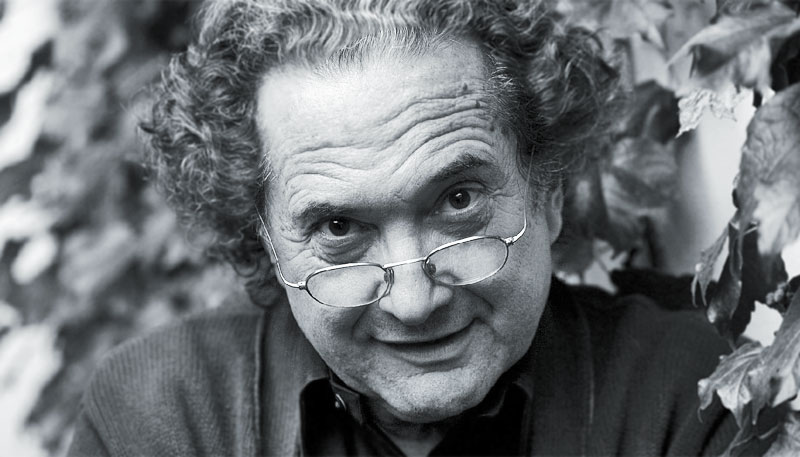
Whenever I visited Jorge Mara’s house in Buenos Aires, I left as if I had been in school or at university or in a class that, for instance, Borges and Piglia attended together.
This latter figure was, by the way, at Mara’s house once when I was lucky enough to be there, listening to him. It was impressive how he spoke that emblematic name of the literary culture of one of the most cultured countries on the globe. Above the voices of the others, Piglia rose with the authority of an encyclopedia and left us all silent and joyful, as if we were in the day cinema and writing were invented.
Hearing Piglia there, in front of a group of friends who argued with him or laughed at him or asked him questions, was one of the greatest pleasures I have had in my life as a reader, as a journalist, and as a human being. Another time I heard him before a crowd in Mexico, where he spoke as if he had just come from a learning that had just reached him, for example from Borges’ voice or from his own childhood.
Piglia came to Madrid a few times, as far as I know, and I had the chance to hear him speak before many people at the opening of the work (and how beautiful) by Eduardo Stupía, at the Círculo de Bellas Artes de Madrid. Perhaps it was then or at another moment, but the truth is that I also see him sitting before me in a place like the Café Gijón in Madrid (which is like the best cafés of Buenos Aires), talking about everything that came to his mind, about his parents… and about Borges.
Remembering him today underscores what Piglia told me: “I have memories that are, in fact, images whose construction I am not always clear about. I have tried to follow certain repetitions, for example the thread of the books I remember. The first memory I have is of my grandfather reading and the astonishment I felt seeing a man so absorbed in the library. His wife had died, and he lived with us at that time.”
That boy was four years old; he watched “and I don’t quite know what to do, because he seemed absent. Then there is a cut. I climb onto the chair, take down a blue book from the shelf, and sit on the threshold of my house, a very quiet street on Vinón and la Estación. Every half hour the people who arrived by train to the capital passed by, and I sit there to be seen reading, something I have done all my life: to be seen reading.”
And there comes, in the voice of Ricardo Piglia, looking me in the eyes as the place where we speak grows darker, the shadow he always sought, as a writer, as a boy, as the child he was. I had asked him (he did that always, then) about the postcard that would tell him about his childhood, and he told me: “I see a shadow telling me I have the book upside down, and I think: it must have been Borges, because to what else can one attribute that pedagogical precision. That has been the first memory. One day I asked my father what that book could be, and my father, who was very ironic, told me: it would be the blue book of Peronism.” And there Piglia laughed, like that boy who remained.
On that occasion, which I still remember, he told me that his childhood shaped the writer he became. “The writer interested in books, why else? that first memory is that scene a little false and a little affected in reading… I often remember postcards of reading scenes, I see myself with a book, given or bought, sometimes I don’t remember the content, but I have a very clear sense that that book was important to me, as if I cared less about what lies behind than the form of the image.”
In that Mexican encounter he also brought Borges, and Piglia was seen reading crouched, glued to the page; I told him that then he was like the desperate reader, the one who has always stayed awake since childhood… That is one of his finest metaphors as a reader, as a writer, as the being that would become. And he told me: “But at the same time in Borges there is the longing to leave the library and go to life. There is always that oscillation in the sense that we are losing something, that something is happening and we are writing without knowing whether it is worth it or not. At one point politics became the space that justified any abandonment of that passion for books.”
One writes, said Piglia, because one has read before. “Reading has the quality of a thought you cannot read in any other way and it also has the quality of quieting one’s own thoughts, often very disturbing. They are with friends, circulating, talking, and those thoughts, often obsessive and disturbing, disappear.” Reading, he said, controls that sort of thing…
It was as if I heard him now, because now, moreover, I heard Piglia recounting what he said about life, about literature, and of course about Borges, before Argentina’s public television in 2013 of this century. A few months ago it was republished in Spain Borges by Piglia (Eterna Cadencia), that book which again seems to be the double voice of Ricardo and of Jorge Luis speaking in different tones, and both interpreted by one who has long known how to interpret the voice of the author of The Aleph. Piglia speaking with Borges without Borges but with Borges always.
In Jorge Mara’s house, Piglia spoke as he pleased, but he always did so knowing that what he said came from the wisdom that came from what he had already read or what he had already heard, among others from Jorge Luis Borges. That night it was as if Borges were listening too, with his cane and his laughter, perhaps imagining that he himself was saying what his disciple said.
Now, so many years later, and years after the deaths of both, reading them together has been a pleasure that blends in my head with the pleasure of having heard them separately.
That Borges of all of us came to Madrid for the last time and wanted to see the only light his eyes could see (as he used to say) in the world… I accompanied him to see that light he located at the Palace Hotel in Madrid, I took him to dinner with my young daughter, with a friend and with my wife, at the behest of Javier Pradera, one of the founders of El País, and its editor at the time. Borges wanted (that is what he told me) chilled vichyssoise, and I handed it to him myself, and the next day he asked me to help him arrange his shirts, “so they breathe.” In an interview I did with him while he sang to our daughter, Borges told me: “Thanks to the white I am never in the dark.”
And he also told me, when I spoke to him about blindness and loneliness: “Blindness is diluted by memory… I would love to be able to skim a book” (and he said skim, not leaf through, that sweet and dramatic nuance of the silent h). “Borges, how young you look, how luminous your suit.” “I don’t know about my suit; María [Kodama] chooses everything for me, even the ties. What suit do I have?” “Nothing. Everything is very well coordinated. The tie goes very well with the suit.”
”I’m glad you are so precise.” “You have an edge. You are very young.” “Dante says nell mezzo del cammin di nostra vita…; I believe there are three ages, one ends at 35. At 35 I wanted to reach 40. Perhaps that means I was already old. But, well, what does age matter. My father died in 1938, when Lugones committed suicide.”
Now I have been reading what Piglia wrote about him that appeared in Borges by Piglia. I doubt that anyone could have loved Borges as much as Piglia did.
Now I feel as if I were again talking with Piglia on those nights that, with him, Jorge Mara gave us.
—————————