
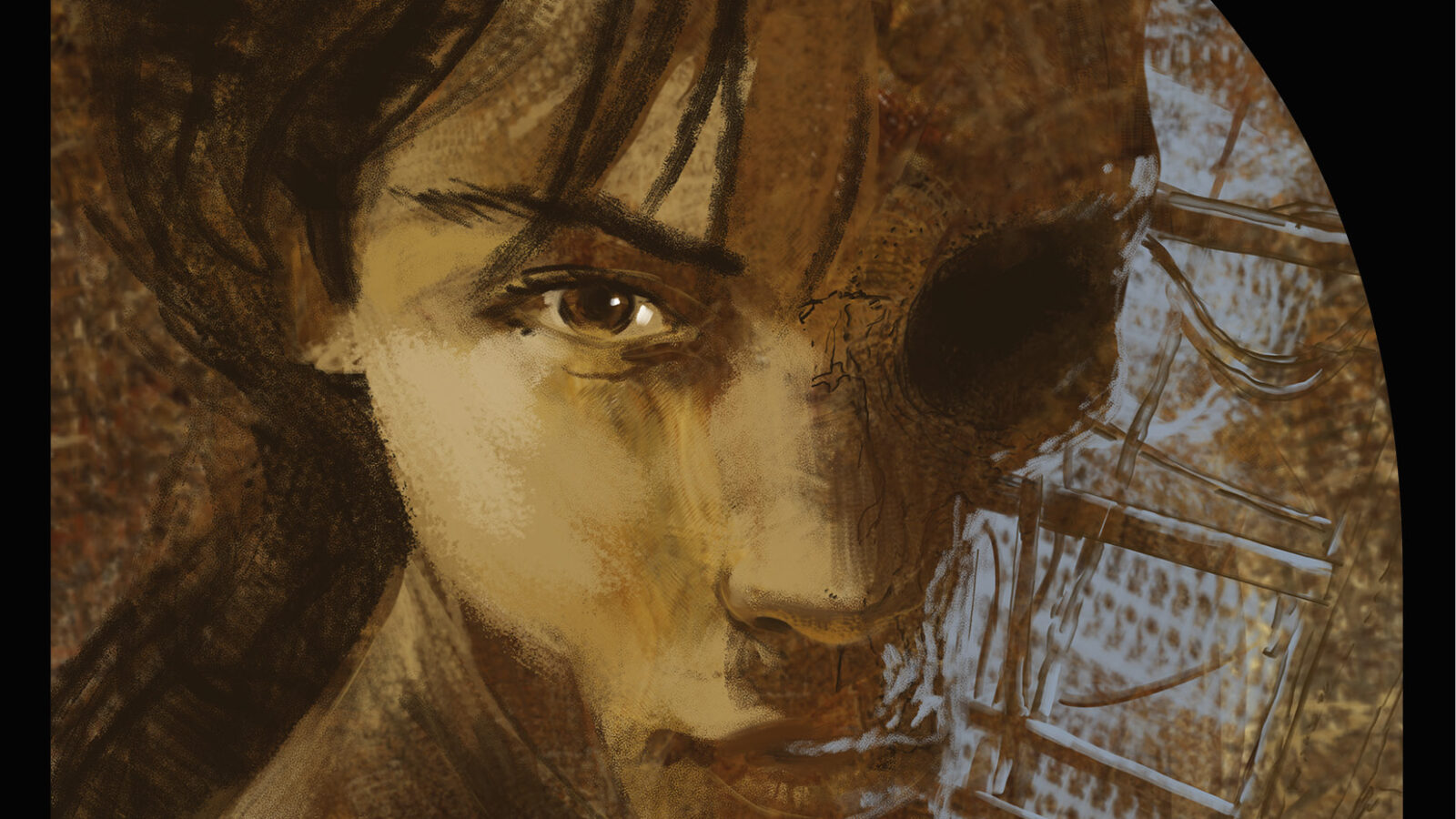
These thirteen stories by John Langan, author of contemporary horror classics such as The Fisherman and Bocadáver, frame horror through elements such as cinema, the academic world, or family legends.
At Zenda we reproduce the opening of one of the tales included in Lost in the Darkness and Other Excursions (Carfax Library), by John Langan.
***
Madame Painte: for sale
—This? —says the man behind the counter—. Oh, this is Madame Painte.
The figure is short, about forty-five centimeters tall, and also stocky, with roughly the same width, made of something that could be porcelain. It has a round face and eyes half-closed by the broad smile that lifts its cheeks. A beaked hat fails to hide the sharp points of its ears. It wears a long apron-like dress over a peasant blouse. It is a garden gnome, you think, except for the colors, from which its name clearly derives. It has been painted without regard to the edges of the clothing and the skin. Black, green and orange run across the figure from right to left. The face is primarily dark green and the hat is a mix of orange and black. A splash of white paint stains the eyes closed; the effect is more like a spiderweb than a mask. You had noticed the figure seated to the left of the antique shop door as you passed by, and its grotesque appearance was so striking that you picked it up, brought it inside, and placed it on the counter. On the way, you read the note hanging from the top of the hat: “must stay outside.”
—I wasn’t referring to its name —you hasten to say.
<p—Of course not —the man answers. He is shorter, more wiry than thin. By the amount of gray in the mustache and hair, you’d say he’s middle-aged —he adds. You were referring to the warning.
—“Must stay outside” —you read—. Why?
—The official reason is that it’s coated in lead-based paint.
You step away from the counter and wipe your hands on your jeans.
—Is there any unofficial reason?
—There is a story —the man says. Would you like to hear it? It’s brief.
—Uh…, sure —you answer, but you don’t approach.
—Madame Painte —continues the man — comes from Holland, via Guam and via Australia. It formed part of a range of garden ornaments produced by a factory on the outskirts of Amsterdam in the 1980s. I don’t know very well how it ended up in the Western Pacific, possibly on a cargo ship. I know that in 1995 it adorned the front garden of a house in Yigo. It was the residence of a colonel stationed at the United States Air Force base. It already bore its distinctive paint, though I’m not sure to whom it belonged. It may have been the colonel’s wife, who was named Priscilla. As I understand it, she was an artist and also an amateur anthropologist. To my knowledge, she was the first person to insist that the figure should stay outside. It was then that it was sold to a young Australian couple, Trudi and Lenard Niles, who were visiting the island. The colonel had been transferred back to the United States. He and his wife had decided to use the opportunity to get rid of some of their belongings. The Niles (well, especially Trudi) were fascinated by Madame Painte. Priscilla resisted parting with her, saying she could not let her go to just anyone. The Niles thought she was trying to drive up the price, but that wasn’t it: she was willing to gift the figure to the right person. I suppose the young couple wasn’t perfect, because they accepted her money, but they had to be good enough to her to part with Madame Painte. And, of course, only after they swore to keep her outside their house. And that is how the figure traveled from Guam to Canberra.
—Let me guess —you say—. The couple brought it inside their house.
—At first not —the man replies—, but eventually they did. Initially they placed it in the back garden, beside a tall ash. The Niles had a small metal table and a couple of chairs in that area. When the weather was good, they would bring out their morning coffee. Trudi was a writer, a travel writer; Lenard held a high post at an electronics company. After he left for the office, she would bring to the table her notebook and her laptop and set to work on the article she had to deliver that month. In fact, she wrote an article about the trip to Guam, which is how I know all I know about Priscilla and the promise she wrung from him.
—What changed? —you ask—. I mean: what made the couple break their promise?
The man shrugs.
<p—I don’t know. I’m not sure that anything changed, that is, I’m not sure there was a moment when one looked at the other and said: “It’s time to break our promise.” I suspect that promise wasn’t much to begin with, little more than words spoken to get what they wanted. Then, one day, years later, they decided to redecorate the house and thought the garden ornament would look better in a corner of the living room. If they remembered the conversation with the colonel’s wife, their promise, it was in a hazy way, as if saying: “Do you remember…?” Madame Painte was divested of dirt and insects and brought indoors.
—And?
—At first, nothing. As I have said, they were redecorating, repainting walls, changing furniture, installing a new kitchen. For a while, the interior of the house was quite chaotic. Madame Painte, sitting in her corner, waited.
—Waiting for what?
—The right moment. Months had passed. The house had taken on its new look. One night, Lenard got up to go to the bathroom. On the way back to bed, he saw something on the wall in the hall. It was a white stain, as if someone had brushed paint across it, or as if the moonlight were reflecting in a living-room mirror. He waved his hand in front of it, with no effect. He pressed the palm of his hand against it, but he did not notice any change in texture. As far as I know, he did not notice the resemblance between the white stain on the wall and the white mask that Madame Painte wore.
—To the next morning, after coffee and working on her article, Trudi saw that a piece of the wall near the bedroom door had faded, as if the paint had aged after years of direct sun exposure. She touched the stain and it peeled away at her fingers. It seemed strange to her, especially since they had recently painted the wall, but she convinced herself it must be some kind of fungus. When she spoke of it at dinner with Lenard, he mentioned his nocturnal vision, but neither of them drew any conclusion. They decided to call a painter.
—A couple of days later, Trudi saw the white stripe again. Again it was night and the house was dark. She had stayed up late finishing an article whose deadline was pressing. Entering the bedroom, she glimpsed something white covering Toro, the Niles’ cat, who slept at the foot of the bed. She was so tired she mistook the stripe for the moonlight filtering through the venetian blinds; only later would she realize that there was a new moon that night.
—In the morning, Toro was not in the bed, which wasn’t unusual, and he also did not come to breakfast, which was unusual. Trudi found him in the garden when she went out for coffee. (Lenard had left early for a meeting). As soon as she sat down, she heard a dull groan coming from somewhere nearby. She recognized the cat, but it was a sound he had never made before, halfway between a complaint and a warning. The hairs on the back of her neck stood up. She stood up, called his name. He uttered that strange groan again. Trudi looked around. It wasn’t hard to find him: what remained of him lay beneath a shrub (I believe a kind of hakea).
—What do you mean, what remained?
—From a little below the abdomen, the cat was mummified; the fur had fallen away, the skin had darkened and shrunk to the bones. It was what you would expect from a cat that had been dead for years. He breathed heavily, evidently in pain, unable to understand what had happened. Trudi’s first impulse was to take him to the veterinarian, but Toro would not allow her to approach; he hissed and scratched when she tried to pick him up. She had to make do with calling the doctor, who promised to come after the clinic closed. By then, it was too late. Toro had shown his fangs to some invisible foe and breathed his last. The veterinarian was baffled, to say the least. That degree of atrophy suggested some kind of venom, but the speed with which it acted was, according to her experience, unprecedented. She asked to take Toro’s remains to her clinic for an autopsy, to which Trudi agreed. However, when the veterinarian lifted him, the cat… disintegrated. The bottom half crumbled away and the entrails fell to the floor. The veterinarian did what she could, but it was no easy task.
—Did you find anything? —you ask.
—Not exactly —the man answers—. Trudi called a couple of days later. From what she had been able to observe under the microscope, the cat’s cells had collapsed, had lost their integrity and had dissolved into one another. It is the kind of effect that certain spider venoms have on the tissues of their victims. But there was more. The parts of Toro that were most affected were completely dry, with not a drop of moisture. Of course, Trudi wanted to know which spider or other creature had done that to her cat. The veterinarian did not know. It’s a very common joke that Australia is full of wild and deadly fauna, but nothing she knew acted in that way in mammals of any size. It may have been an invasive species. He was going to make a few calls, to ask if something new had slipped into the neighborhood gardens. In the meantime, Trudi had to be careful and tell her husband to do the same.
—The next day, Trudi looked at Madame Painte for a moment, at the white stripe that covered the figure’s smiling face, and she noticed the resemblance between that decorative motif and the white stripe she had seen on Toro. Hadn’t Lenard mentioned a white mark on the hallway wall near the bedroom? She remembered the promise she had made to Priscilla. For a moment, the details threatened to come together into a strange and horrible whole. Yet as the idea occurred to her, she rejected it. It was ridiculous, absurd, like something out of an old horror story. That night, during dinner, she shared the thought with Lenard. He nodded at the coincidence, but he also dismissed it.
[…]
—————————————
Author: John Langan. Title: Lost in the Darkness and Other Excursions. Translation: Alberto Chessa. Publisher: Carfax Library. For sale: All Your Books.