

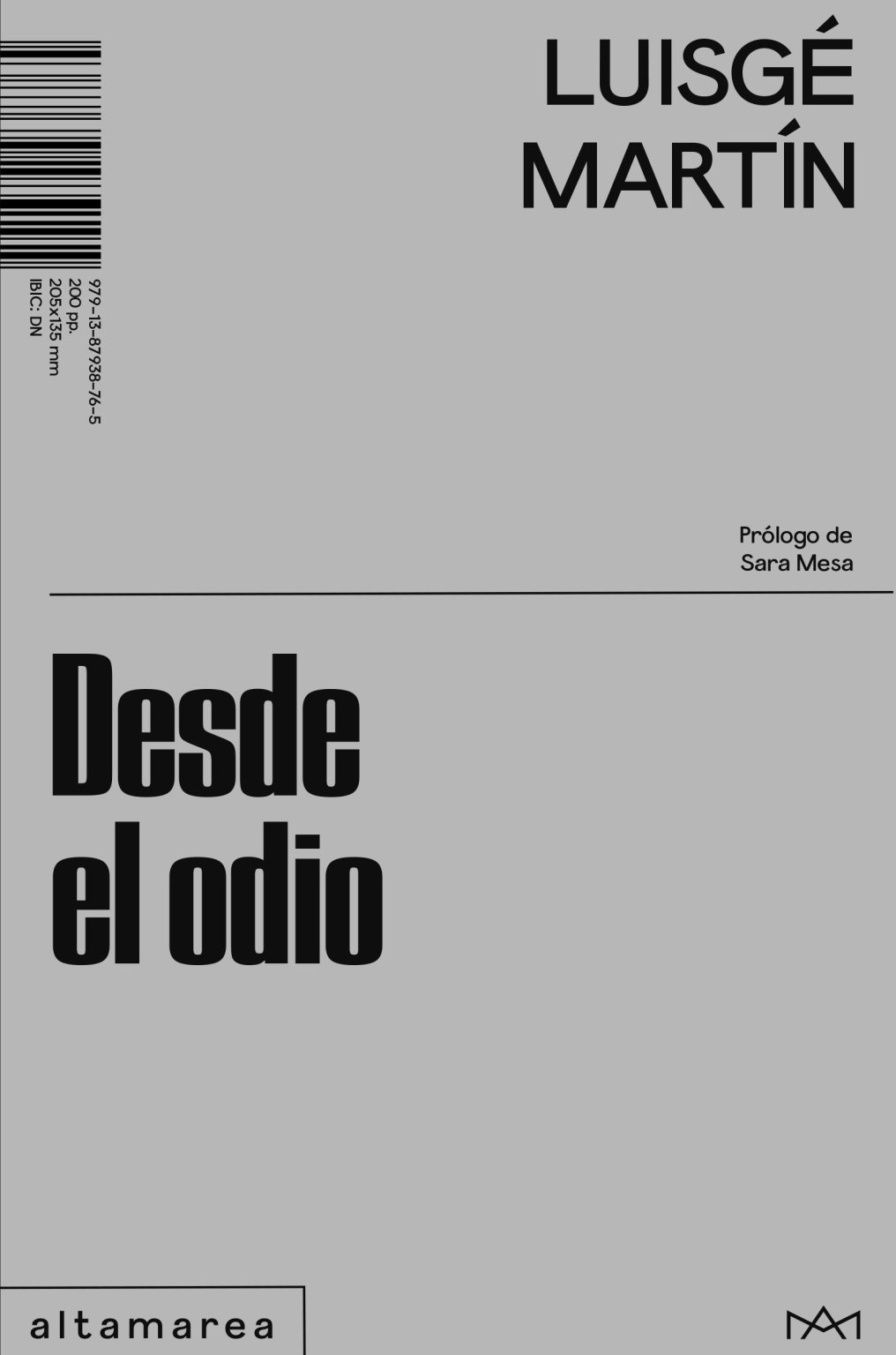
In March 2025, five days before the planned publication date, the publisher that was going to publish The Hate withdrew the book. The general pressure, the media uproar, and the irrefutable condemnation voiced on social networks were enough to prevent readers from getting access to it. No court prohibited it. No law vetoed it. And yet, the book was not published. From Hatred is Luisgé Martín’s response to that unexpected event.
Next, Luisgé Martín answers Zenda’s questionnaire.
*****
—What book, film, series, album, and work of art would you save in a flood or a fire?
—Books, films, series, and albums are already mere copies, so in a flood or a fire I wouldn’t risk saving them; I would simply buy them again later. The only irretrievable things are works of art, and I would save Michelangelo’s David.
—If you had to save someone, choose an actress, an actor, a historical figure and a current politician.
—Meryl Streep and Javier Bardem, the best actors in the world today. For a historical figure, I hesitate between Abraham Lincoln and Nelson Mandela, who are, incidentally, two politicians. I suppose many people answering this questionnaire would say they wouldn’t save any politician; it’s a habit to loathe politics. I, who have stood behind the scenes, would nevertheless save many. Of all my professions — editor, writer, cultural manager, product manager and consultant — it is in politics where I have encountered the most noble and idealistic people, the kindest. And to move away from Spain, I would save Zohran Mamdani, the mayor of New York, and U.S. Congresswoman Alexandria Ocasio-Cortez, whom I hope will rise even higher.
—What real or literary adventure would you have liked to have lived?
—I’m not sure it can be called an adventure, but I would have liked to be at Stonewall on June 28, 1969 and to have participated in that fight for LGBTQ+ rights at its inaugural moment. I also recall that night in The Beautiful Room Is Empty, Edmund White’s novel.
—And what personal memory would you like never to let time erase, like tears in rain?
—I fear I may be overly sentimental, but the memory of my first kiss while in love.
—What is your earliest memory as a reader?
—The Pumby comic books. And in the more literary realm, Dumas. I recall the fever of reading straight through, at sixteen, The Three Musketeers, Twenty Years After and The Vicomte of Bragelonne. That fever is something you lose after youth.
—What is the last book you have read?
—The Conflict Is Not Abuse, by Sarah Schulman, recently published by Capitán Swing. A very intelligent book about how, in private life and in politics, we turn acts that are not actually offenses into affronts or aggression.
—Can you recommend a classic book?
—Frankenstein, by Mary Shelley. The entire condition of humanity is in that book, which is at once beautiful and desolate.
—And a contemporary one?
—Chesil Beach, by Ian McEwan, a literary filigree in which, in my view, lies all the wisdom about romantic relationships.
—Which book have you not been able to finish?
—Many bad ones and many supposedly good ones, because the canon is always debatable. But if I had to pick one that hurts me especially and with which I gave my best effort, it would be Moby-Dick.
—Can you recite a poem by heart?
—I don’t think so. In my day I could recite “Remorse,” by Borges, which fascinates me and which I learned by heart, and some Sonnets of the Dark Love by Lorca thanks to the songs by Amancio Prada. And the famous Machado chant “Caminante, son tus huellas…,” here thanks to Serrat. Music helps memory. Memory, in any case, is not one of my strengths.
—What is the most beautiful song in the world?
—There have been many beautiful songs that accompanied me for long periods and later began to sound more ordinary. The only ones that have withstood the passage of time for me are “Let It Be” by the Beatles and “Ne me quitte pas” by Jacques Brel.
—Can you name a heroine and a hero —literary or cinematic— that are indispensable?
—La Maga from Rayuela is my preferred heroine. I have never felt such tenderness for a literary character. The hero par excellence, for me, is Don Quixote, even if he is an antihero.
—And a villain who fascinates you?
—There are two evil characters that fascinate me: Tom Ripley and the Marquise de Merteuil from Les Liaisons dangereuses. I could marry both, despite their wickedness.
—Do you have a preferred publisher and bookstore?
—How many books are in your library? Approximately what percentage have you read?
—In 2006 I began meticulously recording in an Excel file every book that came into my home and that I read. In these twenty years 3,200 have entered, of which I have read — wholly or in part — 1,750. About one book every four days, according to the calculation I just made. If we add the books before 2006 and my husband’s comic and graphic novel collection, there should be between 6,000 and 7,000 copies at home. The library is the true owner of the house.
—With which book have you been the most moved? Have you cried after reading any?
—While writing The Love of the Inverted, my sentimental autobiography, I could not stop crying. And while reading The Forgetting We Will Be, by Héctor Abad Faciolince, while lying in a hammock in Tayrona National Park, Colombia, I could not stop crying. Desolating tears.
—Have you ever become aroused while reading? If so, with which book?
—I have been aroused many times, of course, but I especially remember a story from Untellable Tales by Aldo Coca, published by La Sonrisa Vertical in the 1980s. It was titled “The Little Hotel” and it was disturbing. In that same collection, and also arousing and disturbing, Las once mil vergas, Apollinaire’s wild novel.
—What is the main trait of your character?
—Even at the risk of sounding pretentious, honesty. I do things out of conviction and I don’t try to pretend otherwise.
—And your main defect?
—Anger. It is almost always fleeting, but uncontrollable.
—What do you value most in your friends?
—Loyalty, understood as a shared and reciprocal way of being in the world. And in a less spiritual sense, the after-dinner conversations and the joy.
—What is your preferred occupation?
—If it counts as an occupation, sex.
—And your happiness dream?
—Consequently, a perpetual orgy, but not the one by Flaubert and Vargas Llosa.
—What is the current state of your spirit?
—Combative. I believe that in these dark times we live in one must fight without inhibitions, especially young people, who have much to gain, and the old, who have less to lose.
—What do you detest the most?
—Cruelty and hypocrisy.
—Which faults inspire you the most indulgently?
—Lust, obviously.
—If you ever had to go to a deserted island, what book would you take?
—In these times, going to a deserted island would feel almost like a blessing. For space, it would be nice to take the entire library, but if I had to choose only one, I would take the Bible, which is, indeed, a book of books and which I have never read in order. Moreover, there would be a possibility that I would start to believe in God and the loneliness would become less painful.
—And which person?
—If I could take only one person, my husband, obviously. I don’t think I could live with anyone else, especially not on a deserted island. But if I could bring more people, I have a large circle of friends who could turn the island into a paradise. Without Twitter, of course.
—If all your answers have been sincere, now tell us one lie.
—All my answers have been sincere.
—————————————
Author: Luisgé Martín. Title: From Hatred. Publisher: Altamarea. Purchase: Todostuslibros.