
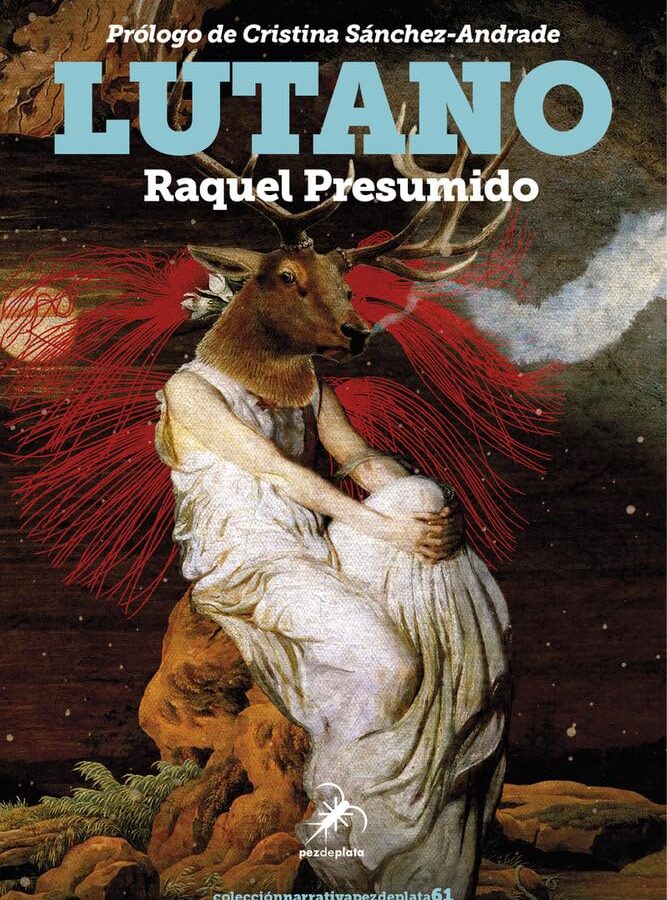
Although the novel features a structure close to a choral one, the presence of the young protagonist, nicknamed Rosina, largely dominates—acting as a sort of alter ego for the author Raquel Presumido. Both originate from the same region, share rural roots, and have trained in the field of audiovisual communication. Rosina returns to a core from which she had promised herself to escape, in order to leave behind the moral mendacity and cultural lack of a rural mountain milieu that is, on the other hand, in decline due to unstoppable depopulation. In this moment, Presumido’s text almost millimeter-echoes the reflections of Sergio del Molino in his emblematic La España vacía (2016), alluding to those rural spaces seen by travelers from the trains that traverse our geography: «We, our houses, our silhouettes, will be nothing more than a blurred landscape seen from the window for five seconds» (23). This is one of the many virtues of an episodic novel, structured in three acts, that interweaves, also in three strands, very direct academic references with the increasingly faint echo of a Spain at the periphery and on the border—and with the emotional tribulations of a young woman today. As for the academic incursions, these can, at times, shock the unsuspecting reader, until one discovers that the text has an extradiegetic recipient of a certain intellectual level: film producers who are the intended recipients of the screenplay that we are reading, at first.
The protagonist expresses in the first person the tension between the authentic yet coarse legacy of her ancestors and the siren calls of a petty, seductive yet sterile urban modernity. And so Lutano manages to set everyone in their place. If in Rodiezmo Rosina tried to flee to escape labeling and the cruel harassment of the different, of silenced abuses and of the absence of cultural glow, Madrid will see her depart with her head bowed, having not achieved her professional dreams. She will leave behind a place no less dysfunctional than the homeland, dominated by excess, imposture, and precariousness. Yet, as throughout almost the entire novel, there is an unmistakable leaning toward the roots, toward the authenticity of the homeland, above the meaningless paraphernalia of today’s urban society. To illustrate, a sample:
When I lived in Madrid I spoke like this. I could utter words such as zeitgeist, anagnorisis, deus ex machina, analepsis, or mcguffin, but never gochos, mormera, mancar, entamar or llume. I hid my tongue as if it were black and gnawed by worms. As if it were something rotten that one has to hide. I clung to all the rest. (31)
Lutano, despite its brevity, is capable of masterfully conveying a series of global-scale discontents through a very concrete story, localized within a small geographic frame and in an ever-dwindling human community. These discontents relate to identity, belonging, relationships among equals—and unequal ones—, the cultural legacy of the past, and the historical burden. The style is direct, syncopated, replete with carefully measured local idioms. Equally careful is the depiction of a cast of characters toward whom one can feel affection—the local grandmotherly “coven” Rosina frequents and draws nourishment from, or the ex-miner Nemesio—or a decided rejection—the renowned university professor and usurper of ideas Manolo Margo or the local bully Diego. In the latter case, it is interesting how Presumido presents, as in nearly every aspect of the novel, two faces of the same coin.
Mention deserves the realism with which the novel begins and its gradual slide toward the anti-mimetic. This latter takes several forms: from Rosina’s extrasensory abilities, manifested through her calambre, to the legendary nature of stories told by the warmth of the fire, and finally, the uncanny tilt of magical realism that, at a certain moment, hits the plot full force and unsettles it, drawing us into a parallel cosmos where the fantastical proves to be the backbone, the marrow, that explains the very existence and evolution of the small society of Rodiezmo. These are two strongly anchored realities that could not be understood one without the other. And indeed, as Cristina Sánchez-Andrade—allies of contemporary rural Spanish-language literature—rightly notes in the book’s preface, the border between the real and the symbolic is one of the many that is explored with great effectiveness in Presumido’s narration. This play between more realistic and more imaginative strands, however, as is common to many unusual texts, rests on the aim of revealing, through extrapolations of unreal fiction, the harshness of reality, the misdeeds of society. Hence the numerous allusions to the ravages of the Civil War that physically and emotionally destroyed the geographic area depicted in the novel. Not by chance, the affectionate dedication from Presumido to her “güelita Rosa” points in this direction, giving a highly personal fictional sense to a real context, a living society with wounds still beating.
It is a genuine and highly recommendable pleasure to lose oneself among the lines of Lutano, a text evocative in every sense. The scent of perfume, gin, and the sweat of a fashionable club in a big city mingles with the aromas of dried grass, manure, and chimney smoke from the mountainous homeland. Between Madrid and Rodiezmo, between the secluded folds of the range, between reality and imagination, between the painful historical burden of the grandparents and the knowledge passed down at the love of cooking, between the magnetism and the vanity of promises unfulfilled by urban modernity, Lutano encompasses an entire universe, a universe that will be cared for by the most unexpected and humble of gods.
—————————————
Author: Raquel Presumido. Title: Lutano. Publisher: Pez de Plata. Available at: Todos tus libros.